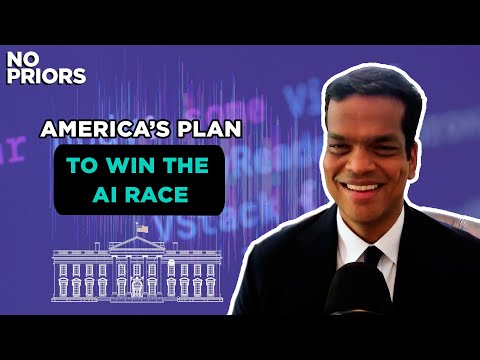
No Priors Ep. 125 | With Senior White House Policy Advisor on AI Sriram Krishnan
Sarah Guo (host), Elad Gil (host), Sriram Krishnan (guest), Narrator, Narrator
In this episode of No Priors, featuring Sarah Guo and Elad Gil, No Priors Ep. 125 | With Senior White House Policy Advisor on AI Sriram Krishnan explores white House AI Advisor Outlines America’s Strategy To Win Global Race Senior White House policy advisor on AI, Sriram Krishnan, outlines the new American AI Action Plan, positioning AI as a decisive economic, cultural, and military battleground—especially versus China. He argues the U.S. lead is small and fragile, using China’s DeepSeek as a wake-up call that triggered a more aggressive national AI strategy. The plan focuses on three pillars: building massive AI infrastructure and energy capacity, removing regulatory obstacles to innovation (especially for open source), and exporting an "American AI stack"—from GPUs to models—to allies worldwide. Krishnan also emphasizes fighting ideological bias in government AI systems and embedding technologists at the center of U.S. policymaking to move fast and compete effectively.
White House AI Advisor Outlines America’s Strategy To Win Global Race
Senior White House policy advisor on AI, Sriram Krishnan, outlines the new American AI Action Plan, positioning AI as a decisive economic, cultural, and military battleground—especially versus China. He argues the U.S. lead is small and fragile, using China’s DeepSeek as a wake-up call that triggered a more aggressive national AI strategy. The plan focuses on three pillars: building massive AI infrastructure and energy capacity, removing regulatory obstacles to innovation (especially for open source), and exporting an "American AI stack"—from GPUs to models—to allies worldwide. Krishnan also emphasizes fighting ideological bias in government AI systems and embedding technologists at the center of U.S. policymaking to move fast and compete effectively.
Key Takeaways
America’s AI lead over China is narrow and cannot be assumed.
DeepSeek’s performance and technical innovations showed that Chinese labs can rapidly close the gap, forcing U. ...
Get the full analysis with uListen
Winning the AI race requires massive new infrastructure and energy build‑out.
Decades of low power‑demand growth left the U. ...
Get the full analysis with uListen
Federal policy will aim to preempt fragmented state regulation that could stifle AI.
Krishnan cites California’s near‑miss SB‑1047 as an example of state rules that could have effectively killed U. ...
Get the full analysis with uListen
Open source AI is framed as both an innovation engine and a security advantage.
The White House team argues that open models democratize access for startups and researchers, counter Chinese open models already being widely used, and—like open software historically—benefit from broader scrutiny that can make them safer and more robust.
Get the full analysis with uListen
The administration wants U.S. hardware, models, and apps to dominate global inference.
They think in terms of global “token market share”: maximizing the proportion of all AI inferences running on American GPUs, models, and applications, and are revisiting restrictive export rules (like the Biden Diffusion Rule) to push an American stack to allies.
Get the full analysis with uListen
The federal government will require AI systems it buys to be “truth‑seeking” and transparent about ideology.
Through the “No Woke AI in the Federal Government” executive order, the plan conditions federal procurement on models avoiding undisclosed ideological bias, signaling a broader cultural fight over how AI systems present history, politics, and social issues.
Get the full analysis with uListen
Robotics and real‑world AI are emerging as a key next front in the U.S.–China contest.
With Chinese advances in drones, humanoids, and autonomous vehicles, the plan includes provisions to support U. ...
Get the full analysis with uListen
Notable Quotes
““DeepSeek told us that America doesn’t have a huge lead on AI. It actually has a very, very small lead.””
— Sriram Krishnan
““We think if America is going to win the race with China, we need to do three things: build infrastructure, unleash innovation, and make sure the world uses our stack.””
— Sriram Krishnan
““The Biden team really looked at AI as something to be centralized and controlled… We want to enable anybody to go build something amazing, not centralize power within a 10‑mile radius of D.C.””
— Sriram Krishnan
““By default, open source is just safer and more secure. More scrutiny you put your libraries through, the safer it becomes—and I think the same holds true for open source and open weights.””
— Sriram Krishnan
““Very simply, we want to win.””
— Sriram Krishnan
Questions Answered in This Episode
How will the administration concretely measure whether the U.S. is “winning” the AI race beyond token‑share and model benchmarks?
Senior White House policy advisor on AI, Sriram Krishnan, outlines the new American AI Action Plan, positioning AI as a decisive economic, cultural, and military battleground—especially versus China. ...
Get the full analysis with uListen AI
What guardrails, if any, will be put around open‑source frontier models to manage bio, cyber, or autonomous weapons risks while still encouraging openness?
Get the full analysis with uListen AI
How will the “No Woke AI” procurement rules be operationalized in practice—who decides what counts as ideological bias or “truth‑seeking”?
Get the full analysis with uListen AI
Given grid and permitting constraints, which specific energy technologies (nuclear, gas, renewables, storage) will be prioritized to power AI data centers, and on what timeline?
Get the full analysis with uListen AI
How will the U.S. balance loosening GPU export controls to allies with preventing leakage of cutting‑edge hardware and models to adversarial states like China?
Get the full analysis with uListen AI
Transcript Preview
(digital music) Hi, listeners. Welcome back to No Priors. Today, Elad and I are here with Sriram Krishnan, a top White House official currently serving as the senior White House policy advisor on artificial intelligence. A former tech executive and venture capitalist, he's one of the lead authors on the American AI Action Plan released this past week. We talk about the national implications of the AI race, what position we hold today, the workforce and energy needs of the future, and how to win.
Sriram, thank you so much for joining us today for No Priors.
Thank you for having me. I'm long-term fan. Never been invited before. I was always a bit sad. But no, thank you for having me for the very first time. And before, I just have to point out for folks who are listening on audio that Elad has never looked as good, as dashing, as handsome as he does now. Elad, you've dressed up for me. I'm honored.
This is how you can tell that Sriram is in politics now. He has the liquid tongue of gold with which he coaxes everybody into doing his bidding, so it's very good. So, you know, for our audience, Sriram has been a well-known Silicon Valley individual. He worked at Andreessen Horowitz. He worked at a number of the sort of marquee companies and names in Silicon Valley over the last decade plus, and now, he's in government, and he's really working on a variety of exciting initiatives around AI and other areas. Could you tell us a little bit more about your role? And should we be calling you Your Excellency or is there some special title we should be using now that you're in government?
Uh, you don't have to, but I will take it. But no, thank you. It's fascinating for me to be here talking to you in this capacity because I've known both of you for forever and ever. You know, we've had hundreds or, uh, of interactions and also been such a fan of the pod. Congratulations. Just to give a little bit of backstory, I've been in Silicon Valley for a long time. I feel very old. Uh, I did a tour of all the large consumer social media companies, and then, um, I was at, uh, Andreessen Horowitz for the last four years, uh, competing actively for series A term seats with both of you folks, I'm sure. And all this while, I had no real intention of joining government, I wasn't very particularly interested in policy, but what, what wound up happening, uh, is a couple of years ago, I moved to England to head up all of Andreessen's international efforts. And at the time, the UK was kind of a hotbed of all the AI policy debates. They had this AI safety summit, uh, at Bletchley Park, and th- this was kind of the peak of, I would say, the effective altruist versus the AI kind of drama which was going on. And, uh, and I got pulled into a lot of those discussions, and I remember thinking to myself, like, "Wow, a lot of people who are ma- in s- very senior roles in governments in the United States back then, uh, and in other parts of the world, didn't know what they were talking about when it came to AI." Uh, I was convinced that they were doing the absolute wrong thing on many topics. For example, open source or helping startups, and it was just really, really bad in a way which I think the industry didn't really appreciate until much later. And that got me interested into just policy, which by the way was a word which I didn't even understand what it means. We can even get into what that means, but, uh, but it got, it got me interested in policy. When President Trump got inaugurated, in the first week he did two things. One, he rescinded the Biden executive order on AI, which was bad and awful in many, many ways which we can get into, and then he signed a new executive order which basically said that America should dominate and win on AI. And he then he called upon a few of us to say, "You guys need to come up with a plan within six months to figure out how America is going to dominate and win." And so that put us off of the races, and I think everything that has happened since then accumulated in the event that we had yesterday where we put together, you know, we put out this long docu- 28-page document on America's AI action plan with a bunch of executive orders. So, so that's kind of the, uh, little bit of history.
Install uListen to search the full transcript and get AI-powered insights
Get Full TranscriptGet more out of YouTube videos.
High quality summaries for YouTube videos. Accurate transcripts to search & find moments. Powered by ChatGPT & Claude AI.
Add to Chrome