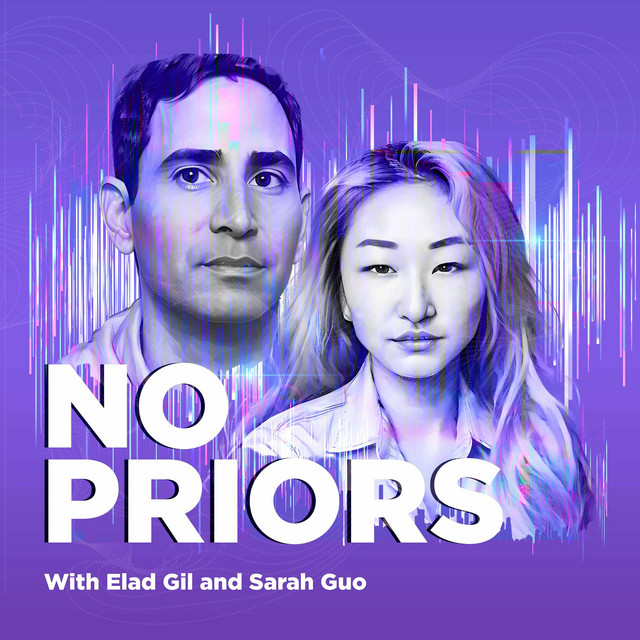
 No Priors
No Priors Ep. 46 | Best of 2023 with Sarah Guo and Elad Gil
Sarah Guo and Ilya Sutskever on aI’s Transformative Year: Governance, Labor, Safety, and Open Innovation Debated.
In this episode of No Priors, featuring Sarah Guo and Ilya Sutskever, No Priors Ep. 46 | Best of 2023 with Sarah Guo and Elad Gil explores aI’s Transformative Year: Governance, Labor, Safety, and Open Innovation Debated This “best of 2023” episode of No Priors curates clips from leading AI builders and thinkers reflecting on how AI is reshaping technology, business, and society. Guests discuss governance models like OpenAI’s capped-profit structure, the democratization of expertise for small businesses, and evolving definitions of intelligence and AI architectures. They explore labor impact and human-AI symbiosis, the convergence of deep learning with probabilistic reasoning in biotech, open models with modular guardrails, and how NVIDIA structures itself to both reliably ship hardware and pursue long-horizon bets. Overall, the episode captures a field moving from speculative promise to concrete deployment, while wrestling with ethics, economics, and collaboration models.
At a glance
WHAT IT’S REALLY ABOUT
AI’s Transformative Year: Governance, Labor, Safety, and Open Innovation Debated
- This “best of 2023” episode of No Priors curates clips from leading AI builders and thinkers reflecting on how AI is reshaping technology, business, and society. Guests discuss governance models like OpenAI’s capped-profit structure, the democratization of expertise for small businesses, and evolving definitions of intelligence and AI architectures. They explore labor impact and human-AI symbiosis, the convergence of deep learning with probabilistic reasoning in biotech, open models with modular guardrails, and how NVIDIA structures itself to both reliably ship hardware and pursue long-horizon bets. Overall, the episode captures a field moving from speculative promise to concrete deployment, while wrestling with ethics, economics, and collaboration models.
IDEAS WORTH REMEMBERING
7 ideasAlign AI business models with societal-scale impact and risk.
Ilya Sutskever argues OpenAI’s capped-profit structure is meant to avoid infinite profit incentives around AGI that could automate most human tasks, highlighting the need for governance that anticipates extreme outcomes.
Use AI to unlock ‘white space’ tasks that are important but neglected.
Alyssa Henry shows how accessible AI tools can finally help small business owners tackle time-consuming functions like marketing that they know matter but previously lacked time, money, or expertise to do.
Design AI systems around routing and context, not just monolithic generality.
Mustafa Suleyman emphasizes that intelligence includes directing attention and computational resources to the right tools or models at the right time, suggesting architectures built around a central ‘router’ coordinating specialized components.
Plan your career around ‘human-plus-AI’ roles, not pure substitution.
Reid Hoffman frames AI as a ‘steam engine of the mind’ and argues that many of the most valuable future roles will be humans amplified by AI, encouraging people to seek complementary, not competing, workflows.
Combine pattern recognition with causal, interpretable reasoning in high-stakes domains.
Daphne Koller notes the pendulum is swinging from pure deep learning back toward integrating probabilistic graphical models for causality and interpretability, which is essential in areas like clinical decision-making.
Separate raw model capability from application-level safety guardrails.
Arthur Mensch contends base models should ‘know everything,’ including harmful content, while applications add modular filters to enforce policies—creating a market for guardrailing solutions rather than relying on a few firms’ internal safety choices.
Structure organizations to balance refinement with flexible, long-range innovation.
Jensen Huang explains NVIDIA’s split between a highly refined organization that builds complex hardware reliably and agile ‘skunk works’ that pursue uncertain 10-year bets, a model for companies navigating fast-moving AI landscapes.
WORDS WORTH SAVING
5 quotes“The goal of OpenAI from the very beginning has been to make sure that artificial general intelligence…benefits all of humanity.”
— Ilya Sutskever
“I got into doing this ’cause I love cupcakes, not because I like writing email marketing.”
— Alyssa Henry
“Actually what you want is to be able to take your raw processing horsepower and direct it in the right way at the right time.”
— Mustafa Suleyman
“I use [AI] to describe it as like steam engine of the mind.”
— Reid Hoffman
“Really assuming that the model should be well-behaved is, I think, a wrong assumption. You need to make the assumption that the model should know everything, and then on top of that, have some modules that moderate and guardrail the model.”
— Arthur Mensch
QUESTIONS ANSWERED IN THIS EPISODE
5 questionsHow effective is a capped-profit structure in practice at mitigating misaligned incentives if AGI becomes as powerful as some expect?
This “best of 2023” episode of No Priors curates clips from leading AI builders and thinkers reflecting on how AI is reshaping technology, business, and society. Guests discuss governance models like OpenAI’s capped-profit structure, the democratization of expertise for small businesses, and evolving definitions of intelligence and AI architectures. They explore labor impact and human-AI symbiosis, the convergence of deep learning with probabilistic reasoning in biotech, open models with modular guardrails, and how NVIDIA structures itself to both reliably ship hardware and pursue long-horizon bets. Overall, the episode captures a field moving from speculative promise to concrete deployment, while wrestling with ethics, economics, and collaboration models.
What are the most impactful, concrete ways small businesses can start using AI today without overhauling their entire operations?
In future AI architectures, who should design and control the ‘router’ that decides which models and tools are used, and how do we govern that power?
How can individuals realistically re-skill or up-skill to position themselves for ‘human-plus-AI’ roles over the next 5–10 years?
What regulatory or industry frameworks would best support an open, competitive market for guardrails and safety modules without stifling innovation?
EVERY SPOKEN WORD
Install uListen for AI-powered chat & search across the full episode — Get Full Transcript
Get more out of YouTube videos.
High quality summaries for YouTube videos. Accurate transcripts to search & find moments. Powered by ChatGPT & Claude AI.
Add to Chrome