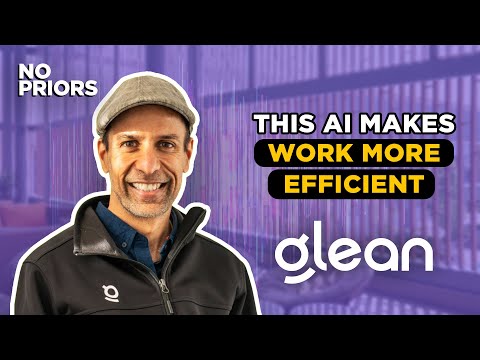
No Priors Ep. 115 | With Glean Founder and CEO Arvind Jain
Elad Gil (host), Arvind Jain (guest), Sarah Guo (host), Narrator
In this episode of No Priors, featuring Elad Gil and Arvind Jain, No Priors Ep. 115 | With Glean Founder and CEO Arvind Jain explores glean’s Arvind Jain on Reinventing Enterprise Search with AI Agents Arvind Jain, founder and CEO of Glean and former Google search leader, explains how large language models and transformers have fundamentally changed enterprise search from brittle keyword matching to deep semantic understanding.
Glean’s Arvind Jain on Reinventing Enterprise Search with AI Agents
Arvind Jain, founder and CEO of Glean and former Google search leader, explains how large language models and transformers have fundamentally changed enterprise search from brittle keyword matching to deep semantic understanding.
He describes Glean’s evolution from a Google-like internal search engine to a ChatGPT-style assistant and agent platform that sits on top of a company’s entire knowledge corpus while strictly enforcing permissions and governance.
Jain outlines the technical and go-to-market challenges of building effective enterprise AI, including data access, scale, security, and user education, and why many previous enterprise search attempts failed.
He also discusses choosing an ostensibly bad market, building for top-down enterprise sales, and his vision of every worker having a personalized AI “team” of assistants, coworkers, and coaches.
Key Takeaways
Modern enterprise search must combine embeddings with classic IR signals.
Vector search/embeddings are powerful but insufficient alone; high-quality enterprise search also needs relevance signals like freshness, authority, and correctness to avoid surfacing obsolete or low-trust content.
APIs and SaaS unlocked a problem that killed previous enterprise search attempts.
Pre-SaaS, simply connecting to scattered on-prem systems was prohibitive; today’s API-first SaaS ecosystem lets platforms like Glean reliably ingest and unify company-wide knowledge, making turnkey enterprise search feasible.
Enterprise AI must treat permissions and governance as foundational, not add-ons.
You cannot dump all internal data into a single model and expose it to everyone; every AI experience must mirror underlying ACLs so that users only see content they’re authorized to access, or it becomes a data-leak engine.
Good search can expose governance gaps—often becoming a security product.
Once search actually works, it reveals sensitive docs (e. ...
Users are still trained on keyword search and need help learning AI capabilities.
Despite a simple chat box, most employees don’t naturally write rich prompts; companies must scaffold usage with targeted suggestions and education, aligned to users’ roles and daily tasks, to realize ROI on AI investments.
Some products are structurally unsuited to PLG and require enterprise rollout.
Because Glean must index and reason over the entire company corpus to be useful, it can’t cheaply serve a handful of users; this pushes a top-down, company-wide deployment and argues for starting PLG and sales in parallel when possible.
Challenging markets can be viable when fundamentals change.
Despite a ‘graveyard’ of failed enterprise search companies, Jain bet on clear, widely-felt pain plus three structural shifts—SaaS/APIs, cloud scale, and transformers—as enough to overturn negative priors and justify starting Glean.
Notable Quotes
“LLMs have completely changed [search]… they allow us to really deeply understand a question a user is asking and similarly… what a document is about.”
— Arvind Jain
“You can't actually build a model inside your enterprise, dump all of your internal company's data into it, and then make that model available to everybody… because if you do that, you're leaking information.”
— Arvind Jain
“We had no budgets, there was no concept of buying a search product in the enterprise… it was a graveyard of all these companies that tried to solve the problem and didn't.”
— Arvind Jain
“We actually ended up becoming a security product. A lot of companies buy us to fix governance… and become AI ready.”
— Arvind Jain
“Each one of us is gonna have this amazing team of assistants, coworkers, coaches that are totally personal to you… and this team… does 90% of your work for you.”
— Arvind Jain
Questions Answered in This Episode
How should enterprises prioritize AI initiatives: horizontal assistants like Glean vs. deeply vertical, process-specific agents?
Arvind Jain, founder and CEO of Glean and former Google search leader, explains how large language models and transformers have fundamentally changed enterprise search from brittle keyword matching to deep semantic understanding.
What concrete steps can a company take to fix data governance issues before rolling out an AI assistant safely?
He describes Glean’s evolution from a Google-like internal search engine to a ChatGPT-style assistant and agent platform that sits on top of a company’s entire knowledge corpus while strictly enforcing permissions and governance.
How do you measure and prove ROI for an internal AI assistant beyond anecdotal productivity stories?
Jain outlines the technical and go-to-market challenges of building effective enterprise AI, including data access, scale, security, and user education, and why many previous enterprise search attempts failed.
Where do you see the limits of LLMs alone, and what retrieval or structuring techniques will matter most over the next five years?
He also discusses choosing an ostensibly bad market, building for top-down enterprise sales, and his vision of every worker having a personalized AI “team” of assistants, coworkers, and coaches.
For founders, how can you tell when negative market priors are valid warnings versus outdated assumptions that structural shifts have overturned?
EVERY SPOKEN WORD
Install uListen for AI-powered chat & search across the full episode — Get Full Transcript
Get more out of YouTube videos.
High quality summaries for YouTube videos. Accurate transcripts to search & find moments. Powered by ChatGPT & Claude AI.
Add to Chrome