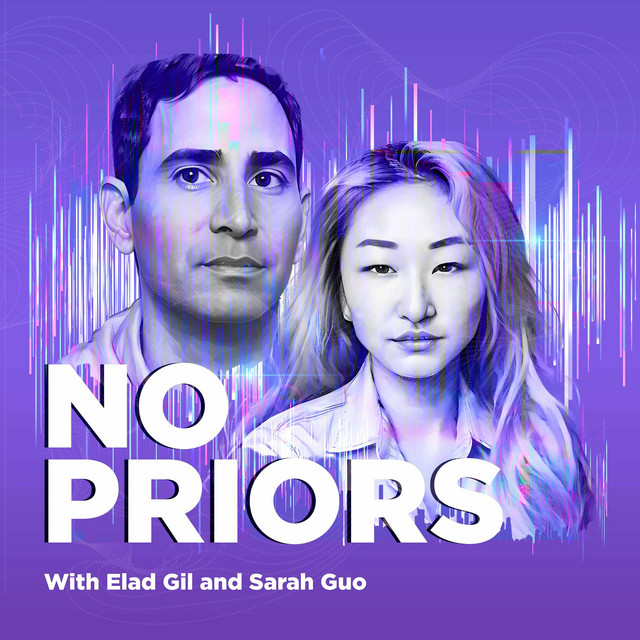
 No Priors
No Priors Ep.61 | OpenAI's Sora Leaders Aditya Ramesh, Tim Brooks and Bill Peebles
Sarah Guo and Tim Brooks on openAI’s Sora: Building a World-Simulating Video Engine for AGI.
In this episode of No Priors, featuring Sarah Guo and Tim Brooks, No Priors Ep.61 | OpenAI's Sora Leaders Aditya Ramesh, Tim Brooks and Bill Peebles explores openAI’s Sora: Building a World-Simulating Video Engine for AGI The episode features Sora leads Aditya Ramesh, Tim Brooks, and Bill Peebles discussing OpenAI’s new text-to-video model and its role on the path to AGI.
At a glance
WHAT IT’S REALLY ABOUT
OpenAI’s Sora: Building a World-Simulating Video Engine for AGI
- The episode features Sora leads Aditya Ramesh, Tim Brooks, and Bill Peebles discussing OpenAI’s new text-to-video model and its role on the path to AGI.
- They frame Sora not just as a generative video tool, but as an early world simulator that learns physics, 3D structure, and human/animal behavior directly from raw video.
- The team explains the core technical ideas—diffusion transformers and spacetime patches—chosen to make minute‑long HD, multi‑aspect‑ratio video scalable in the same way GPT is for text.
- They also cover potential applications (creative tools, education, robotics, avatars), current limitations (cost, speed, object interactions, safety), and why they see Sora as the “GPT‑1 moment” for visual models.
IDEAS WORTH REMEMBERING
7 ideasTreat video models as world simulators, not just media generators.
By learning to predict future frames from raw video, Sora implicitly acquires knowledge of 3D structure, physics, and social interactions—similar to how humans mentally simulate scenarios—making it a plausible building block for AGI.
Architectural choices were made for long‑term scalability, not quick wins.
Instead of extending image models, the team designed Sora from scratch around diffusion transformers and spacetime patches, optimized from day one for minute‑long HD video, diverse aspect ratios, and broad data coverage.
Scaling laws appear to hold for video much like for language.
Using GPT‑style transformers on video tokens, they observe that more compute and data systematically improve quality, suggesting a clear path to stronger physical reasoning, longer sequences, and richer interactions as resources increase.
Tokenizing video as latent spacetime patches unlocks generality.
Representing videos as 3D cubes in latent space lets a single model handle different resolutions, durations, orientations, and even still images, analogous to how text tokens let LLMs train on diverse textual formats.
Creative empowerment and new media forms may be the first big wins.
Early artist tests show Sora lowering barriers to high‑quality visual storytelling and hint at entirely new interaction paradigms (e.g., personalized stories, dynamic educational content) beyond traditional film or clips.
Safety, cost, and latency are gating broader public deployment.
OpenAI is limiting access to artists and red teamers while it addresses misuse risks (deepfakes, misinformation, sensitive content) and works to make generation cheaper and faster enough for mainstream use.
Current models still struggle with fine‑grained, persistent object interactions.
While Sora can maintain some state (e.g., a bite mark in a burger, paint trails), it can still lose track of objects or break physical consistency over time, signaling a key research frontier for future versions.
WORDS WORTH SAVING
5 quotesWe really believe models like Sora are on the critical pathway to AGI.
— Aditya Ramesh
This is the GPT‑1 of this new paradigm of visual models.
— Tim Brooks
This is really the first generative model of visual content that has breadth in a way that language models have breadth.
— Bill Peebles
The best way to learn intelligence in a scalable manner is to just predict data.
— Tim Brooks
It understands 3D… we didn’t explicitly bake 3D information into it whatsoever, we just trained it on video data and it learned about 3D because 3D exists in those videos.
— Tim Brooks
QUESTIONS ANSWERED IN THIS EPISODE
5 questionsHow far can pure next‑frame prediction in video take us toward general reasoning, and where will it hit conceptual limits?
The episode features Sora leads Aditya Ramesh, Tim Brooks, and Bill Peebles discussing OpenAI’s new text-to-video model and its role on the path to AGI.
What new creative or interactive formats do the Sora team anticipate emerging that don’t resemble today’s films, games, or social videos?
They frame Sora not just as a generative video tool, but as an early world simulator that learns physics, 3D structure, and human/animal behavior directly from raw video.
How should responsibility for deepfake and misinformation risks be shared among model providers, platforms, and end‑users?
The team explains the core technical ideas—diffusion transformers and spacetime patches—chosen to make minute‑long HD, multi‑aspect‑ratio video scalable in the same way GPT is for text.
In what concrete ways will Sora‑like world models feed into robotics and embodied agents over the next few years?
They also cover potential applications (creative tools, education, robotics, avatars), current limitations (cost, speed, object interactions, safety), and why they see Sora as the “GPT‑1 moment” for visual models.
What types of personalization—style, aesthetic, long‑term memory—do they envision adding to Sora, and how will they balance that with privacy and safety constraints?
EVERY SPOKEN WORD
Install uListen for AI-powered chat & search across the full episode — Get Full Transcript
Get more out of YouTube videos.
High quality summaries for YouTube videos. Accurate transcripts to search & find moments. Powered by ChatGPT & Claude AI.
Add to Chrome