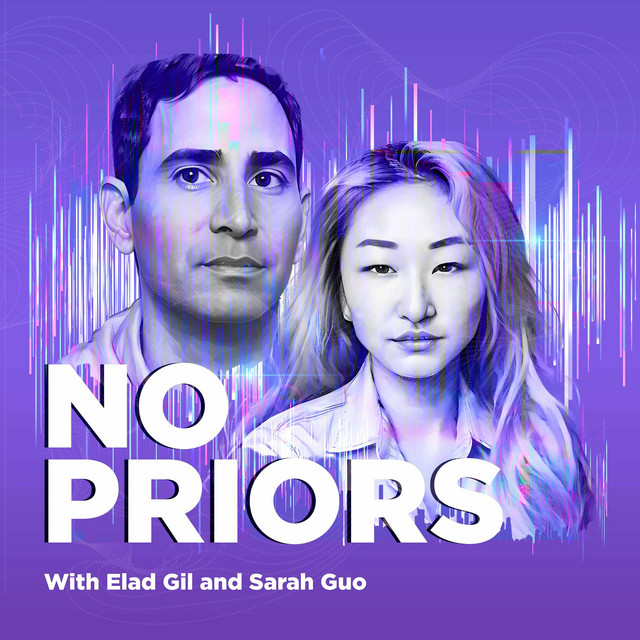
 No Priors
No Priors Ep. 114 | With Duolingo CEO Luis von Ahn
Sarah Guo and Luis von Ahn on duolingo CEO: Motivation, Gamification, And AI Are Rewiring Learning.
In this episode of No Priors, featuring Sarah Guo and Luis von Ahn, No Priors Ep. 114 | With Duolingo CEO Luis von Ahn explores duolingo CEO: Motivation, Gamification, And AI Are Rewiring Learning Luis von Ahn discusses how Duolingo grew from a PhD project into the world’s largest education app by obsessing over motivation and gamification rather than traditional pedagogy. He explains how short sessions, streaks, and even passive‑aggressive notifications drive consistent practice, which he sees as the real bottleneck in learning. Von Ahn details how large language models now power Duolingo’s content creation, conversational practice, and upcoming math, music, and chess offerings, aiming to be nearly as effective as a tutor but as fun as a mobile game. He also reflects on Duolingo’s unconventional brand, the 16,000 A/B tests behind the product, and how AI will slowly but profoundly reshape schools and global skill acquisition.
At a glance
WHAT IT’S REALLY ABOUT
Duolingo CEO: Motivation, Gamification, And AI Are Rewiring Learning
- Luis von Ahn discusses how Duolingo grew from a PhD project into the world’s largest education app by obsessing over motivation and gamification rather than traditional pedagogy. He explains how short sessions, streaks, and even passive‑aggressive notifications drive consistent practice, which he sees as the real bottleneck in learning. Von Ahn details how large language models now power Duolingo’s content creation, conversational practice, and upcoming math, music, and chess offerings, aiming to be nearly as effective as a tutor but as fun as a mobile game. He also reflects on Duolingo’s unconventional brand, the 16,000 A/B tests behind the product, and how AI will slowly but profoundly reshape schools and global skill acquisition.
IDEAS WORTH REMEMBERING
7 ideasDesign for low-friction starts: shrink commitments to make learning habitual.
Moving from 30-minute to 2-minute lessons dramatically increased engagement, not by reducing total time spent, but by lowering the psychological barrier to starting; people will often chain many short sessions once they’ve begun.
Motivation is more important than pedagogy for most learners.
Von Ahn argues that 90% of learning outcomes depend on actually showing up and putting in hours, so Duolingo intentionally borrows engagement mechanics from games and social apps to keep mostly unmotivated users coming back.
Streaks and emotionally charged nudges are powerful behavioral drivers.
Simple streak counters and a passive-aggressive “we’re going to stop sending reminders” notification proved unexpectedly effective at reactivating users, revealing how loss aversion and perceived abandonment can be harnessed to sustain habits.
AI can massively scale and personalize education content and practice.
Large language models now generate most of Duolingo’s course content and enable realistic, judgment-free conversation practice, allowing the company to offer many more language pairings and richer experiences than human authoring alone.
The optimal challenge point for enjoyment is around an 83% success rate.
Duolingo’s models predict performance per exercise and aim to give users items they’ll get right roughly 83% of the time—high enough to feel competent but not so high as to be boring—maximizing enjoyment and persistence over hundreds of hours.
A distinctive, risky brand can be a strategic asset in consumer edtech.
Leaning into the internet’s dark memes about the Duolingo owl and creating absurd TikToks built outsized awareness and affection; being an education company gives them more leeway to be “unhinged” without heavy backlash.
AI tutoring will likely augment, not replace, schools and teachers—slowly.
Von Ahn expects classrooms to increasingly rely on AI for individualized instruction while teachers handle care and supervision, but bureaucracy, regulation, and cultural norms mean the shift will unfold over many years rather than overnight.
WORDS WORTH SAVING
5 quotesThe hardest thing about learning is motivation.
— Luis von Ahn
If given the choice, people would rather scroll on Instagram or TikTok. That’s just reality.
— Luis von Ahn
We just have to clock those 500 hours for Spanish. That’s it.
— Luis von Ahn
Whenever we give you an exercise, the right thing to do is to give you an exercise that you’re about 83% chance of getting correct.
— Luis von Ahn
Duolingo is the result—we have run, over the history of the company, 16,000 A/B tests.
— Luis von Ahn
QUESTIONS ANSWERED IN THIS EPISODE
5 questionsHow might Duolingo’s motivational techniques translate (or fail) in high-stakes subjects like advanced math or professional certification?
Luis von Ahn discusses how Duolingo grew from a PhD project into the world’s largest education app by obsessing over motivation and gamification rather than traditional pedagogy. He explains how short sessions, streaks, and even passive‑aggressive notifications drive consistent practice, which he sees as the real bottleneck in learning. Von Ahn details how large language models now power Duolingo’s content creation, conversational practice, and upcoming math, music, and chess offerings, aiming to be nearly as effective as a tutor but as fun as a mobile game. He also reflects on Duolingo’s unconventional brand, the 16,000 A/B tests behind the product, and how AI will slowly but profoundly reshape schools and global skill acquisition.
What are the ethical boundaries around using loss aversion and passive-aggressive nudging to drive engagement in education products?
As AI-generated content dominates course creation, how does Duolingo ensure quality, cultural sensitivity, and pedagogical soundness at scale?
In a future where AI tutors are pervasive, what uniquely human roles should teachers and schools prioritize to remain essential?
Could Duolingo’s approach to data-driven optimization and A/B testing be applied to reform traditional school curricula, and what resistance would it face?
EVERY SPOKEN WORD
Install uListen for AI-powered chat & search across the full episode — Get Full Transcript
Get more out of YouTube videos.
High quality summaries for YouTube videos. Accurate transcripts to search & find moments. Powered by ChatGPT & Claude AI.
Add to Chrome