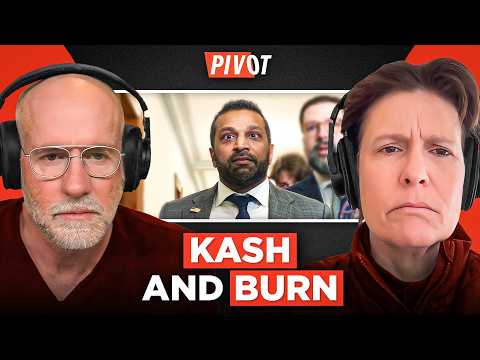
Kara Swisher: Kash Patel is a “National Security Risk” | Pivot
Scott Galloway (host), Kara Swisher (host)
In this episode of Pivot, featuring Scott Galloway and Kara Swisher, Kara Swisher: Kash Patel is a “National Security Risk” | Pivot explores politics, AI trust, and Netflix shifts amid institutional incompetence debate They argue the Atlantic’s reporting on FBI Director Kash Patel depicts an alarming blend of incompetence and personal instability that creates a national security risk, and they expect the defamation suit to fail and Patel to be pushed out.
Politics, AI trust, and Netflix shifts amid institutional incompetence debate
They argue the Atlantic’s reporting on FBI Director Kash Patel depicts an alarming blend of incompetence and personal instability that creates a national security risk, and they expect the defamation suit to fail and Patel to be pushed out.
They frame the Trump administration’s Iran posture and Pakistan peace-trip choreography as performative and underprepared, warning that weakened diplomacy and erratic threats accelerate global energy insecurity and push countries toward renewables—where China dominates manufacturing.
They criticize the idea that a Joe Rogan text can spur an executive order on psychedelic drug fast-tracking, noting ibogaine’s promise but stressing that politicized, ad hoc governance undermines FDA-style rigor and could harm patients.
They describe a regulatory vacuum in AI that forces CEOs like Anthropic’s Dario Amodei to make quasi-governmental decisions, while public trust collapses and industry “manifestos” and PR missteps worsen brand damage.
They read Netflix’s earnings as fundamentally strong despite a market selloff, and interpret Netflix’s moves into short-form vertical video and exclusive podcasts as late-but-powerful attempts to capture younger attention and advertising dollars.
Key Takeaways
A defamation suit can be a political weapon even when reporting is strong.
They characterize Patel’s $250M lawsuit as intimidation and narrative control rather than a credible rebuttal to extensive sourcing, and they suggest leaks reflect internal alarm about security risks.
Get the full analysis with uListen
Institutional “brand” damage is a strategic liability, not just PR noise.
Galloway argues Patel has “trashed” the FBI’s prestige brand, and they connect institutional credibility to recruitment, morale, and operational effectiveness—not just public optics.
Get the full analysis with uListen
Performative diplomacy fails because the real work must happen before the summit.
They claim the U. ...
Get the full analysis with uListen
Energy chokepoints drive nations toward renewables—and that shift benefits China most.
They argue Hormuz-style risk makes countries seek energy security via renewables, while citing China’s outsized shares in wind (60%), EVs (70% of global sales), and solar (80% production).
Get the full analysis with uListen
Good policy can be initiated for bad reasons—and still be dangerous.
They see psychedelic therapies (ibogaine/psilocybin) as promising, but warn that “Rogan texts Trump” governance erodes safety norms and turns health policy into a loyalty transaction.
Get the full analysis with uListen
AI governance cannot depend on CEO benevolence; the state must set guardrails.
They argue it’s untenable to rely on executives to self-restrict powerful models, proposing structured review periods, independent testing, and clear rules that balance growth with security.
Get the full analysis with uListen
Netflix can be ‘late’ and still win by leveraging distribution and ad momentum.
They note Netflix’s ad tier now drives most new signups in ad markets and see vertical video plus podcasts as logical attention-capture plays given Netflix’s household reach and data advantage.
Get the full analysis with uListen
Notable Quotes
“It creates a national security risk, which is, I think, why all these people are leaking, right?”
— Kara Swisher
“I think Patel is all of the incompetence with none of the stature or bravado. I just think he looks stupid.”
— Scott Galloway
“This is not good health policy.”
— Scott Galloway
“If we're trusting... that the US and existential threats are gonna be dependent upon the kindness and wisdom of CEOs, we are fucked.”
— Scott Galloway
“When, when you can buy your way out of any mistake... the basic mechanism by which humans learn that other people are real goes dark.”
— Kara Swisher (quoting Noah Hawley)
Questions Answered in This Episode
What specific legal standard would Patel need to meet to win a defamation case against The Atlantic, and why do you think it’s unlikely here?
They argue the Atlantic’s reporting on FBI Director Kash Patel depicts an alarming blend of incompetence and personal instability that creates a national security risk, and they expect the defamation suit to fail and Patel to be pushed out.
Get the full analysis with uListen AI
Which allegation in The Atlantic report most directly implicates ‘national security risk,’ and what would the FBI’s internal safeguards normally be?
They frame the Trump administration’s Iran posture and Pakistan peace-trip choreography as performative and underprepared, warning that weakened diplomacy and erratic threats accelerate global energy insecurity and push countries toward renewables—where China dominates manufacturing.
Get the full analysis with uListen AI
What concrete diplomatic groundwork is missing from the Pakistan/Iran talks that makes you predict “nothing is gonna come out of this”?
They criticize the idea that a Joe Rogan text can spur an executive order on psychedelic drug fast-tracking, noting ibogaine’s promise but stressing that politicized, ad hoc governance undermines FDA-style rigor and could harm patients.
Get the full analysis with uListen AI
If chokepoint risk accelerates renewables adoption, what should the U.S. do immediately to avoid ceding the supply chain to China?
They describe a regulatory vacuum in AI that forces CEOs like Anthropic’s Dario Amodei to make quasi-governmental decisions, while public trust collapses and industry “manifestos” and PR missteps worsen brand damage.
Get the full analysis with uListen AI
What would a responsible ‘fast-track’ pathway for ibogaine look like that preserves rigor but reduces FDA slowness—trial design, timelines, and oversight?
They read Netflix’s earnings as fundamentally strong despite a market selloff, and interpret Netflix’s moves into short-form vertical video and exclusive podcasts as late-but-powerful attempts to capture younger attention and advertising dollars.
Get the full analysis with uListen AI
Transcript Preview
I think Patel is all of the incompetence with none of the stature or bravado. I just think he looks stupid.
[upbeat music] Let's get into today's news, Scott. FBI Director Kash Patel just filed a two hundred and fifty million dollar defamation suit against The Atlantic over an article he called a quote "hit piece." It was not a hit piece. The Atlantic is calling the suit meritless. The story is based on interviews with more than two dozen current and former officials about Patel's time at the FBI. It alleges excessive drinking, frequent absences, and erratic freak outs, including over computer sign-in. There were reportedly multiple times over the past year where Patel's security detail had trouble waking him because he appeared to be intoxicated. One incident involved a request for breaching equipment, the kind a SWAT team use, uh, after Patel was unreachable behind locked doors. It... This is all true, everybody. It's repulsive when you read it. So what do you think's happening here? What's going on in the... as to the lawsuit?
Look, I, I think The Atlantic, my sense is this is thoughtful reporting, and his, uh... it seems like his drinking is sort of an open secret. It's not about alcoholism, in my view. It's incompetence.
Mm-hmm.
I, I don't doubt that the alcohol hurts him, but generally speaking-
Mm-hmm
... this is an incompetent person-
Right
... who has lax judgment, doesn't show up for work on time, panics. Uh, uh, you know, he's so skittish, he thinks that, he thinks that he's not, um... that he's being fired. I don't mind you drinking during the weeknight if you work for me, but be at work the next morning. And if you're not drinking and you don't show up at work, it doesn't mat- it doesn't matter why you aren't showing up for work. This guy doesn't appear to be showing up.
Right. Right, right. They-
And is totally focused on-
This was alleging that drinking had a lot to do with it, as he drinks so much, he drinks to excess, that he doesn't-
Right.
He's also... It creates a national security risk, which is, I think, why all these people are leaking, right?
Fair point.
It's not because they l- dislike him, but he also is a huge national security risk. He's also abusing his privileges. Very Kristi Noem here, right? This is the version of Kristi Noem, and obviously, it's so- sort of who's gonna Kristi, who's gonna take him down, right?
Well, I like the idea of him and Hagsath are now referred to as the liquor cabinet. [chuckles]
Yeah.
I think that's a good one.
Yeah. Yeah. There was a good one. They said, uh, "Defense secretary, a FBI head, and a lead prosecutor go into a bar." Oh, wait, that happens every day. [chuckles] It was for Jeanne Biro, is the other one they were talking about. This group is really kind of... They're just, like, so not in control of themselves. Let me just say the la- the one thing that really was the most disturbing in that entire story was that he then will try to do something to please Trump, like try to prosecute people who prosecuted January 6th people or do election denial. He's gonna try to serve up, like, a little, a little mouse to Trump in order to save his job, and the only thing that Trump hates is drinking 'cause his brother was an alcoholic and died. Um, but it, it'll be interesting if Trump will not fire him because of this piece, if that makes sense.
Install uListen to search the full transcript and get AI-powered insights
Get Full TranscriptGet more from every podcast
AI summaries, searchable transcripts, and fact-checking. Free forever.
Add to Chrome