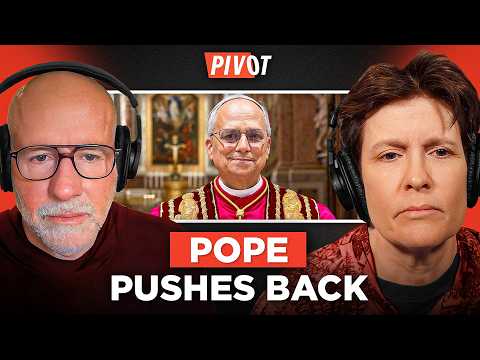
How Trump’s Fight With the Pope Backfired | Pivot
Scott Galloway (host), Kara Swisher (host)
In this episode of Pivot, featuring Scott Galloway and Kara Swisher, How Trump’s Fight With the Pope Backfired | Pivot explores trump Feuds, Iran Escalation, and Tech Backlash Shape Turbulent Week They argue Trump’s public attack on Pope Leo is strategically pointless and risks alienating key Christian constituencies while showcasing erratic, grievance-driven behavior.
Trump Feuds, Iran Escalation, and Tech Backlash Shape Turbulent Week
They argue Trump’s public attack on Pope Leo is strategically pointless and risks alienating key Christian constituencies while showcasing erratic, grievance-driven behavior.
They assess the Strait of Hormuz blockade as both a dangerous escalation and one of the few remaining levers to force broader international pressure on Iran, after poorly planned diplomacy and coalition-building.
They frame Viktor Orbán’s electoral defeat and concession in Hungary as a major symbolic setback for far-right politics and a reminder that conceding elections is foundational to democracy.
They discuss Rep. Eric Swalwell’s abrupt exit from the California governor’s race amid sexual misconduct allegations, emphasizing power-imbalance “red lines” and media/political complicity in ignoring known behavior.
They cover accelerating AI/security tensions (Anthropic’s Mythos) and a violent targeting of Sam Altman, warning that public anger at tech must be channeled into regulation and elections—not violence.
Key Takeaways
Picking a fight with the Pope is political self-harm.
They see no upside for Trump in attacking a popular, articulate American pope, especially given the risk of alienating evangelical and Catholic voters while elevating a credible moral counter-voice.
Get the full analysis with uListen
Iran’s leverage increases when the conflict drags on.
Using the WGA/Netflix strike as an analogy, Galloway argues Iran’s incentive is to extend talks and conflict to regroup and exploit the Strait of Hormuz as an economic choke point.
Get the full analysis with uListen
The blockade may be the “least bad” option—but it’s still a quagmire signal.
They criticize the lack of congressional buy-in, allies, and clear objectives, yet note a maritime choke-point crisis forces China, Europe, and Gulf states to care because they rely on free navigation.
Get the full analysis with uListen
Orbán’s concession matters as much as Orbán’s defeat.
They treat peaceful transfer of power as the core democratic norm, contrasting Orbán’s concession with U. ...
Get the full analysis with uListen
For leaders, sex with staff is a bright-line governance failure even before criminal questions.
Galloway argues consensual workplace romance is different from relationships with direct-report power imbalance; Kara adds Swalwell’s situation appears broader and must be investigated, highlighting how “known” behavior can be tolerated until it explodes publicly.
Get the full analysis with uListen
AI capability is outpacing defense, making systemic cybersecurity risk inevitable.
They interpret Bessent’s warning about Anthropic’s Mythos as recognition that models can industrialize vulnerability discovery, creating incentives for both offensive misuse and defensive adoption.
Get the full analysis with uListen
Violence against tech leaders is never justified—channel anger into regulation and voting.
They condemn attacks on Altman while arguing the underlying resentment comes from perceived tech rapaciousness and regulatory vacuum; their prescription is structural reform, not vigilantism.
Get the full analysis with uListen
Notable Quotes
“Don’t fuck with El Papa.”
— Scott Galloway
“We have given Iran something… more dangerous and effective than enriched uranium… their ability to put a stranglehold on… the Strait.”
— Scott Galloway
“If you do not concede elections, the very basis, the very foundation of democracy does not exist.”
— Scott Galloway
“If you are a powerful senator or congressperson… anyone who works for you… you cannot have sex with. Simple. Cut and dry.”
— Scott Galloway
“The anger needs to be funneled towards the ballot booth.”
— Scott Galloway
Questions Answered in This Episode
What, specifically, did Pope Leo say or do that triggered Trump—and why do you think Trump chose to escalate publicly rather than ignore it?
They argue Trump’s public attack on Pope Leo is strategically pointless and risks alienating key Christian constituencies while showcasing erratic, grievance-driven behavior.
Get the full analysis with uListen AI
If the Strait of Hormuz blockade is the best remaining lever, what clear end-state should the U.S. define to avoid an open-ended quagmire?
They assess the Strait of Hormuz blockade as both a dangerous escalation and one of the few remaining levers to force broader international pressure on Iran, after poorly planned diplomacy and coalition-building.
Get the full analysis with uListen AI
In your WGA/Netflix analogy, who is the “Netflix” in the Iran standoff—what actor benefits most from delay, and how should U.S. strategy change accordingly?
They frame Viktor Orbán’s electoral defeat and concession in Hungary as a major symbolic setback for far-right politics and a reminder that conceding elections is foundational to democracy.
Get the full analysis with uListen AI
How much of Orbán’s defeat is about corruption fatigue versus a genuine ideological shift away from far-right governance in Europe?
They discuss Rep. ...
Get the full analysis with uListen AI
You praised Orbán for conceding—what institutional reforms would make U.S. concessions more automatic and less personality-dependent?
They cover accelerating AI/security tensions (Anthropic’s Mythos) and a violent targeting of Sam Altman, warning that public anger at tech must be channeled into regulation and elections—not violence.
Get the full analysis with uListen AI
Transcript Preview
Don't fuck with El Papa.
I know.
Even though I, I always think there's certain political instincts that the president has that I don't see that end up being less wrong than I thought and sometimes right, I do not see any upside here.
[upbeat music] Hi, everyone. This is Pivot from New York Magazine and the Vox Media Podcast Network. I'm Kara Swisher.
And I'm Scott Galloway.
You're back, I see.
I am back. That's right.
Yeah.
That's right.
Did you have a good time off? Did you have a nice time?
Yeah. I didn't do a whole lot, but yeah, it was really nice. I was in Florida. A lot of walks on the beach with my dogs. Um, I actually got kind of bored, which was a, a lovely-
Good
... and strange feeling.
Well, we missed you. We had some good hosts, but no one is you. Anyway, we gotta get to things.
Okay.
Let's get to things.
Mm-hmm.
There's a lot of news. Jesus Christ.
Yeah.
There was so much while you were away. I think we've forgotten that stuff. But Pope Leo says he has no fear of the Trump administration after the president lashed out at him on Truth Social Sunday night. Trump called the Pope, quote, "weak on crime" and, quote, "terrible on foreign policy" in his post. Neither one of those are his jobs. He accused Pope Leo of, quote, "catering to the radical left" and then told him to focus on, quote, "being a great pope, not a politician." Trump later posted an AI-generated image of himself as Jesus, though it looks like he might have deleted it and told reporters that he thought the image was him as a doctor. Oh my God, he's such a liar. We'll get to... Well, let me general. It's not just the Pope. Trump called out Tucker Carlson, Megyn Kelly, Candace Owens, and Alex Jones over, over their criticism of the war last week. Alex Jones responded, "We are witnessing the Epstein presidency." He's a nod to Scott Galloway there. That Candace Owens said that it may be time to put grandpa up in a home. Uh, let's see. We'll get to the latest on the war, but first, talk about this, this alienation of everybody. It seems demented. He was tweeting all last night from, like, nine PM to four AM, like, regularly. Thoughts?
I, I don't see the strategy here. And granted, I think Trump has had an ability to zag when everyone else is zigging. I thought one of the greatest insights in political history was when Trump told somebody, "Everybody claims to be socially liberal and fiscally conservative." He said, "The key is to be fiscally liberal and socially conservative," and it struck me that that was sort of a genius political positioning. But I fail to see how alienating a core constituency of the Republican Party, and that is Ev-Evangelical Christians, by taking on the Pope. I mean, people say Social Security is the third rail. I do think the American public is coming to grips with the fact that the wealthiest generation in the history of the planet probably shouldn't be taking one point two trillion dollars from the most anxious, obese, and depressed generation in history, and that's people under the age of 40. But that used to be the third rail, but I would argue kind of the most obvious third rail. You don't go after the... I mean, El... Don't fuck with El Papa. So I, I just-- Even though I, I always think there's certain political instincts that the president has that I don't see that-
Install uListen to search the full transcript and get AI-powered insights
Get Full TranscriptGet more from every podcast
AI summaries, searchable transcripts, and fact-checking. Free forever.
Add to Chrome