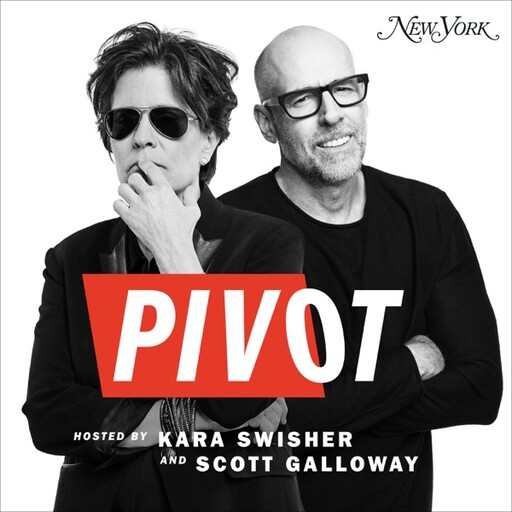
EVERY SPOKEN WORD
50 min read · 10,012 words- 0:00 – 1:26
Why Dixon still believes: blockchains as a path back to an open internet
- KSKara Swisher
Chris Dixon is the founder and managing partner of a16z Crypto, Andreessen Horowitz's VC fund for crypto and Web3 startups. He's also the author of a new book, Read Write Own: Building the Next Era of the Internet. We're having a lot of Silicon Valley people on, uh, of late. We had Aileen Lee on last week. Welcome, Chris.
- CDChris Dixon
Thanks, Karen. Thanks for having me.
- KSKara Swisher
So, uh, so, it's been a, uh, a rough couple of years for crypto and blockchain, but you're still making a case for it in this book. Um, actually, Scott has too in a lot of ways. But why don't you, why don't you explain why you're still a believer?
- CDChris Dixon
Yeah. Sure. So, I mean, in the book I try to explain what I would call the productive aspects of blockchains and why I think that blockchains can help us, um, return the internet to its original ideals as being an open and democratic network, which is why I got involved. I've been involved in the internet for 25 years. I got excited by the early ideals of the internet and, you know, look, if you fast-forward to today, the internet's become very consolidated. The top five tech companies account for half of the Nasdaq-100 market cap. Top 1% of social networks, 95% of traffic. You know, Google and Apple have a duopoly on what y- mobile operating systems. I'm sure you both have talked about this plenty. It, the internet, I worry the internet's at risk of becoming, like, '70s broadcast TV or something where you have three channels. Um, and I think that's bad for the world. I also think it's bad for our business. You know, we're in the startup business. Um, we, we want a dynamic internet.
- 1:26 – 2:21
Innovation vs. regulation: changing internet power structures through architecture
- KSKara Swisher
But you write about, uh, blockchain technology and this is a quote from you. "This is a chance to create the internet you want, not the internet you inherited." It's something we talk about a lot. Like that the same companies are in charge. Um, what does that, what do you mean by that? It, when you say there's lots of opportunities for innovation here, uh, that starts from ground zero presumably versus starts with Google in charge or Microsoft or whoever.
- CDChris Dixon
I, I'm guessing that we s- somewhat agree on the problem.
- KSKara Swisher
Mm-hmm.
- CDChris Dixon
Um, meaning, uh, ph- having five companies control everything is, um, not ideal. Um, I think there's different ways one could think about solving that. And so for example, a lot of people talk about regulation. I believe there is a role for regulation. Um, I think, you know, we'll see what happens with DOJ and Apple and things like that. Um, I, my proposal is to also try to do it through innovation. And by, and, and through that, we want to create a new wave of internet services that return power to the edges of the network. And so to give you an example, o- one of the reasons that
- 2:21 – 3:58
Escaping platform lock-in: owning identity and audiences (email vs. social)
- CDChris Dixon
social networks are so powerful is you're locked in. Right? They have network effects, so you know, I know, I think you switched recently to Threads. Um, and when you did, you had to give up your audience, right? You had to go build a new audience.
- KSKara Swisher
I, I'm still over there 'cause I got there first, but go ahead.
- CDChris Dixon
But okay, so you maybe (laughs) , may- maybe you're the exception. But generally, you're locked in, right? To these networks. So like, and especially if you're like a creator for example, and you build a business on TikTok or Instagram and, and you don't like the fact that they changed the algorithm or did some other thing, you're locked in. And so, one of the key aspects for example in, uh, in these new blockchain-based social networks which is one category we're investing in, is a user owns his or her identity. And they own their followers in the same way you do in the email world, right? So if on email, if you have a newsletter on Substack and you don't like Substack, you can switch and you can take your followers with you. So that's just one example of how a different architecture by empowering users with ownership, this is the Read Write Own, and that's what I mean by ownership is a, is a user controls their followers, not the service. That, that change in architecture I believe can have sort of profound downstream consequences on, on the ultimate control of these services and the economics and you know... These, these networks, I don't think we knew this 10 or 15 years ago but today we know, they control the flow of global money, uh, business, culture, politics. They're very, very important, um, and I, and I don't think that having four or five people, whoever they might be, maybe you know, at one point you like the management and at one point you don't, I just am fundamentally against the idea that five people can control those things. I think that they should be more like the early web.
- KSKara Swisher
You're talking to people who like to own. So Scott, go ahead.
- 3:58 – 5:33
Scott’s taxonomy: tokens, NFTs, DAOs—and what’s actually working
- SGScott Galloway
Chris, good to see you. So, uh, and this may be the wrong bucketing but I think of blockchain in terms of front-facing applications is- is bucketed into three areas. There's the tokens, you know, crypto, there's NFTs and there's DAOs. Um, DAOs haven't really gotten any traction. NFTs I think have lost 90-plus percent of their value, I think I'm being generous there, and the, the token market's been kind of loosely speaking in terms of market cap been cut in half even with its resurgence from its peak. Wh- talk about those three categories and where do you see the opportunity?
- CDChris Dixon
Yeah. So I, I think with DAOs, so a couple of things, like I mean there, there are active DAOs. Um, a lot of them are around these DeFi protocols so for example Uniswap and Compound and um, Maker are, they're, what's interesting about them is they're, they're networks in the same way that Facebook is a network but the users control those networks. Um, and those are networks that have a- active, they, Uniswap had trillions of dollars in trading volume and the users decide how to upgrade the code. Um, admittedly that is early, those are experiments. I- in my book I have a section on what I call network governance where I talk about this. And my argument is essentially that it's a, um, a very powerful new way to design community-governed systems. I, I don't claim that we've fully figured it out. I, I think that it, it requires a lot more work to evolve. NFTs, look the NFT standard was f- the, was finalized in 2020. Then we had this, you know, big rise in the market. Last year in 2023, there were $8.6 billion in NFT sales so I think the sort of decline has been exaggerated.
- 5:33 – 6:14
NFTs after the hype: wash trading concerns and “internet bubble” cycles
- SGScott Galloway
But how much of that $8.6 billion do you think is, is false flags as people trying to pump up the volume?
- CDChris Dixon
According to the, we have a data science team and I asked them to pull these numbers and they, they b-They believe that's removing wash trading, if that's what you're referring to. Um, so, so, so they do believe that. But look, uh, uh, admittedly, the, you know, it's hard to get the exact numbers. But, but, um, I, I think that's a pretty accurate number. Um, and so, um, the, so NFTs... So, a- and look, I think NFTs went through... I, the way I kinda look at these things is like the internet, we all, I think, lived through the internet bubble, right? I kinda began my real career post-internet when everyone thought the internet was over. And the way I view it is, a lot of these new technologies go through these cycles where people get overly optimistic, and I think that probably happened with NFTs, and now I believe they're overly pessimistic.
- 6:14 – 8:25
The ‘casino’ problem: fraud, offshore exchanges, and the case for guardrails
- KSKara Swisher
All right. Let me, let me ask you about that because you talk about the casino culture of crypto, which has become the dominant narrative, and obviously the law, uh, the Binance thing, Sam Bankman-Fried, et cetera. Talk about the less nefarious side, a- and what about the impact of that, those, those cases? And also, the SEC did approve Bitcoin ETFs a few weeks ago, though the price of Bitcoin has been falling.
- CDChris Dixon
The casino stuff? Yeah.
- KSKara Swisher
So overall, it's sort of in that moment. And I would agree with you, there was a lot of real scammy stuff at the beginning of the internet for those who weren't there. Um, and it went on for quite a while, for quite a while actually. Um, but talk about sort of that, how to shed it, 'cause I think people think of it now with FTX, even though they made a great investment in Anthropic, it was mostly not a good story for crypto or in general.
- CDChris Dixon
In my book, I have a long section where I talk about this, what I call the casino, and I am, and I'm a- again, very against it. And I think it's destructive. I think it's destructive primarily to consumers who are victims of things like FTX. But I also think it's quite destructive to what I'm trying to work on, which is to, to build a productive side of these technologies. But look, the way I would describe it is, a blockchain is a tool, tokens are a tool, right? And just like any tool, you know, you can... A hammer can build or a hammer can destroy. And there's two sides to the tool. And I, I f- I think there's been a lot of attention paid to the casino aspect. There are, you know, like we have dozens of startups in our portfolio who are working on the, on the productive side. And I, and I, the reason I wrote the book partly was to tell that story 'cause I do think it's a bigger story than people realize. I, I also think that we need, um, more proactive policy. We've been calling this for this for years, since before FTX, to put guardrails around the casino stuff, to eliminate the offshore activity. And look, I was involved, I mean, the reason we were non-investors in FTX is I was involved with Coinbase for years. Coinbase, contrary to, I think, some, some popular perception, it was heavily regulated. They're Bank Secrecy Act-regulated. They do full KYC on all their customers. They, there's a, there's a whole series of regulations. They're audited, they're a public US company. Um, Binance, FTX, there's a whole series of companies that are offshore, non-audited, all these other kinds of, you know, all these ish, running exotic pro- products. I mean, that's the kinda stuff that I think we need to clean up and have very clear rules.
- 8:25 – 8:45
Bitcoin ETFs: institutional acceptance, but a distraction from utility
- KSKara Swisher
What about the Bitcoin ETF? It does sort of introduce consumers to it in a, in a safer-feeling way. You know, if I'm getting it from Fidelity, I certainly trust them more than even Coinbase, for example.
- CDChris Dixon
Yeah, and I, and I think, I think the Bitcoin ETF was a, I mean, in my mind, is a net positive in the sense of it's sort of more institutional acceptance.
- KSKara Swisher
Oh, you say net positive. What, what's the negative?
- 8:45 – 10:24
Crypto as a countermeasure to AI: deepfakes, authentication, and audit trails
- CDChris Dixon
Oh, it's good. (laughs) No, sorry. I mean, it's good overall. I, look, I, I've very focused on the utility side of building applications. And so, it's a new financial instrument, so it's, for me, it's less of a focus. That's what I mean. Um, and it's just not, you know... Like, I would love for, to more of the news cycles to be focused on, "Hey, this person just came up with a cool new way to fight deepfakes. This person just came up with a cool new business model for creative people." I think specifically with the rise of AI, I see a lot of blockchain applications as the countermeasure in many ways. So like, just to go back to maybe if I could talk about the deepfakes for a second, uh, um, you know, we're now gonna have an internet awash with fake video, awash with, you know, very advanced phishing. Um-
- KSKara Swisher
Yeah, we have it actually.
- CDChris Dixon
Yeah, we probably have it. Um, you, you can now-
- KSKara Swisher
No, talked to Taylor Swift this week. But go ahead. Sorry.
- CDChris Dixon
Yeah, yeah. Taylor Swift. You can, you can simulate people's voices perfectly now. They can take your voice from the podcast. Yeah, they can, they can then call... I actually had a partner, Martin, who they called... Someone called his parents using his voice to try to get money. This is ac- this is actually, like, a real thing happening. And so in that world, we need to use, I believe, tools like cryptography to authenticate things. And I think, you know, for example, one, one way to do that is you c- uh, one thing a blockchain's very good at doing is storing an immutable audit trail. And so you can have an immutable audit trail that says this video is attested to by, you know, it came from Kara Swisher, um, and it was attested to, or by her, as an example. And so it gives you this ground truth in a world in which you lose that. I think also, blockchains allow for new business models for creative people in a world where, like, generative AI will put significant downward pressure on, you know, the ability for, let's say, an illustrator to sell things, right? If you can just go (laughs) to Midjourney or something. Um, and so, you know, I think it becomes more important, um, in, in an AI world.
- 10:24 – 13:18
Who leads the ‘productive’ crypto movement? Coinbase, Ethereum, and builders
- SGScott Galloway
So when I think about, uh, kind of the consumer-facing technologies that have built so much value in tech, and I think about the leadership there, I think about the original gangsters. I think about Gates and Jobs and then t- the new, you know, the new guys, and they were all guys, Brin, Page, Bezos. These, say what you will about them, they were, they're all visionaries. And, and I, I, and I would argue at their core, they were all... I, I'll, I'll go on and I'll... I think they're good people. And the, the two kind of iconic figures in blockchain are either in jail or going to jail. And, and my question is, who are the new... Who's the next generation of leadership that you would point to that will, quite frankly, uh, to sort of clean this mess up? Because right now, from a public perception standpoint, it feels like a levered Ponzi scheme.
- CDChris Dixon
I think there's just two very different worlds, Scott. So I think there's the, the SBF world, and then I think there's, you know, like people like Vitalik Buterin and Ethereum.
- SGScott Galloway
Well, you mentioned Brian Armstrong, or you alluded to him.
- CDChris Dixon
I think, uh... Look, I, I think B- look, Brian h- like Brian got, you know, he got flak for years for being sl-... I mean, their market share got low single digits. Um, they were getting crushed by Binance and FTX. If you talked to any Silicon Valley VC, it was like, "Why is Coinbase so slow?"
- SGScott Galloway
Stocks aren't crazy. They're doing really well now.
- CDChris Dixon
And then, and, and Brian, like Brian kept... I, I mean, I think what he did was admirable. He really kept his head down. He never changed what he does. He invests h- very heavily in security and compliance. Um, and, and you know, and he's not, he's not... He hasn't gotten all the market share yet, but I think that approach has proven correct. I think Brian has done a great job. I think there's folks like Vitalik, and there's a lot more. Look, there's these conferences, like...... you, you go to DevCon, it's an Ethereum conference and there's like, tens of thousands of very earnest kind of, you know, um, uh, thoughtful technologists. And it feels to me kind of like, I don't know, 2005 Web 2.0 movement when I was, you know, I was part of that. And you go to these things and, and yeah. And look, they weren't ... I mean, look, you never know who, who the Larry Page is at the time. I mean, obviously Larry Page is, I'm sure brilliant and everything else. (laughs) I didn't know him. Over time, these folks will emerge. And I do, I do, I would say I think there's a very strong productive, positive movement that I think just gets kinda crowded out by all of the, you know, the coverage of the casino stuff. Um, but I think it very much exists. And that's why, look, that's why I wanted to write the book. I, I wanted to go through in detail and explain this and make the case.
- KSKara Swisher
Let me ask that then, c- I was just looking at Coinbase stock, which is up recently, but it's certainly down from, to 2022, like quite a bit. Like, or 2021, especially when it was in the h- you know, s- what is it? Two ... High was 332 and then it's now down to 131. It was down in the $80s and $70s and stuff like that. Uh, but that, that, using them not as an example of, of, but you know Scott called them the AOL of blockchain. But nonetheless, um, it's been a-
- CDChris Dixon
Is that a, is that a good thing? (laughs)
- KSKara Swisher
No, I don't think so.
- SGScott Galloway
Well, was for a while.
- CDChris Dixon
It was for a while.
- KSKara Swisher
It was for a while.
- SGScott Galloway
It was a great thing for a while.
- KSKara Swisher
Yeah.
- CDChris Dixon
It was great 'til it wasn't.
- 13:18 – 14:13
Must crypto be mainstream? Blockchain as ‘steel’—the invisible building material
- KSKara Swisher
Um, but, but, it, it has been around for a while. And it, the main ... Does it have to be mainstream? 'Cause AI suddenly is everywhere mainstream, you know? It's, it's, it seems ubiquitous every- everywhere. Does it have to be mainstream or just, we're the electricity, we're the, inf- we're the, we're the, I don't know, the drywall or whatever? I don't know.
- CDChris Dixon
Yeah. I, I, in, uh, in my book I analogize blockchain as to steel, uh, in the sense of like, it's a b- it's a building material, right? 'Cause people sometimes say, "What problem does it solve?" And it, I really see it as a building material for building better internet services. So, I think ultimately if the movement that I'm part of succeeds, it will be, it won't be, eh, some parts of it will be visible. The fact that you can, hey, there's a social network where I can exit. You know, there's a, I can sell digital merchandise as a musician directly to my fans. Like, you'll see parts of it, but you won't see all the plumbing. And I think most of the plumbing is behind the scenes. And it, and ... By the way, it may, may happen with AI too. Maybe AI is just sort of baked into everything, I think is probably a likely outcome.
- 14:13 – 16:19
Where to start today: music, social, stablecoins, games, and loyalty programs
- KSKara Swisher
AI feels more like the internet, right? It feels more like, or a web, or s- or something like that. But if you, i- if people wanted to get into crypto right now, where would you tell them to start?
- CDChris Dixon
Uh, I think, look, I think there's a lot. So, some examples of things I'm excited by. We have, um, a few things around music. So, there's a project called Sound.xyz where musicians ... So musicians today don't make money on the internet. They make very little money on streaming. A lot of them, if you ask them, will say they go offline and they tour and they sell merchandise, um, to, to support themselves. And so, um, there's various projects like Sound.xyz that let use m- musicians sell backstage passes and digital merchandise to their consumers and add additional income stream. So, that's one interesting area. There's a social network called Farcaster that's a lot like kind of something like Twitter or Facebook, except the user controls their name and their followers and can move around, and developers can hack on it. Car- you remember early Twitter, how it became like, a developer platform? Like, I was very excited by Twitter at that point. Th- those are two examples. Um, the, the, um ... Look, there's also th- the stablecoins are quite popular, um, in the developing world. There were something like $600 billion in stablecoin transactions last month. So there are also other, you know, as I mentioned, NFTs are, I think are bigger than most people realize. There, there's, yeah, there's a bunch of interesting games that are launching. Like, we have one, it's sort of a Zynga style game called Pirate Nation where you have NFTs as digital collectibles. Eve Online, the, the popular, is a very popular video game, they're launching a, an NFT version soon which lets kind of have more of a peer-to-peer economy where users can create spaceships and sell them to other users. So, I think there's a really interesting wave of new companies that are much more accessible. Um, Blackbird is one in New York where it's a restaurant. Um, it's actually the founder of Resy and Eater.
- KSKara Swisher
Hmm.
- CDChris Dixon
Ben Leventhal, you may know him? Experienced-
- KSKara Swisher
Yeah, I know him. Yes.
- CDChris Dixon
... entrepreneur. Yeah. So, he's doing an NFT, it's like a restaurant thing where you can use NFTs as a way to kind of reward loyal, loyal patrons. Um, so I, I feel like we're having this kind of out of the downturn, there's a, there's a ... It feels to me like a lot of people are kind of saying, "Hey, we gotta really level up our game and have really great product experiences," and we're seeing a, a, an exciting wave. And like, I'm excited about it.
- 16:19 – 18:32
VC extraction critique and lockups: addressing ‘dumping on retail’ fears
- SGScott Galloway
There was a fear that a lot of these crypto projects were essentially VCs financing a group of intelligent guys who ha- had found something they thought, claimed was new technology. The VC fund would lend its capital and create this project, they'd issue a coin. Because, and then kinda leveraging the fact this FOMO of Main Street Americans who wanted to participate in what was hot, they'd then buy these coins. And because there's no SEC requirements on, uh, lockups or even disclosing when you'd sell these coins, that then these VCs would basically dump their entire stake. And that these projects were not financing any sort of growth or underlying technology, they were essentially just an elegant transfer of wealth from Main Street investors to the limited partners of VCs. Do you think there's any truth to those claims?
- CDChris Dixon
I think it's possible. I think that ... Look, I mean, I will just say that probably the number one thing that we have asked for and pushed for in policy for years is longer lockups, okay? So, we have tenure, we're, we're a venture fu- all of our funds are venture funds, including the crypto funds. They have a tenure, life cycle. Um, we push for long lockups in the deals we do, but we don't have unlimited market power. If we go p- push too hard, they will do a deal with somebody else, right? And so we have ... I think the number one thing that the policymakers could do to improve the space would be long lockups on every project. Because I believe in, that, that real technology takes years to build and you need to avoid that. Yes, I, look, I think all sorts of things have happened.
- SGScott Galloway
But Andreessen hasn't, hasn't been subject to these lockups or self-imposed them.
- CDChris Dixon
We ... In all the deals we do, we have multi-year lockups.
- SGScott Galloway
I'm sorry, I just wanna clarify this. When you invest in a crypto project and there's a coin issued, you have a self-imposed lockup on when you can sell those coins?
- CDChris Dixon
The lockup's in the term sheet. It's a k- it's a term in the term sheet, yeah.We do and the founders do.
- SGScott Galloway
So, the crypto projects you, you funded in the last few years, you have not sold coins? You still own those coins?
- CDChris Dixon
We have 94% of the coins that we bought, we hold in all our crypto funds today.
- SGScott Galloway
So wouldn't that indicate that Andreessen has taken an enormous drawdown or loss on these projects, given what's happened in the crypto market?
- CDChris Dixon
(laughs) We're RIA, I'm not allowed to talk about our returns, but, I mean, it, we, we have 94% (laughs) of our, of our tokens, yeah. I mean, think d- it's a, uh, v- venture capital's a highly volatile market.
- 18:32 – 21:01
Most compelling use cases: collaborative storytelling, the open metaverse, and AI-era media models
- SGScott Galloway
And then my last case is just give us what you feel is the most compelling use case for consumers or, or, or enterprise, say, it doesn't even have to be now, but in three years. What, what do you think the use cases are?
- KSKara Swisher
Outside of speculation.
- CDChris Dixon
Sorry to keep pushing my book, but I have seven sections at the end of the book where I go through seven, uh, like deep into seven areas of use cases, and I talk about social networking, I talk about finance, I talk about, um, media businesses, like NFT media businesses. Um, I'll just give you one kind of maybe a flavor of a cool idea that I like, um, as that's one of the sections, which is, uh, an area called collaborative storytelling. And that the idea there is it's kind of Wikipedia-style, is, um, uh, internet fans get together and create narrative universes like the next Harry Potter and the next Marvel. And if they get rewarded with tokens proportionate to their contribution, um, and then they go and they, the, the, that, the narrative universes they conger- create can then be made into licenses and made into movies and comic books and other kinds of things. Like that's a cool new idea that just sort of couldn't exist before you had crypto. But there's just like a bunch of, there's games, I have a section on games in the Metaverse. Like I, look, I think that, uh, very clearly, we're gonna have, you know, the so-called Metaverse. I know it's jargony, is a, but it is a thing that's gonna happen, and whether... I'm not talking just strictly about VR headsets. I'm talking about people spending more time in 3D worlds through video games and things like this. That's just, we're gonna have more and more people in 3D worlds. They're more persistent. Um, um, it becomes a bigger part of our lives. And I think an important question is, how is that Metaverse structured? Is it structured with like one company owning it, like does Fortnite own it? Or is it structured like the web, like where there's a bunch of different, you know, like it's an open system and you can add a component to it? Um, like that, that's another im- important, you know, area that I'm focused on. Um, I think, as I mentioned before, like in a world of generative AI, um, or, or let's talk about your business, the media business. Um, you know, the internet has operated on an implicit covenant between distribution, like search engines and social networks, and, uh, websites, right? What happens in a world where you go to a ChatGPT, and you just get an answer, and you don't have to click through anymore, right? So, we're very soon entering a world where you don't click through (laughs) anymore, and you don't go... And I was on the board of Stack Overflow for years. Stack Overflow data was used to train a lot of these systems, and now Stack Overflow's tr- traffic is way down, right? So, so how do we train, how do we create content in the future? How do we reward content creators? So, you know, I have a section in the book on this, about like different things people are working on and ideas for like new ways to use blockchains to create business models in an- in a world of AI systems that give you the answer.
- 21:01 – 22:13
Closing: institutional momentum and final endorsement of ‘Read Write Own’
- KSKara Swisher
One of the last things, I'm sorry, uh, I just noticed, Larry Fink, who was a big, um, detractor of Bitcoin and stuff, of course, has done an about face and is calling himself a big believer. Of course, they have, they filed paperwork for an ETF too at Blockworks. It's, I think the finance stuff and the speculation might be a little calmer with these new... You know, it's part of that. It'll be part of that, presumably, that will still... I know, and you're not in that area, you're in the tools part, but as a speculative tool of ownership, I think it's, it, it, this will change it quite a bit, a lot of people feel like. Um, and then there are limiting...
- SGScott Galloway
Yeah, I think the sort of institutional...
- KSKara Swisher
Yeah, the institutional people are really piling in a lot more 'cause it feels safer. And that makes sense. That makes sense from a lot of perspectives. Anyway, uh, really fascinating book actually, and we love to, we love to own. We, Chris, we're owners. Um, and you know I am. You know, I'm like tired of selling my stuff to other people. Um, anyway, again, Chris Dixon, he's one of my favorite venture capitalists, and th- that's a very short list. Um, and, uh, the book is Read, Write, Own: Building the Next Era of the Internet. It's really worth your while to read it. Thanks, Chris.
- SGScott Galloway
Thanks, Chris. Good to see you again.
- CDChris Dixon
Yeah. Thanks, Scott. Thanks, Kara. You too.
Episode duration: 22:14
Install uListen for AI-powered chat & search across the full episode — Get Full Transcript
Transcript of episode jmtLvjlIABs



