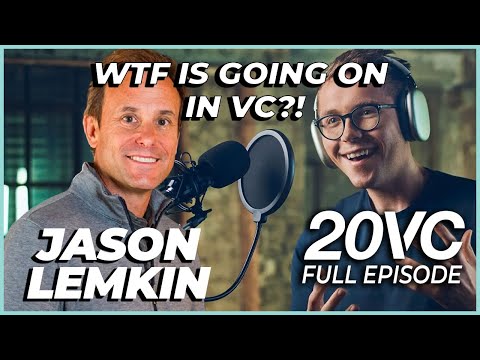
Jason Lemkin: WTF is Going On in VC? Are LPs Investing in New Funds? | 20VC #965
Jason Lemkin (guest), Harry Stebbings (host)
In this episode of The Twenty Minute VC, featuring Jason Lemkin and Harry Stebbings, Jason Lemkin: WTF is Going On in VC? Are LPs Investing in New Funds? | 20VC #965 explores jason Lemkin Explains the Brutal New Reality of Venture Capital Jason Lemkin and Harry Stebbings dissect the post‑2021 venture and SaaS landscape, contrasting the exuberant, inflated years with today’s far stricter funding and operating environment.
Jason Lemkin Explains the Brutal New Reality of Venture Capital
Jason Lemkin and Harry Stebbings dissect the post‑2021 venture and SaaS landscape, contrasting the exuberant, inflated years with today’s far stricter funding and operating environment.
Lemkin argues that while great companies and growth still exist, the bar for being fundable has dramatically risen: capital efficiency, realistic paths to $100–200M ARR, and true competitive advantage now matter again.
They explore shifting LP appetite, the slow‑motion reset of growth and marketing spend, the overhang of overvalued unicorns, and why founders must assume capital is scarce and build accordingly.
Lemkin predicts conditions will improve modestly by year‑end, but insists the extreme valuations and easy money of 2021 are gone for good, and founders must embrace that startups are supposed to be hard.
Key Takeaways
Being fundable now requires both top‑tier growth and capital efficiency.
Investors want companies that can plausibly reach $100–200M ARR within a decade while keeping total capital raised closer to ~$100M, not the $300–400M that briefly became normal; burn without efficiency is no longer tolerated.
Get the full analysis with uListen AI
Competition and true differentiation matter again—founders must explain why they’ll win.
The “Postmates effect” era, where several #3–#5 players could still produce billion‑dollar exits, has ended; founders need a clear, credible story about segment focus or product edge and why competitors stumbled.
Get the full analysis with uListen AI
Cutting marketing and sales too deeply will starve future pipeline.
Companies are over‑reacting by slashing long‑term marketing and sales capacity to protect runway, but Lemkin argues this will leave them under‑staffed and under‑pipelined when demand and multiples improve.
Get the full analysis with uListen AI
Founders must build conservative, sensitivity‑driven financial models.
Teams often underestimate how a small miss on growth, with fully loaded headcount, can spike burn; leaders should model downside scenarios, accept their trailing 3–4 months as the baseline reality, and plan from there.
Get the full analysis with uListen AI
Assume you are unfundable unless you have concrete evidence otherwise.
Lemkin urges founders to operate as if follow‑on capital won’t be available—raise as much as you can when you can, and only relax that stance if trusted investors explicitly commit to future term sheets at specific milestones.
Get the full analysis with uListen AI
Many richly funded early unicorns are structurally blocked from good exits.
Companies that raised huge rounds at extreme multiples now need improbably large outcomes (often 10x capital raised) for everyone to make money, making M&A difficult; combining with competitors may be their only real path.
Get the full analysis with uListen AI
The market will improve somewhat, but 2021 is never coming back.
Lemkin expects public SaaS multiples to rise 20–40% as macro uncertainty clears, unlocking more deployment, but insists that 80x ARR IPOs and COVID‑era hyper‑growth are one‑off anomalies, not a future baseline.
Get the full analysis with uListen AI
Notable Quotes
“For founders, you have to understand that will never lead to a return of 2021. Never.”
— Jason Lemkin
“The competition slide finally matters again. Why will you win?”
— Jason Lemkin
“If you didn’t have multiple billion‑dollar cash exits in 2021, you’re not a good investor.”
— Jason Lemkin
“If you join a company with a valuation over a billion in 2023, you’re going to make nothing.”
— Jason Lemkin
“When I see a founder cry, I have no sympathy… it’s supposed to be hard.”
— Jason Lemkin
Questions Answered in This Episode
If the bar for being fundable stays this high, how should early‑stage founders redesign their roadmaps and hiring plans from day one?
Jason Lemkin and Harry Stebbings dissect the post‑2021 venture and SaaS landscape, contrasting the exuberant, inflated years with today’s far stricter funding and operating environment.
Get the full analysis with uListen AI
What practical steps can a startup take to restore investor confidence if it raised at an extreme valuation and is now stuck with too much capital and too little growth?
Lemkin argues that while great companies and growth still exist, the bar for being fundable has dramatically risen: capital efficiency, realistic paths to $100–200M ARR, and true competitive advantage now matter again.
Get the full analysis with uListen AI
How can founders balance the need to extend runway with the imperative to keep investing in marketing and sales to build future pipeline?
They explore shifting LP appetite, the slow‑motion reset of growth and marketing spend, the overhang of overvalued unicorns, and why founders must assume capital is scarce and build accordingly.
Get the full analysis with uListen AI
Given Lemkin’s view that employees at current‑vintage unicorns are unlikely to see meaningful equity upside, how should top talent think about joining startups versus big tech?
Lemkin predicts conditions will improve modestly by year‑end, but insists the extreme valuations and easy money of 2021 are gone for good, and founders must embrace that startups are supposed to be hard.
Get the full analysis with uListen AI
What specific metrics or signals should founders track to know whether they are genuinely “fundable today” versus hoping for a future market “thaw” that may never come?
Get the full analysis with uListen AI
Transcript Preview
When I see, like, a founder cry, I have no sympathy. (upbeat music) The competition slide finally matters again. Why will you win? I almost wanted to jump off the roof if we couldn't be number one in categories, right? Being number two wasn't good enough, right? Oh, my God.
I want to invest, but there's no companies. So what do I do, Jason?
You know, if you didn't have multiple billion dollar cash exits in 2021, you're not a good investor. I felt like an idiot not investing in a bunch of these companies. For founders, you have to understand that will never lead to a return of 2021. Never.
Jason, this is gonna be a very freeform discussion. But I wanted to start with-
Yes.
... something that I'm seeing a lot, which is, I'm in a lot of WhatsApps with GPs and they're going, "I want to invest. I want to invest."
Yes.
"But there's no companies." And then I'm going on Twitter and the companies are saying, "Are any VCs investing?" And I just want to understand, how do you see where we're at today? Especially when I see what I just said there?
I've been investing in venture since 2013, as you know. Um, we met fairly early in your career. And I, I w- I bolted out of the gates in 2013, right? I did Pipedrive, Talkdesk, Algolia, Greenhouse, and SalesLoft all within 12 months. Uh, I did almost no investing the last 12 months, and some of it's certainly the macro. I mean, the, boy, the market's changed a lot in 12 months, didn't they? (laughs) I mean, the world changed. But it is, I will say, an- and, and I will say I do think it's harder to find good deals. And I think it is true, and I think people are a little bit full of it on the Twitter, right, and on the social media. And there's probably a lot of it going on, um, and, and some of it is just that, like, we just, we, we all have to reset, which is that we all took so much risk for two years and the markets were so strong that we're, we're resetting to a day when we're looking for so much more out of an investment. The, the bar's gone up and, and they are harder to find. Um, but I, I think that anyone who's... You know, I look, I agree with you. I look at folks on Twitter, they're like, "Yeah, it's, it's whatever, January something 2023, I've done 11 deals this year." I'm like, "Kudos." (laughs)
(laughs)
Kudos, because I have, I have not seen 10 times the qualified deal flow of 12 or 24 months ago. I haven't seen it in these times, right?
Can I ask, what has changed in what early stage investors are looking for in the companies that we back?
Install uListen to search the full transcript and get AI-powered insights
Get Full TranscriptGet more from every podcast
AI summaries, searchable transcripts, and fact-checking. Free forever.
Add to Chrome