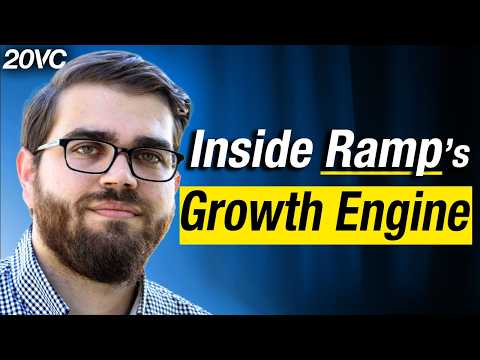
George Bonaci, VP of Growth @Ramp: How Ramp Became the Fastest Growing SaaS Company Ever |E1264
George Bonaci (guest), Harry Stebbings (host)
In this episode of The Twenty Minute VC, featuring George Bonaci and Harry Stebbings, George Bonaci, VP of Growth @Ramp: How Ramp Became the Fastest Growing SaaS Company Ever |E1264 explores ramp VP George Bonaci Reveals Scientific Playbook Behind Hypergrowth Success George Bonaci, VP of Growth at Ramp, explains why effective growth is fundamentally a scientific, experiment-driven discipline rather than a set of transferable marketing playbooks. He emphasizes building a portfolio of bets across time horizons, aggressively scaling what works to saturation, and accepting that most experiments will fail. The conversation covers how to structure growth teams, find 'alpha' through non-obvious channels, hire and evaluate early growth talent, and use pre- and postmortems to systematically learn. Bonaci also discusses the rising role of brand, AI’s impact on growth skillsets, and why product quality plus unconventional distribution is critical in competitive markets.
Ramp VP George Bonaci Reveals Scientific Playbook Behind Hypergrowth Success
George Bonaci, VP of Growth at Ramp, explains why effective growth is fundamentally a scientific, experiment-driven discipline rather than a set of transferable marketing playbooks. He emphasizes building a portfolio of bets across time horizons, aggressively scaling what works to saturation, and accepting that most experiments will fail. The conversation covers how to structure growth teams, find 'alpha' through non-obvious channels, hire and evaluate early growth talent, and use pre- and postmortems to systematically learn. Bonaci also discusses the rising role of brand, AI’s impact on growth skillsets, and why product quality plus unconventional distribution is critical in competitive markets.
Key Takeaways
Treat growth like science: hypotheses, experiments, and a portfolio of bets.
Start from first principles, not past playbooks; design experiments with clear hypotheses, measurable outcomes, and an explicit mix of short-, medium-, and long-term bets, assuming most will fail.
Get the full analysis with uListen AI
Prioritize experiment velocity while maintaining just enough rigor to learn.
Ship fast, accept imperfection, but ensure experiments are structured so you can actually attribute outcomes; when under time pressure, bias to speed, then backfill rigor once you’ve hit near-term goals.
Get the full analysis with uListen AI
Aggressively scale channels that work until you hit saturation.
When a channel shows strong performance, don’t just ‘slightly’ increase spend—push it rapidly until the response curve clearly starts to decay, then decide if marginal returns are still acceptable.
Get the full analysis with uListen AI
Seek alpha in non-obvious, underused, or contrarian channels.
Look for channels others ignore or dismiss—like early TikTok, direct mail, B2B influencer marketing, WhatsApp, or even door-to-door/field sales—where competition is low and experimentation at scale is possible.
Get the full analysis with uListen AI
Hire junior, analytical generalists as first growth hires, not big-name veterans.
At early stages, prioritize potential, logical thinking, and quantitative ability (ex-consultants, finance, engineers) over traditional marketing résumés or large-company playbook operators.
Get the full analysis with uListen AI
Use structured onboarding, tests, and real data to evaluate talent quickly.
Design detailed 30/60/90-day plans, give take-home case studies using messy real-world data, and expect new hires to ship something in week one to move beyond ‘vibes’ to fact-based assessment.
Get the full analysis with uListen AI
Brand and creative channels matter more as core performance channels saturate.
When direct response channels hit diminishing returns, invest in brand to drive long-term demand generation (including educating people who don’t yet know they have a problem), accepting fuzzier attribution.
Get the full analysis with uListen AI
Notable Quotes
“Growth is mostly just science; you have to come in with a blank slate, form a hypothesis, and then run a bunch of experiments.”
— George Bonaci
“If you’re doing things right, you should assume the majority of your bets are going to fail, which is why velocity is more important than getting things perfect.”
— George Bonaci
“Another mistake most startups make is they see something that works and they’re like, ‘Okay, great, let’s increase our spend a bit.’ Ideally, if it’s working, you take that channel to saturation as quickly as possible.”
— George Bonaci
“No one should be that attached to any experiment. If you’re not failing, honestly, you’re probably not doing your job well.”
— George Bonaci
“A good leader needs to know how to do everyone on their team’s job, but poorly.”
— George Bonaci
Questions Answered in This Episode
How would you translate George’s portfolio-of-bets framework into a concrete quarterly roadmap for a specific early-stage startup?
George Bonaci, VP of Growth at Ramp, explains why effective growth is fundamentally a scientific, experiment-driven discipline rather than a set of transferable marketing playbooks. ...
Get the full analysis with uListen AI
What are practical ways a small team with limited data can still design rigorous-enough experiments without a dedicated analytics function?
Get the full analysis with uListen AI
How can a founder objectively determine when a channel has reached true saturation versus simply needing better execution or creative?
Get the full analysis with uListen AI
What signals should a startup look for to know it’s time to meaningfully invest in brand, despite the attribution challenges?
Get the full analysis with uListen AI
How might AI-enabled tools reshape the ideal skill profile for growth hires over the next 3–5 years, especially around technical versus creative strengths?
Get the full analysis with uListen AI
Transcript Preview
(upbeat music plays) I think the way that you find alpha is either by doing things that no one else knows about. I think another aspect is probably doing things that everyone is convinced will not work. I think a good leader needs to know how to do everyone on their team's job, but poorly. And I think the poorly part's important. I would always skew more junior. I think hiring for potential, especially early on in the business, is far more important.
Ready to go? (upbeat music plays) George, I'm so excited for this, dude. Ramp is one of my favorite companies to feature. I've heard so many great things about you. So thank you so much for joining me today.
No, thank you so much for having me.
Now, listen, as we just said, I know a show is gonna be great when I actually have to do very little work because you give me such great suggestions. You said to me before, "Growth is just science, and most marketers are bad at science." I was always terrible at science, so, you know, it doesn't bode well for me. What did you mean by that statement?
The goal of growth is to figure out how to grow the business, and usually, like early on, that's very top-of-funnel focus. How do you figure out how to get more leads? How do you figure out a channel that works and is repeatable and has, uh, predictable outputs given some inputs? And the honest answer is, like no one really knows. Every business is different. So even if you understand from past experience something that's worked, usually just taking, like that one playbook or that one tactic and copy and pasting it to a new company, like generally doesn't work. And I think that's, uh, the tendency of, of a lot of marketers. So, when I say that like growth is mostly just science, I mean that you kind of have to come in with a blank slate, form a hypothesis, and then run a bunch of experiments. And you'll be surprised about what works, you'll be surprised at what doesn't work, um, but ultimately if you, if you run enough of those experiments, you'll, you'll find something. Uh, and I think that's usually lost on a lot of marketers 'cause they don't think in terms of experiments. They think in terms of like, "What do I know?" And "How can I apply it here?"
Is that because the profile of person that they are that they don't think in that way?
Partially. It's probably partly the profile, but it's also partly just like how you think. Like, I think the type of person that would go and become a chemist like me or an engineer is probably very different than someone that's like, "Hey, I want to become a writer," or "I want to get into comms or PR." Like, very valuable skills, but very, very different from the way in thinking or way of thinking that would make someone successful, like scoping an experiment and thinking about like what my hypothesis is and how I'm gonna measure results. It's just like a different part of your brain. Like, I would be a terrible writer, for example.
Install uListen to search the full transcript and get AI-powered insights
Get Full TranscriptGet more from every podcast
AI summaries, searchable transcripts, and fact-checking. Free forever.
Add to Chrome