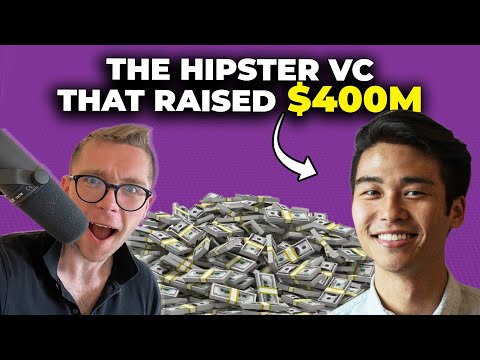
Chris Paik: How I Raised $400M; Substack's Broken Business Model; Music on TikTok vs IG | E1011
Chris Paik (guest), Harry Stebbings (host)
In this episode of The Twenty Minute VC, featuring Chris Paik and Harry Stebbings, Chris Paik: How I Raised $400M; Substack's Broken Business Model; Music on TikTok vs IG | E1011 explores chris Paik Dissects Venture Capital Incentives, Markets, and Moats Chris Paik, co‑founder of Pace Capital and former Thrive Capital investor, explains how his accidental entry into venture led to building a concentrated, early‑stage firm with an equal‑partnership model and no platform/portfolio‑services team. He emphasizes timing, markets, and structural business mechanics over founder mythology, arguing that many popular venture narratives around defensibility, market risk, and ‘doing good’ are misunderstood. Paik introduces core frameworks such as atomic value swaps, the seven deadly sins as motivators, and the distinction between product–market fit and business‑model–product fit, applying them to companies like Twitch, TikTok, Tesla, and Substack. The conversation closes with a critical look at LP–GP misalignment, the fee-and-carry model, and how regulation and incentive redesign might reshape the venture ecosystem.
Chris Paik Dissects Venture Capital Incentives, Markets, and Moats
Chris Paik, co‑founder of Pace Capital and former Thrive Capital investor, explains how his accidental entry into venture led to building a concentrated, early‑stage firm with an equal‑partnership model and no platform/portfolio‑services team. He emphasizes timing, markets, and structural business mechanics over founder mythology, arguing that many popular venture narratives around defensibility, market risk, and ‘doing good’ are misunderstood. Paik introduces core frameworks such as atomic value swaps, the seven deadly sins as motivators, and the distinction between product–market fit and business‑model–product fit, applying them to companies like Twitch, TikTok, Tesla, and Substack. The conversation closes with a critical look at LP–GP misalignment, the fee-and-carry model, and how regulation and incentive redesign might reshape the venture ecosystem.
Key Takeaways
Market quality often matters more than founder quality in venture outcomes.
Paik argues that even world‑class founders cannot overcome a structurally bad or non‑existent market, likening startups to surfers who can ride waves but cannot create them; strong markets (the waves) are the dominant driver of outsized outcomes.
Get the full analysis with uListen AI
Venture capital should target businesses with genuine market risk, not pure execution risk.
He distinguishes between building into validated demand (e. ...
Get the full analysis with uListen AI
Defensibility is designed in the system from day one, not stumbled into accidentally.
Paik contends moats come from deliberate product and system design choices that scale (e. ...
Get the full analysis with uListen AI
The ‘atomic value swap’ is a powerful lens for analyzing any business model.
By breaking a product down into the precise value exchanged between company and counterparty (e. ...
Get the full analysis with uListen AI
The seven deadly sins map closely to the core motivators behind consumer behavior.
Paik reframes pride, envy, lust, gluttony, greed, sloth, and wrath as enduring motivators that explain why people use products; successful consumer products (like Twitch or TikTok) typically tap into multiple of these at once on both the creator and consumer sides.
Get the full analysis with uListen AI
New UGC platforms win by enfranchising creators who were structurally disadvantaged on prior platforms.
Using TikTok as an example, he shows how embedding music into the content format elevated dance creators—previously second‑class citizens on Instagram—illustrating that big new platforms often empower a previously constrained creator class rather than just poaching incumbents’ stars.
Get the full analysis with uListen AI
Venture’s fee-and-carry structure and LP–GP dynamics create deep incentive misalignments.
Paik criticizes carried interest being taxed as capital gains (rather than labor), fee stacking across multiple funds, lack of cross‑fund carry clawbacks, and SPV behavior, arguing these features over‑attract talent into venture, distort fund sizing, and misalign GPs with both LPs and founders.
Get the full analysis with uListen AI
Notable Quotes
“Great founders are incredible at putting themselves in position to surf waves, but I don’t think anybody can make waves themselves.”
— Chris Paik
“Any company that is pure execution risk without any market risk is not a suitable venture investment.”
— Chris Paik
“I don’t think anybody oopses their way into a moat.”
— Chris Paik
“You can’t pay someone else to go to your kid’s soccer games for you.”
— Chris Paik (on why Pace doesn’t build a portfolio‑services platform)
“Show me the incentives, I’ll show you the outcome.”
— Chris Paik (repeated in context of both firm design and industry structure)
Questions Answered in This Episode
How can founders practically assess whether their idea has true market risk versus being a pure execution play in an already validated category?
Chris Paik, co‑founder of Pace Capital and former Thrive Capital investor, explains how his accidental entry into venture led to building a concentrated, early‑stage firm with an equal‑partnership model and no platform/portfolio‑services team. ...
Get the full analysis with uListen AI
When evaluating an early‑stage company, what specific signals reveal that its ‘atomic value swap’ is mispriced or structurally unsustainable?
Get the full analysis with uListen AI
If many DTC and ‘virtuous’ businesses are mis‑fit for venture, what alternative capital models should ambitious founders be pursuing instead?
Get the full analysis with uListen AI
How might regulation of carried interest and fee structures realistically change who becomes a VC and how funds are sized and managed?
Get the full analysis with uListen AI
What concrete product or system design choices should founders make early if they want real defensibility 5–10 years down the line, rather than just brand or distribution advantages?
Get the full analysis with uListen AI
Transcript Preview
... you're surfing a wave. Half the battle is making sure you're in the water when the wave comes, right? That is really important because, like, if you see the wave coming, you're still on the beach, there's, there's no way that you're gonna get out there in time to be able to surf it. I think that goes into the importance of timing. The other thing is, no surfer really can make waves. You don't have the power to change the actual tide. And so, I think that great founders are incredible at putting themselves in the position to surf waves, but I don't think anybody can make waves themselves. You can just surf them.
Chris, I am so excited for this. I love the frameworks that you wrote. I heard so many great things from Josh, from Jared, from many others. So thank you so much for joining me today, Chris.
Thank you for having me. It's, uh, uh, it's a pleasure to be here.
Now, we're gonna have a great discussion today. I always love a little bit of background, a little bit of context setting. So how did you make your way into the world of venture first? And let's start there.
Yeah. Uh, I wish I could say it was, uh, in- intentional and not accidental, but (laughs) it was more accidental. Um, truth be told, I didn't even know that venture capital was a thing when I was, uh, growing up or in college. Um, I actually maybe thought it was... I, I probably as a kind of bleeding heart liberal college student lumped it in and maligned it with all the finance of like, oh, the like, this isn't that actually interesting. Um, it wasn't until I graduated, um... I graduated, I didn't have a job, I wasn't sure what I wanted to do. Um, I stumbled basically backwards into, like, the tech meetup scene in New York. I remember going to a meetup at Shake Shack back when there was just one Shake Shack, and it was like a couple dozen people, it's this meetup called Hackers and Founders. And I just became enamored by the idea of, uh, a tech ecosystem in, uh, in the non-, in that's not Silicon Valley. I, I grew up in Burlingame, uh, which is like halfway in between San Francisco and Palo Alto on the peninsula.
(laughs) Yeah, you've got-
So I grew up in kind of-
... Alana's there. It's one of my favorite brunch spots. (laughs)
(laughs) It's, it's an amazing, amazing place to grow up. I feel like the, the cops in Burlingame have pretty easy jobs. Um, for me-
Right.
... for better or for worse, I'm a hipster with all, like, the insufferable qualities associated with it. And the idea of a tech pla- like, a tech epicenter that wasn't too on the nose was really interesting. And I think in retrospect, in hindsight, I just got very lucky that rising tide lifts all boats, and, you know, New York and other cities, um, anywhere that wasn't Silicon Valley also benefited greatly from globalization, internet, and Zoom, and inter- you know, digital communication. Um, but to answer your question succinctly, um, I knew Josh Kushner from college. Um, we were classmates. He was a year above me. And, uh, uh, ver- you know, as I was getting my feet wet in the trying to figure out what was up from down in tech, I was reaching out to all my friends who were in, in tech, tech adjacent, and they're like, "Hey, have you caught up with Josh recently? He's, um, he's like starting a venture capital firm and angel investing." "No." So he and I caught up and I obviously had lo- very low switching cost at the time not doing anything. And I asked him if he wanted help. And, and very graciously started working together. And that was my introduction to venture. I... Thrive Capital at the time, it was a $10 million fund. Um, I'd like to think that I got a startup experience, but it just happened to be a venture capital firm, um, because we really went from zero to, you know, you name it, uh, in a ve- very rich, very short period of time.
Install uListen to search the full transcript and get AI-powered insights
Get Full TranscriptGet more from every podcast
AI summaries, searchable transcripts, and fact-checking. Free forever.
Add to Chrome