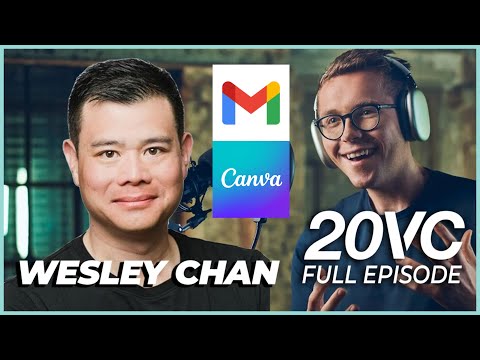
Wesley Chan: How I Created Google Analytics; The Founding Story of Gmail & Canva | 20VC #919
Harry Stebbings (host), Wesley Chan (guest), Narrator
In this episode of The Twenty Minute VC, featuring Harry Stebbings and Wesley Chan, Wesley Chan: How I Created Google Analytics; The Founding Story of Gmail & Canva | 20VC #919 explores wesley Chan on backing two‑gigabyte founders and timeless companies Wesley Chan recounts his journey from building iconic Google products like Analytics, Voice, and early Android to founding FPV Ventures, a small, fast-moving fund focused on “Navy SEAL–size” teams. He shares formative product lessons from Larry and Sergey—especially the insistence on world-changing ambition and Gmail’s famous jump from 200MB to 2GB—as the basis for his investing lens. Chan emphasizes backing founders with 100‑year product visions in markets that are created or massively expanded, rather than optimizing for rigid ownership targets or conventional market-sizing slides. He also discusses navigating today’s tougher funding environment, his aversion to faddish areas like crypto, and his belief that his edge lies in spotting true product visionaries and being a founder’s first phone call.
Wesley Chan on backing two‑gigabyte founders and timeless companies
Wesley Chan recounts his journey from building iconic Google products like Analytics, Voice, and early Android to founding FPV Ventures, a small, fast-moving fund focused on “Navy SEAL–size” teams. He shares formative product lessons from Larry and Sergey—especially the insistence on world-changing ambition and Gmail’s famous jump from 200MB to 2GB—as the basis for his investing lens. Chan emphasizes backing founders with 100‑year product visions in markets that are created or massively expanded, rather than optimizing for rigid ownership targets or conventional market-sizing slides. He also discusses navigating today’s tougher funding environment, his aversion to faddish areas like crypto, and his belief that his edge lies in spotting true product visionaries and being a founder’s first phone call.
Key Takeaways
Aim for ‘two‑gigabyte moments,’ not incremental features.
Chan looks for founders offering an order‑of‑magnitude leap—like Gmail’s jump from 200MB to 2GB or Canva’s radically simpler design UX—rather than small improvements that feel like features, not products.
Get the full analysis with uListen AI
Ask if the idea is truly big enough to change the world.
A core lesson from Larry and Sergey is to reject projects that aren’t ‘big enough for the world’; Chan now asks founders if their mission is genuinely worthy of a decades‑long effort and can plausibly be a fund-returning company.
Get the full analysis with uListen AI
Focus on 100‑year visions, but stay flexible on early wedges.
The best founders, in his view, have a clear long‑term picture of the world and their role in it, even if they start with a narrow wedge; he backs those who can articulate how today’s product evolves over many decades.
Get the full analysis with uListen AI
Treat market reports skeptically; understand whether a new market is being created.
He largely ignores TAM slides and Gartner/McKinsey estimates, preferring to see whether a founder has a non-obvious insight about expanding or inventing a market that existing reports don’t capture.
Get the full analysis with uListen AI
Avoid dogma on ownership, geography, and board seats.
Chan’s Canva investment broke nearly every traditional VC rule (no board seat, less than 20% ownership, remote geography, romantically involved founders); he optimizes for getting into exceptional companies over rigid checklists.
Get the full analysis with uListen AI
In choppy markets, don’t rush to fundraise if you don’t have to.
He advises founders with runway to avoid being lumped in with desperate companies; instead, quietly extend runway with insiders or trusted investors until pricing stabilizes and capital flows normalize.
Get the full analysis with uListen AI
Your edge comes from mastery: pair mechanics with unique judgment.
Anyone can learn term sheets and portfolio math; Chan believes durable advantage comes from a practiced, almost artistic ability to identify product visionaries and judge how a company can morph over time, much like interpreting a complex piano piece.
Get the full analysis with uListen AI
Notable Quotes
“I ask founders, ‘What’s your two‑gigabyte moment?’”
— Wesley Chan
“The market always wins, but the truly visionary founders know how to create it.”
— Wesley Chan
“Are you building a feature or are you building a product? If it’s a feature, it’s not worth our time.”
— Wesley Chan (recalling advice from Bill Campbell and his own filter)
“I want the founder who can tell me what this company looks like in 100 years.”
— Wesley Chan
“It’s the best time to have a fund. It’s not the best time to be investing.”
— Wesley Chan
Questions Answered in This Episode
How can a founder practically discover and define their own ‘two‑gigabyte moment’ when their current product feels incremental?
Wesley Chan recounts his journey from building iconic Google products like Analytics, Voice, and early Android to founding FPV Ventures, a small, fast-moving fund focused on “Navy SEAL–size” teams. ...
Get the full analysis with uListen AI
What concrete signals does Wesley use to distinguish a true product visionary from a polished storyteller during early meetings?
Get the full analysis with uListen AI
How should founders balance having a 100‑year vision with the need to pivot when early customer feedback contradicts their thesis?
Get the full analysis with uListen AI
In today’s funding climate, what are the most effective strategies for quietly extending runway without triggering negative signaling?
Get the full analysis with uListen AI
Looking back, how might Wesley design a process to reduce ‘expert bias’ so he doesn’t miss the next Twilio in domains he knows well?
Get the full analysis with uListen AI
Transcript Preview
Three, two, one, zero. You have now arrived at your destination. Wes, I cannot believe it's been four or five years since we last made this happen. So much has changed, but thank you so much for joining me once again.
Oh, it's a pleasure to be here. It's always fun to do this with you.
Oh, it's so much fun. Uh, I enjoyed our dinner in London so much. But I wanna start with a little bit on you. So tell me, how did you make your way into the world of venture first, and then how did you come to found FPV most recently?
Yeah, I mean, i- it's always an accident, right? Everything in life is a, is a pleasant accident and, uh, you know, I found my way into venture when I was, uh, after t- you know, almost more than 10 years at Google. I had built some of Google's most interesting and, and, and, uh, and, and well-known products. You know, I started Google Analytics, uh, helped build the ad system, uh, helped build Google Voice, and helped bring in a lot of the, uh, the tech into Android. Uh, and after 10 years, uh, Google had ballooned to some large number of people, right? I think there were hundreds of people when I went there, and when I left, there were somewhere around 50,000, uh, or when I was thinking about leaving. Um, and in, uh, 2009, I basically went to Larry and Sergey, uh, and said, "I love you guys, but, uh, you know, I've been 10 years here and, uh, I, I miss the old days of being part of a very, very small team." You know, my best work on Google Analytics or on Google Voice was done when the team was less than 20 people, right? You could feed it one or two pizzas. Um, and it was like a Navy SEAL mission. Everybody believed in, in accomplishing the impossible, uh, and we, we, we, w- we, uh, we built something that the, the world needed and the world appreciated and, you know, every time I go and give a talk at a conference, everybody raises their hand when I say, "Have you ever used or are you using Google Analytics?" Uh, it's incredible. So, uh, on, uh, when I told Larry I was gonna leave and, uh, do a startup, uh, it was my dream, was to go be a CEO and, uh, build a startup and then found something to build, you know, great products. Larry just looked at me and said, like, "Wesley, look, um, I had to buy toilet paper when I started Google. I had to go and, like, you know, shop for, shop for p- paper towels and cleaning supplies and everything else, and, like, buy health insurance." And, uh, he looked at me and said, "You know, that might not be your calling, so why don't you go and think about doing investing? You were great at buying, uh, some of the, Google's most interesting acquisitions, uh, with, uh, with, uh, Urchin for Google Analytics, with, uh, Grand Central for Google Voice." Uh, helped with, uh, Android and YouTube, and he said, uh, "You know, if you're good at picking companies t- for us to buy and, you know, m- uh, and they turned in some of Google's most, um, iconic, uh, products and services, uh, you might wanna try your hand at investing, and we're starting Google Ventures. Corporate venture capital has been an utter distaste in the success and founders hate it because, you know, the, the, the, the interest of the company that's investing and the interests of the founders diverge, and I want you to go build a venture fund that I would take money from." And, uh, you know, I helped, uh, s- help build and start Google Ventures with David Crane, with, uh, with Bill Marrs, with Rich Miner, and that original group of, uh, of four or five GPs, and built Google Ventures, uh, and spent five years there learning the craft of investing from some of the world's best venture capitalists. You know, some of them were on Google's board, Mike Moritz and John Doerr, Bill Campbell, Brook Byers. These guys were legends in the business, um, and, uh, it was just wonderful to be able to spend five years building it. And then Google Ventures got way too big and, uh, so I left and joined, uh, my, uh, really good friend and partner, Aydin Cenk at Felicis Ventures, who, you know, built one of the most amazing seed funds, helped him build that. And then, uh, you know, as, as, as, as, as Aydin built up Felicis, it, you know, got to a size where I said, "I l- you know, I love you guys, but it's time for me to go back to my roots of being on a Navy SEAL sized team where I can go and make decisions quickly and work with amazing founders in a way that's authentic and legit to me." And that's, uh, w- sort of how we wound up, uh, starting FPV Ventures. It's Pegan, myself, and a couple o- folks. We're five people. We move really fast. Uh, you know, we decide on things in less than 12 hours sometimes. Sometimes we meet a founder and we say, "You're amazing. You check all the boxes. We wanna back you. Your mission's s- nothing short of incredible," give 'em a term sheet on the same day and, and, you know, m- uh, sign it that night. Uh, we're that type of nimble fund, and like I said, uh, I, I work best on Navy SEAL mission-driven sized teams where I can feed 'em with one or two pizzas, and, uh, when you have that, you can just accomplish very impossible things.
Install uListen to search the full transcript and get AI-powered insights
Get Full TranscriptGet more from every podcast
AI summaries, searchable transcripts, and fact-checking. Free forever.
Add to Chrome