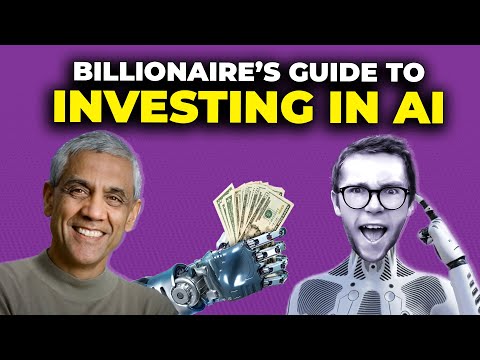
Vinod Khosla: How AI Impacts Healthcare, Energy, Geo-Politics, Media and Climate Change | E1045
Vinod Khosla (guest), Harry Stebbings (host)
In this episode of The Twenty Minute VC, featuring Vinod Khosla and Harry Stebbings, Vinod Khosla: How AI Impacts Healthcare, Energy, Geo-Politics, Media and Climate Change | E1045 explores vinod Khosla on AI’s Disruption of Jobs, Health, Energy, Geopolitics Vinod Khosla argues that AI is at an inflection point similar to the early internet, mixing real technological breakthroughs with inevitable hype and bubble dynamics. He believes AI will massively boost productivity, GDP, and abundance while simultaneously worsening inequality unless societies proactively redistribute gains through mechanisms like universal basic income. Khosla highlights healthcare, climate/energy, transportation, and media as domains where AI and other deep tech (e.g., fusion, geothermal) can be transformative if solutions are truly economic at global scale. He also explores how these shifts will reshape geopolitics, the future of work, creative industries like music, and the rise of countries such as India as crucial tech talent hubs.
Vinod Khosla on AI’s Disruption of Jobs, Health, Energy, Geopolitics
Vinod Khosla argues that AI is at an inflection point similar to the early internet, mixing real technological breakthroughs with inevitable hype and bubble dynamics. He believes AI will massively boost productivity, GDP, and abundance while simultaneously worsening inequality unless societies proactively redistribute gains through mechanisms like universal basic income. Khosla highlights healthcare, climate/energy, transportation, and media as domains where AI and other deep tech (e.g., fusion, geothermal) can be transformative if solutions are truly economic at global scale. He also explores how these shifts will reshape geopolitics, the future of work, creative industries like music, and the rise of countries such as India as crucial tech talent hubs.
Key Takeaways
Plan now to cushion AI-driven job displacement with shared prosperity mechanisms.
Khosla expects large-scale job disruption over 20–25 years; he advocates reserving a portion of incremental GDP growth into social funds or universal basic income rather than constraining AI progress itself.
Get the full analysis with uListen AI
Use AI to augment, not replace, professionals—especially in healthcare.
He envisions AI handling the bulk of cognitive load (e. ...
Get the full analysis with uListen AI
Focus climate efforts on breakthrough, economically competitive technologies at scale.
Incremental, permanently subsidized solutions won’t work globally; fusion, deep geothermal, low-carbon cement, fertilizers, and steel must beat fossil alternatives on cost (the “Chindia price”) to be broadly adopted.
Get the full analysis with uListen AI
Anticipate fusion and new energy sources massively reshaping industries and geopolitics.
High-temperature superconductors enable much smaller, cheaper fusion reactors; retrofitting existing coal plants with fusion “boilers” could rapidly transform power infrastructure and reduce conflicts over strategic resources like oil.
Get the full analysis with uListen AI
Expect AI to democratize and personalize creativity in music and media.
Tools like Splash. ...
Get the full analysis with uListen AI
Recognize that innovation rarely comes from large institutions; back bold, early bets.
From OpenAI to Commonwealth Fusion, Khosla emphasizes investing ahead of obvious market timing, focusing on exponential trajectories and instigators who catalyze new fields rather than waiting for certainty.
Get the full analysis with uListen AI
Reimagine infrastructure—especially transport and cities—around new technical possibilities.
He argues self-driving should be applied to public transit (e. ...
Get the full analysis with uListen AI
Notable Quotes
“Technology is very fun to talk about disruption. It's not a lot of fun to be disrupted.”
— Vinod Khosla
“The future is not predictable, but it is discoverable.”
— Vinod Khosla
“Happiness in our society will be a function of equality, not just GDP growth.”
— Vinod Khosla
“You don't want a computer telling you you have cancer. You want a caring human being.”
— Vinod Khosla
“I'd rather try and fail than fail to try, which is what most people have done.”
— Vinod Khosla
Questions Answered in This Episode
How should policymakers practically design and fund a social fund or universal basic income that scales with AI-driven GDP growth without stalling innovation?
Vinod Khosla argues that AI is at an inflection point similar to the early internet, mixing real technological breakthroughs with inevitable hype and bubble dynamics. ...
Get the full analysis with uListen AI
What concrete steps can medical schools and health systems take in the next five years to redesign the doctor’s role around AI augmentation and empathy-first selection?
Get the full analysis with uListen AI
Which fusion or geothermal deployment models are most realistic for retrofitting existing fossil infrastructure at scale, and what regulatory changes would be required?
Get the full analysis with uListen AI
How can creators, labels, and platforms fairly balance IP protection with the benefits of fully AI-generated, IP-clean content in music and media?
Get the full analysis with uListen AI
What policies could the U.S. and Europe adopt to harness India’s and other countries’ tech talent without triggering political backlash against immigration and globalized work?
Get the full analysis with uListen AI
Transcript Preview
Technology is very fun to talk about disruption. It's not a lot of fun to be disrupted. I do think we'll have to pay special attention to the people being disrupted, and their needs and desires and wants. (instrumental music plays)
Vinod, I am so excited for this. I've been absolutely loving your Twitter content recently. And so first off, thank you so much for joining me again today.
Happy to do it. Always like talking to entrepreneurs.
That is so kind of you. But I want to start today on the, kind of, topic of the day, which is obviously AI, artificial intelligence. And Khosla and you have been one of the biggest proponents and, uh, conversationalists of the space in the last 10 years, really, a- as one of the first investors in OpenAI. And I just wanted to start with the question of, do you believe the recent hype in AI is due to technological breakthroughs and innovation, or is it the result of hype cycles keeping up with innovation from years ago?
A little bit of both. Uh, let me give you a perspective, um, going back a long time. In 1982 at Sun, we adapted TCPIP and the internet as our native network. We were the only ones. Uh, by 1996, it was clear that exponential growth was going to continue, and we invested in Juniper, which, by the way, was a 2,500X return, a $7 billion return for us on a $3 or $4 million investment. Uh, when the internet really took off, and, uh, I remember investing, uh, meeting Marc Andreessen to invest in Netscape, the browser company, on a Saturday morning, uh, in Mountain View, um, when it was three people. It really took off, but the exponential was clear much earlier. The reason I bring this up is I wrote my first blog on, uh, AI, do we need doctors and do we need teachers? Uh, a little tongue-in-cheek, but, uh, encapsulating the idea that expertise could be free in 2011, 2012. It was pretty controversial then, but it was a similar moment to when we had, uh, adopted the internet and TCPIP in the '80s at Sun. And then when ChatGPT came out, it became like the browser moment for the internet, and, uh, it's now obvious to people the extreme capability that we've developed here and will continue to develop and is progressing at a rate where even I can't keep up. But anytime there's a rich area for development, bubbles form, and I worry a little bit that that will happen here. There's obviously real technological progress, real expansion of the opportunity set for real building businesses, but also a lot of hype that follows, you know, a l- or sort of a rich area to mine. Sort of the gold rush phenomena. What I'm fundamentally optimistic about is when you look at bubbles... In the 1800s, 1830s, there was a bubble in England when you got the right to build a railroad between two towns, you could issue scripts almost immediately. But... And it did, the bubble did burst. But more railroad was built after the bubble burst than before. My point is, I think the progress of AI applications in utility for society will go on a steady pace based on technical capability and entrepreneurial interest in it, not what Wall Street or, uh, investors think about it. So, I think investors are important, because they fund these developments, but investors cause bubbles, uh, the reality is the underlying technology and its applications.
Install uListen to search the full transcript and get AI-powered insights
Get Full TranscriptGet more from every podcast
AI summaries, searchable transcripts, and fact-checking. Free forever.
Add to Chrome