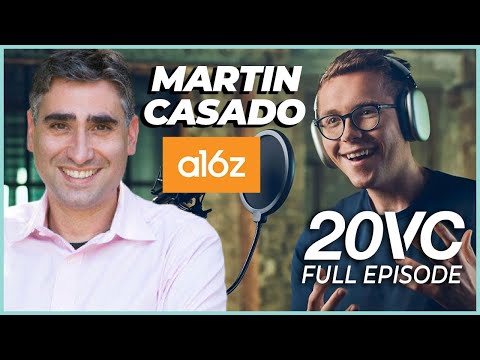
a16z GP Martin Casado: How I Went from Engineer to VC; Lessons from Chris Dixon | 20VC #956
Harry Stebbings (host), Martin Casado (guest), Narrator, Narrator
In this episode of The Twenty Minute VC, featuring Harry Stebbings and Martin Casado, a16z GP Martin Casado: How I Went from Engineer to VC; Lessons from Chris Dixon | 20VC #956 explores from Founder to VC: Martine Casado Redefines Scaled Venture Capital Martine Casado, GP at Andreessen Horowitz, traces his path from failed physicist to founder to billion‑dollar operator to infrastructure-focused VC, and explains how that operating history shapes his empathy and board style more than his picking ability.
From Founder to VC: Martine Casado Redefines Scaled Venture Capital
Martine Casado, GP at Andreessen Horowitz, traces his path from failed physicist to founder to billion‑dollar operator to infrastructure-focused VC, and explains how that operating history shapes his empathy and board style more than his picking ability.
He argues the traditional venture model is outdated for a now-mature, massive tech market, and pushes for a barbell world of highly specialized boutiques and fully scaled multi-stage platforms that can finance innovation from seed through public markets.
Casado details his investment approach: obsessively mapping infrastructure spaces, following where the smartest founders go, and choosing relative winners in a cohort rather than pretending to be an all-knowing oracle on any single company.
He also covers category creation, market timing, board dynamics, layoffs and re-plans in downturns, the role of junior investors, and why he believes tech-positive capital should increasingly displace traditional finance across the company lifecycle.
Key Takeaways
Operating experience helps empathy, but can hurt judgment if not contained.
Casado says prior CEOs on boards often overfit their own playbooks and backseat-drive; the value of operating is deep empathy and pattern recognition, but only if you’ve “gotten it out of your system” and resist treating a founder’s company like your own.
Get the full analysis with uListen AI
The venture model must evolve into a scaled, multi-product innovation finance platform.
He argues tech and private markets are now so large and mature that VC should resemble a sophisticated financial platform—offering specialized funds from seed to public and debt—so founders aren’t forced into late-stage capital that doesn’t care about innovation.
Get the full analysis with uListen AI
Great investing is about deep work in spaces, not hot-deal chasing.
Casado spends most of his time studying infrastructure categories, talking with founders, and building a detailed map of markets; when a round moves fast, they can decide quickly only because that work was already done, not via quick pattern-matching at deal time.
Get the full analysis with uListen AI
Follow where the smartest founders go; they are better signal than VCs or analysts.
Borrowing from Chris Dixon, he treats founder movement into new problem areas as the strongest early indicator that a space is interesting, then dives deep to understand which among several startups is best positioned.
Get the full analysis with uListen AI
Category creation requires intentional storytelling and “market annealing,” not ad hoc marketing.
Casado stresses that there’s almost no good literature on category creation; founders must lock themselves away to write a clear, compelling narrative of the future and use it to drive culture, recruiting, marketing, and early sales over many years of grinding the market.
Get the full analysis with uListen AI
In downturns, start with top-down re-plans and scenarios, not arbitrary cuts.
He advises building bull/median/bear operating plans based on realistic revenue impacts and capital access, then sizing the company to those plans; blanket directives like “cut 40%” without a plan are irresponsible and often counterproductive.
Get the full analysis with uListen AI
Junior partners can be uniquely valuable if they lean into market knowledge over advice-giving.
Younger investors often know more about competitive landscapes than founders because it’s their full-time job; Casado tells them to synthesize data, diligence, and market maps rather than dictating strategy or trying to relive their (often limited) operating experience.
Get the full analysis with uListen AI
Notable Quotes
“I think that we should be running Wall Street, not the finance people that don’t believe in any of these things.”
— Martine Casado
“I used to have the hubris to believe that if a company walked in, I could determine if it’s a good investment. I’ve decided that’s a totally underdetermined problem.”
— Martine Casado
“The only thing you can’t game in investing is the work.”
— Martine Casado
“Category creation is as important and as hard as the product development.”
— Martine Casado
“I want a future where if you pull a dollar of random finance, that dollar is given by somebody that believes innovation is good and believes in founding teams.”
— Martine Casado
Questions Answered in This Episode
How can a founder practically balance aggressive category-creation efforts with the need to cut burn and extend runway in a tighter funding environment?
Martine Casado, GP at Andreessen Horowitz, traces his path from failed physicist to founder to billion‑dollar operator to infrastructure-focused VC, and explains how that operating history shapes his empathy and board style more than his picking ability.
Get the full analysis with uListen AI
What concrete structures or products would a fully ‘grown-up’ venture platform need to offer to truly compete with private equity and banks across the full company lifecycle?
He argues the traditional venture model is outdated for a now-mature, massive tech market, and pushes for a barbell world of highly specialized boutiques and fully scaled multi-stage platforms that can finance innovation from seed through public markets.
Get the full analysis with uListen AI
How should early-stage founders evaluate whether a multi-stage firm on their cap table will genuinely support them across rounds versus introducing hidden conflicts or pressures?
Casado details his investment approach: obsessively mapping infrastructure spaces, following where the smartest founders go, and choosing relative winners in a cohort rather than pretending to be an all-knowing oracle on any single company.
Get the full analysis with uListen AI
If there’s almost no good literature on category creation, what specific exercises, rituals, or milestones should startup teams adopt to systematically ‘anneal’ a new market?
He also covers category creation, market timing, board dynamics, layoffs and re-plans in downturns, the role of junior investors, and why he believes tech-positive capital should increasingly displace traditional finance across the company lifecycle.
Get the full analysis with uListen AI
How can junior investors in smaller or emerging firms replicate Casado’s space-mapping and founder-driven approach without the scale advantages of a16z?
Get the full analysis with uListen AI
Transcript Preview
Martine, I've referenced the shit out of you, as we've just been talking about.
(laughs)
I'm so excited for this show. (laughs) So thank you so much for joining me today.
No, I'm just delighted, absolutely.
That is very kind of you. But I wanna start with a little bit of context. So, you know, you're at v- A- Andreessen today and I wanna start with, in your words, how did you make your way to be a GP at Andreessen today? Before we dive in.
Well, the quick story is, um, (clears throat) I'm a failed physicist. (laughs) So in undergrad, I did computational physics, worked at a national lab. Decided that computer systems are much more accessible, and so I moved into systems, ended up doing a PhD at Stanford. Started a company based on the research. Ben Horowitz joined my board. Uh, this is, by the way, this was in, you know, I started the company in 2007. So 2008 was the Great Recession, almost went out of business. Marc and Ben saved the company. We ended up selling that, um, about four years later to VMware. Uh, I ran that business for a while. And then, you know, I decided that I'm super in love with innovation. I love startups, I love infrastructure and systems. I spent 10 years doing the operating thing, built a billion-dollar business, and it was time to kind of move to a different abstraction level. And so I joined and I just focused on infrastructure at Andreessen Horowitz. So that is the crooked path I took. (laughs)
Oh my God. I, I, w- w- ... You know what I love? That, that, there is this weird correlation between the more successful someone is, the shorter their intro is.
(laughs)
And the least successful they are, the longer it is.
(laughs)
And that was so succinct. Um, I, I want to ask you-
Okay.
... you mentioned the incredible operating career there. How do you think that operating career impacted your investor mindset, say, positively, first?
So I've just, I've had multiple boards. I've done two companies and I've had multiple board. And, and, and in my experience, you kinda have three types of board members. I think the, the mean board member, the median, the, the, the average board member, you know, they, they're investors. They've seen a lot of stuff. They'll roll up their sleeves, they'll help, you know, recruit or whatever. Um, but otherwise, they're just not close enough to product market fit to add much value, you know? And so, like, they'll say the things, they're polite, they're nice people. You know, they're, they're kinda net neutral, right? I think this is the-
Mm-hmm.
... the average board member. I think, unfortunately, the next most common board member is the frustrated operator. And so they've kind of ... think they're an operator, you know, maybe were an exec in a large company, you know, maybe had a small exit or whatever, and they, they really want to kinda backseat drive the company. Um, and I've definitely dealt very directly with those. And they can be incredibly disruptive, just because they don't realize that it's, you know, (laughs) it's not their company. Uh, and then, you know, periodically, you get like a pretty phenomenal board member. Like for me, that was Ben Horowitz, which, you know, listen, had a huge exit, spent 11 years, you know, re- really kind of learning a craft, but also kinda getting it out of the system. Um, and so I- I'll say, uh, I'll say a couple of things. For, on the investment side, I don't know if operating helps or not. Like, I don't know if it helps you pick. I don't know if it helps you close. (laughs) I don't know. Like, I don't know how to answer that. Probably not, it probably hurts more than helps. Um, but on the operating side, if you can realize it's not your own company, you end up having seen a lot of stuff and having a, a deep level of empathy that unless like basically, you know, you had to pay payroll out of your bank account, which I had to do, unless you almost, you know, shut down the company multiple times, which I had to do, unless you had to go begging for money about 50 times, like I had to do, (laughs) unless you, like, you know, almost sold the company then didn't sell the company and almost get fired by your board, like I had to do, um, you know, it's hard to have that kind of level of, of empathy, and also just understanding. And so I think for that, you know, it's useful. But I just wanna caveat it, like y- you know, hopefully you did your run and it's out of your system. Otherwise, you can be disruptive.
Install uListen to search the full transcript and get AI-powered insights
Get Full TranscriptGet more from every podcast
AI summaries, searchable transcripts, and fact-checking. Free forever.
Add to Chrome