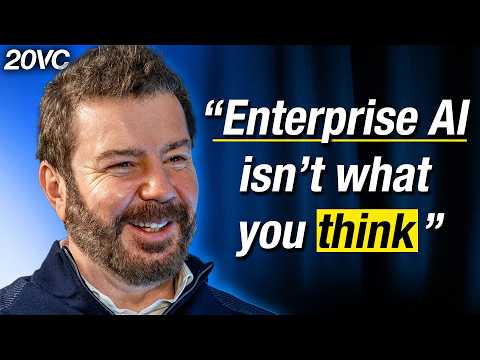
Daniel Dines, UiPath CEO & Founder: Why Agents Do Not Mean RPA is F*** | E1240
Daniel Dines (guest), Harry Stebbings (host), Narrator
In this episode of The Twenty Minute VC, featuring Daniel Dines and Harry Stebbings, Daniel Dines, UiPath CEO & Founder: Why Agents Do Not Mean RPA is F*** | E1240 explores uiPath’s Daniel Dines On Agents, RPA, And The Second Act UiPath founder and CEO Daniel Dines explains why large language model (LLM)–based agents will not replace rule-based RPA, but instead sit alongside it within a unified, rule-based orchestration layer. He argues that in today’s AI cycle, product experience, reliability, and orchestration matter more than pure model innovation, and describes UiPath’s shift to an AI‑first, agentic architecture built from the ground up. Dines outlines why enterprises want deterministic workflows, human-in-the-loop validation, and ‘Switzerland‑like’ orchestration across many specialized models and platforms, rather than monolithic, fully autonomous agents. The conversation also touches on his philosophy of leadership, the loneliness and stress of being a founder-CEO, and a personal evolution toward wanting less and focusing on meaning over material outcomes.
UiPath’s Daniel Dines On Agents, RPA, And The Second Act
UiPath founder and CEO Daniel Dines explains why large language model (LLM)–based agents will not replace rule-based RPA, but instead sit alongside it within a unified, rule-based orchestration layer. He argues that in today’s AI cycle, product experience, reliability, and orchestration matter more than pure model innovation, and describes UiPath’s shift to an AI‑first, agentic architecture built from the ground up. Dines outlines why enterprises want deterministic workflows, human-in-the-loop validation, and ‘Switzerland‑like’ orchestration across many specialized models and platforms, rather than monolithic, fully autonomous agents. The conversation also touches on his philosophy of leadership, the loneliness and stress of being a founder-CEO, and a personal evolution toward wanting less and focusing on meaning over material outcomes.
Key Takeaways
In this phase of AI, product experience and orchestration matter more than raw model innovation.
Dines believes LLMs are ‘mature enough’ for many use cases; the differentiator now is packaging them into reliable, easy-to-use products with great UX, observability, and the ability to swap in better models over time.
Get the full analysis with uListen AI
RPA and LLM agents solve different problems and must coexist within the same business process context.
RPA excels at long, rule-based, deterministic workflows across multiple systems, while LLM agents handle unstructured, non-rule-based, ‘tribal knowledge’ segments; both need to be orchestrated together inside end-to-end processes.
Get the full analysis with uListen AI
Enterprises will favor semi-autonomous, human-in-the-loop agents for a long time.
Because LLMs are ‘idiot savants’—brilliant in some tasks and unreliable in others—customers prefer systems that fail predictably over ones that are too smart but erratically wrong, so agents will mostly recommend while humans approve.
Get the full analysis with uListen AI
The winning platforms will act as neutral ‘Switzerland’ orchestrators across multiple models and systems.
Dines expects a world of many specialized models and platform-specific agents, with customers unwilling to centralize sensitive data (e. ...
Get the full analysis with uListen AI
Building robust agents is less about the agent itself and more about reliability, scale, and governance.
The hard part is not creating a single cool agent but managing thousands: deployment, monitoring, retries, exception handling, access control, analytics, and connecting agents to robots, APIs, and humans in production.
Get the full analysis with uListen AI
Enterprise adoption of agentic AI will be slower than hype suggests due to organizational inertia and complexity.
RPA itself is still far from fully penetrated; Dines estimates 5–10+ years for broad deployment of agentic + automation with today’s LLMs, given the need for programs, change management, and end‑to‑end process redesign.
Get the full analysis with uListen AI
For UiPath, the existential challenge is executing a true ‘second act’ as an AI‑first company.
Dines is reorganizing UiPath around agentic AI, replacing legacy components like their workflow engine, repurposing engineers, and trying to re‑energize employees after a volatile public-market journey.
Get the full analysis with uListen AI
Notable Quotes
“Agents will not be good at doing rule-based tasks. They are not, for sure.”
— Daniel Dines
“Our customers prefer our workflows to fail than to be too smart.”
— Daniel Dines
“It’s not enough to have a technology that automates a single task. You have to be capable of automating thousands of tasks and managing them.”
— Daniel Dines
“I believe in some certain lack of discipline. It’s very important in order to stimulate creativity.”
— Daniel Dines
“There is not a single thing that I possess that is worth spending cycles wanting it.”
— Daniel Dines
Questions Answered in This Episode
How should an enterprise practically map its end-to-end processes to decide which segments are best handled by RPA, which by agents, and where humans must remain in the loop?
UiPath founder and CEO Daniel Dines explains why large language model (LLM)–based agents will not replace rule-based RPA, but instead sit alongside it within a unified, rule-based orchestration layer. ...
Get the full analysis with uListen AI
What technical and organizational capabilities are actually required to operate a large fleet of agents safely in production, beyond just plugging into an LLM API?
Get the full analysis with uListen AI
If LLMs remain inherently stochastic, what new architectures—or entirely new forms of AI—does Dines believe are needed to achieve the ‘predictable 120 IQ’ enterprise AGI he describes?
Get the full analysis with uListen AI
How might the role and skill set of a ‘developer’ evolve as prompt engineering, evaluation, and orchestration become as important as traditional coding?
Get the full analysis with uListen AI
What are the concrete indicators, inside UiPath and in the market, that would convince Dines that the company has successfully achieved its ‘second act’ in agentic AI?
Get the full analysis with uListen AI
Transcript Preview
This is a story that, uh, I never told anyone. (screen whooshes) I've wasted my, uh, late 20s, big part of my 30s and 40s thinking in this way. It's a totally waste of cycles (laughs) and energy, man. (screen whooshes) I am a lonely wolf. I find life pretty lonely, man. That's not only about this job, but I live mostly in my head, thinking, analyzing, reflecting. This is how I spend my life.
Ready to go? (upbeat music) Daniel, dude, I am so excited for this. Thank you so much for joining me in the studio again.
Well, I invited you basically (laughs) for this podcast.
(laughs) Now, uh-
So thank you for having me.
Dude, honestly, our first show did so well. I got so many emails from young entrepreneurs so inspired by your journey. And so I thought I would capitalize on the success of the first show. And I wanted to start with something that you said to me before, which is, at this stage of kind of the AI cycle, product matters more than innovation. Can you unpack that for me?
Yeah. Actually, I was thinking a lot lately, what's, you know, our story in, you know, in within the AI narrative we've... where we can really bring a lot of value. So over the last two years, we, um, we've spent a lot of time really trying to fine-tune LLMs, build around them, and to a certain degree of success. But I've got really inspired by stories like Cursor.ai, and my development team loves that product. It's a beautiful product built on the top of multiple LLMs, but it just, it just works. And I, uh, I recall actually how we started UiPath. There, maybe there is a... This is a story that, uh, I never told anyone. And, uh, so in the beginning, we, uh... So we were always based on AI in a way, but we were using a library called OpenCV, which among many other things provided a really cool feature to find a, a smaller image within a bigger image. So, and we repurposed that library for the sake of automation. So we can take a screenshot of an application, and if you want to click on a button, we can take an image of that button and then, uh, find it, you know, during, uh, during replay, just call, you know, a function, find this image of the button, I will get the coordinates, and I will click on the button. But that was not the only thing that we did. We created, I think, a magical experience. So we let someone to basically record the flow on the screen, just show I need to click this button, indicate on the screen the button, and then we'll generate, like, a very simple statement, like click that button with the image. Everything was stored. So you could have recorded an entire flow based only on, you know, working with images, even typing in a, typing in an edit box. So we will capture the edit box image and then, like, a label, and we can, we will find them during run time. But from the perspective of the user, it was really simple. So I remember it was, like, 2013 when I showed, I demoed this product to some guys that were really Blue Prism experts. And in order to do the same thing in Blue Prism, it would have taken, like, two days, and, uh, the outcome would be not as reliable as in our case. I did in front of them this flow, like, in three, five minutes, press run, and it worked. And I asked them, "What do you think, guys?" Total silence. They couldn't believe their eyes. And this is how actually we found our first niche to fight what was a giant for us, like Blue Prism at that point, and it was that niche where people would have to automate processes without having access to the applications other than by remote desktop via, like, Citrix, kind of. And this image-based recognition was the only way to, to do it properly. And that was our first niche where people would deploy and would prefer us versus Blue Prism. And from that one, we have basically expanded, you know, into what we are today.
Install uListen to search the full transcript and get AI-powered insights
Get Full TranscriptGet more from every podcast
AI summaries, searchable transcripts, and fact-checking. Free forever.
Add to Chrome