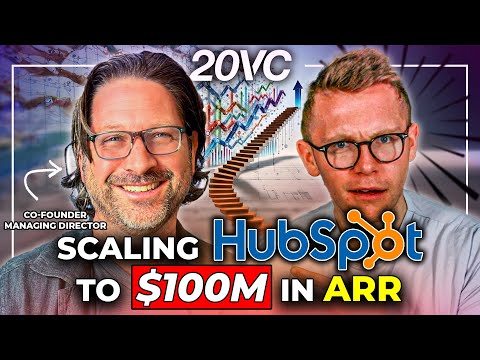
Mark Roberge: The Framework for How Startups Should Scale into the Enterprise -Stage 2 Capital|E1176
Mark Roberge (guest), Harry Stebbings (host)
In this episode of The Twenty Minute VC, featuring Mark Roberge and Harry Stebbings, Mark Roberge: The Framework for How Startups Should Scale into the Enterprise -Stage 2 Capital|E1176 explores mark Roberge Reveals How Startups Should Really Scale Enterprise Sales Mark Roberge, early HubSpot sales leader and Stage 2 Capital co-founder, discusses how founders should transition from founder-led selling to a scalable sales organization.
Mark Roberge Reveals How Startups Should Really Scale Enterprise Sales
Mark Roberge, early HubSpot sales leader and Stage 2 Capital co-founder, discusses how founders should transition from founder-led selling to a scalable sales organization.
He explains why hiring based solely on industry experience fails, and argues deal size expertise and core sales skills matter more than domain familiarity.
Roberge outlines how to design first sales hires, comp plans, and ICPs, and warns against premature enterprise moves, misguided PLG/enterprise comp, and overreliance on big-channel partnerships.
He also shares practical benchmarks on CAC payback, retention metrics, and when (and how) to move from SMB and PLG motions into larger, more complex deals.
Key Takeaways
Prioritize deal-size experience over domain experience when hiring early sales
A rep who has closed deals at your target ACV (e. ...
Get the full analysis with uListen AI
Use role plays and coachability to evaluate sales hires, not resumes
Roberge advocates interactive role plays with discovery-focused conversations, then giving feedback and seeing if the candidate self-assesses accurately and improves—coachability is a strong predictor of long-term success.
Get the full analysis with uListen AI
Avoid traditional commission plans before product–market fit
In the PMF search phase, compensate salespeople mostly with salary and equity, not commission, to attract people who enjoy discovery and iteration rather than those who are stressed about near-term quota.
Get the full analysis with uListen AI
Align sales compensation with strategic objectives and customer health
Instead of paying all commission on closed ACV, tie a portion to an early ‘leading indicator of retention’ (e. ...
Get the full analysis with uListen AI
Design PLG and land-and-expand comp to favor expansion, not upfront ACV
Pay lower rates on initial deal size and higher rates on expansion revenue; otherwise, reps will push oversized initial contracts that conflict with PLG’s ‘start small, grow later’ model and hurt retention.
Get the full analysis with uListen AI
Use unit economics, not just ACV, to decide if sales teams make sense
CAC payback under ~12–15 months is attractive at Series A and IPO, but founders must include all sales and marketing costs in CAC; ACV thresholds are meaningless without understanding conversion and cost dynamics.
Get the full analysis with uListen AI
Delay enterprise focus until you have scale and real pull, then be selective
Going upmarket too early can distort roadmap, drain capital, and distract teams; even when large customers show interest at low revenue levels, it may be better to say no until the company is structurally ready.
Get the full analysis with uListen AI
Notable Quotes
“The skill necessary to get a million dollar deal done... my million dollar seller that sells to healthcare has all those skills. My person that sells to banks, but they sell $10,000 deals has none of those skills.”
— Mark Roberge
“What most people do, which is a big mistake, is they hire a salesperson or leader and... that person uses the sales comp model from their last company. That’s really broken.”
— Mark Roberge
“I don’t like commission-plan salespeople in the journey to product market fit. I just want pure equity people.”
— Mark Roberge
“At some point you need to get above 100% net revenue retention, because if you’re not... in order to grow you have to outsell that gap with new customers.”
— Mark Roberge
“It’s a little bit of a trap for most entrepreneurs to wanna go to the enterprise too early.”
— Mark Roberge
Questions Answered in This Episode
How should a first-time founder practically structure a hiring process to test for coachability and complex-deal skills in sales candidates?
Mark Roberge, early HubSpot sales leader and Stage 2 Capital co-founder, discusses how founders should transition from founder-led selling to a scalable sales organization.
Get the full analysis with uListen AI
What are some concrete examples of effective ‘leading indicators of retention’ that early-stage startups can tie to commission?
He explains why hiring based solely on industry experience fails, and argues deal size expertise and core sales skills matter more than domain familiarity.
Get the full analysis with uListen AI
How can a startup systematically refine its ICP using the green–yellow–red framework as it scales from SMB to mid-market?
Roberge outlines how to design first sales hires, comp plans, and ICPs, and warns against premature enterprise moves, misguided PLG/enterprise comp, and overreliance on big-channel partnerships.
Get the full analysis with uListen AI
What internal signals should a company watch to know it’s finally ready to pursue true enterprise deals without losing focus?
He also shares practical benchmarks on CAC payback, retention metrics, and when (and how) to move from SMB and PLG motions into larger, more complex deals.
Get the full analysis with uListen AI
Under what conditions, if any, can early-stage startups make channel partnerships with large platforms (e.g., Workday, SAP) actually work?
Get the full analysis with uListen AI
Transcript Preview
I was consulting to HubSpot when it was, like, one or two people and eventually joined the company as the fourth employee. The skill necessary to get a million dollar deal done, there's so much in there in terms of, like, how do I identify and build a good champion? How do I understand the political dynamics? How do I differentiate between an economic buyer, a technical buyer, an end user, a coach, and a champion? How do I, like, deal with procurement? How do I deal with legal? My million dollar seller that sells to healthcare has all those skills.
Ready to go? (instrumental music plays) Mark, I am so excited for this. I just mentioned, I've loved your content for a while now, so this is really exciting. Thank you so much for joining me today.
Oh, yeah, sure, Harry. I'm honored. Thank you for saying that.
Now, I would love to start, how did you first make your way into the world of sales, and when did you know that, like, sales was really one of your loves?
It was a- a lot, like a lot of the wins in my career, it was completely serendipitous, uh, almost accidental. (laughs) Um, you know, I was, uh, at 23, I discovered that I wanted to be an entrepreneur. And even to this day, I kinda consider myself more of an entrepreneur than a sales leader. Even though I was a founder CEO coming out of school, I knew I wanted a functional alignment and I was torn between marketing and sales. I was like, I really, like, there's not a lot of MBAs that go into sales, so that's weird, but I really love the art of the deal and I know generally speaking in tech, salespeople make more than marketers and I had a young family and, like, I was the financial, you know, f- you know, re- responsible for that, so, like, that was important and an ingredient. But I felt like the MBA provided you more for marketing. Marketing was going more in a data-driven direction. I was consulting to HubSpot when it was, like, one or two people and eventually joined the company as the fourth employee, and that's where it serendipitously kicked in 'cause Halligan was the co-founder and he is a sales guy, you know? And he was like, "If we're gonna use you one day a week to consult, then I want you to sell." And so that's how I got into sales. Like, I didn't, I was like, "All right, cool. Like, Dharmesh hired me for one day a week, you're now the CEO, if you want me to sell, I'll sell. If you want me to write code, I'll write code." Like, 'cause (laughs) it- it is what it is. So that's how I got into it and it would actually, worked out beautifully because I was not only in sales, but I was selling cutting edge marketing software. So I- I got to learn all about both, which was completely accidental, but awesome.
Install uListen to search the full transcript and get AI-powered insights
Get Full TranscriptGet more from every podcast
AI summaries, searchable transcripts, and fact-checking. Free forever.
Add to Chrome