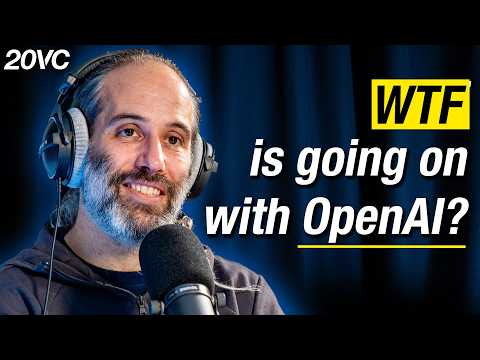
Guy Podjarny: The Future of AI Software Development - What is Real & What is BS | E1232
Guy Podjarny (guest), Harry Stebbings (host), Narrator
In this episode of The Twenty Minute VC, featuring Guy Podjarny and Harry Stebbings, Guy Podjarny: The Future of AI Software Development - What is Real & What is BS | E1232 explores guy Podjarny Dissects AI Hype, Developer Futures, and Venture Excesses Guy Podjarny, founder of Snyk and Tessell, explores what’s real and what’s overhyped in AI-driven software development, from frontier models and agentic dev tools to Copilot-style assistants. He argues that capital intensity will keep foundation models concentrated while specialized models win in the near term, and that SaaS value is far more than code that AI can replicate. Podjarny forecasts major shifts in developer and PM roles toward architecture and product thinking, alongside rising security risks from AI-generated code and closed, agentic platforms. He also discusses market structure, fundraising excess, OpenAI vs Anthropic, and how timing and discipline matter more than sheer capital in AI startups.
Guy Podjarny Dissects AI Hype, Developer Futures, and Venture Excesses
Guy Podjarny, founder of Snyk and Tessell, explores what’s real and what’s overhyped in AI-driven software development, from frontier models and agentic dev tools to Copilot-style assistants. He argues that capital intensity will keep foundation models concentrated while specialized models win in the near term, and that SaaS value is far more than code that AI can replicate. Podjarny forecasts major shifts in developer and PM roles toward architecture and product thinking, alongside rising security risks from AI-generated code and closed, agentic platforms. He also discusses market structure, fundraising excess, OpenAI vs Anthropic, and how timing and discipline matter more than sheer capital in AI startups.
Key Takeaways
Foundation models will stay capital intensive while specialized models win near-term niches.
Podjarny largely agrees with the view that entering the frontier model race requires tens of billions of dollars, but expects smaller, specialized models (e. ...
Get the full analysis with uListen AI
SaaS companies are not just code, so ‘AI can rebuild your SaaS in seconds’ is misguided.
He rejects the idea that LLMs can trivially clone meaningful SaaS businesses, emphasizing durable advantages like customer relationships, distribution, data, integrations, switching costs, and partner ecosystems that go far beyond the raw software artifact.
Get the full analysis with uListen AI
AI dev tools today excel at reducing toil, not fully autonomous software creation.
Cursor, Copilot, and similar tools provide real value in code completion, tests, and docs by lowering startup friction, but they still suffer from “jagged edge” unpredictability and mostly generate average-quality code that must be reviewed carefully.
Get the full analysis with uListen AI
Agentic development platforms risk creating closed ‘magic boxes’ that centralize power.
If tools like Devin or deeply integrated GitHub flows own the end-to-end understanding and creation of software, third-party dev tools may become marginalized, and a small number of players could dominate software creation with opaque systems.
Get the full analysis with uListen AI
Developers will move up the stack into architecture and product, not disappear.
He expects the hands-on coding portion of a developer’s job to shrink, with more emphasis on system design trade-offs, long-term architecture decisions, and user/product thinking, while raw coding becomes an edge-case activity for special situations.
Get the full analysis with uListen AI
Security risk will increase as AI accelerates messy, poorly reviewed, and unmaintained code.
Because LLMs generate but don’t maintain code, and humans often under-review AI outputs, more insecure, rotting code will end up in production, expanding attack surfaces and demanding new guardrails and ownership models.
Get the full analysis with uListen AI
Raising huge rounds early can be as dangerous as it is empowering.
From his vantage point as a founder and prolific angel, Podjarny sees two main failure modes: spending too fast before finding product–market fit, or losing urgency and market timing because runway feels endless; both can doom even well-funded AI startups.
Get the full analysis with uListen AI
Notable Quotes
““If you have a SaaS business and your only differentiation is, ‘I’ve written all this code that nobody else can do,’ then your days are numbered.””
— Guy Podjarny
““From everybody that I talk to that has tried Devin, they all think it’s really cool and that it doesn’t really work.””
— Guy Podjarny
““The real challenge with LLMs right now is that we lose all control. We make a request and we get something back, and we hope that it is correct.””
— Guy Podjarny
““I think the coding piece of software developers’ work will diminish substantially… coding would be very much alive and well, but it would be the edge case.””
— Guy Podjarny
““The two primary mistakes with raising too much money too early are spending it too quickly and not spending it fast enough.””
— Guy Podjarny
Questions Answered in This Episode
If agentic development platforms become dominant, what practical mechanisms could preserve openness and interoperability for third-party dev tools?
Guy Podjarny, founder of Snyk and Tessell, explores what’s real and what’s overhyped in AI-driven software development, from frontier models and agentic dev tools to Copilot-style assistants. ...
Get the full analysis with uListen AI
How should software teams concretely redesign their review, testing, and security practices to account for AI-generated code and the ‘jagged edge’ of LLM behavior?
Get the full analysis with uListen AI
What skills and experiences should individual developers prioritize now if they want to thrive in the more architecture- and product-centric future Podjarny describes?
Get the full analysis with uListen AI
How can founders realistically distinguish between a ‘crowded but healthy’ market and a fatally over-competitive one in fast-moving AI categories?
Get the full analysis with uListen AI
Where is the line between legitimate optimism and fundraising-driven AGI hype, and how should investors and operators calibrate their expectations about timelines and capabilities?
Get the full analysis with uListen AI
Transcript Preview
... I think that's bullshit. Like, I don't think that's, uh, true for a variety of reasons. You know, first, SaaS businesses are far more than just the software that they create. In fact, you have a SaaS business and your only differentiation is, "I've written all this code that nobody else can do," then your- your days are numbered. Expectation of when would, uh, GPT-5 scale models arrive. I now think that those are further away. You've sort of seen Sam Altman and others change their tune to talk about reasoning and things like that as the progress. And my sense is there are actually some architectural problems, so it's possible there's a year or two in which these things are stuck.
Ready to go? (instrumental music plays) Guy, I am so excited for this. Listen, I always learn so much from our conversations, so thank you so much for joining me today.
Oh, thanks for having me back on. Clearly, uh, I said a few interesting things last time, if you were to do it. (laughs)
Do you know, I- I- I always learn from ours. Now, I've got a little bit spicy, and I wanna start with, like, a quick fire on what people said and how we think about it. Now, Masa Son said, "NVIDIA is undervalued today." Agree or disagree, and why?
I think there are really three questions in one in that one. Uh, the first one is, is the market NVIDIA in- is in, you know, going to continue to grow? And I think that is absolute yes. You know, the semiconductors for AI, no doubt, it's gonna grow. I think there's gonna be a lot more, there are gonna be a lot more players in that space. But, uh, I think the second question is how much would NVIDIA capture of that market? I think they are going to continue to dominate. I- I don't know percentage wise, but I think they're doing some brilliant things like taking advantage of their momentary, uh, lead, right? Not that momentary (laughs) , they have, you know, quite a substantial, uh, hard-to-, uh, capture lead, but they know that the clouds, for instance, have distribution advantages, and so they're building a cloud, they're using their semiconductor advantage. So, I think they will continue to be, like, the market leader by a margin for a long time. I think the third question is, what do you think about, what is it now, like, 35X multiple on these revenues? Uh, that one's a bit trickier 'cause it- it really isn't a question of would they grow. The question is, uh, should you put that money into other stock and would they grow faster? That one's a bit harder for me to answer.
So, uh, just... The only one I have a question on there is actually the market itself, which I think everyone would actually uniformly be surprised at me questioning. Everyone seems to also acknowledge that actually we're gonna go through this peak of, uh, or trough of disillusionment, that companies will realize that actually the RIO on a lot of these AI tools hasn't proven out in this first batch, and actually, there's gonna be this kind of, uh, depression, so to speak-
Install uListen to search the full transcript and get AI-powered insights
Get Full TranscriptGet more from every podcast
AI summaries, searchable transcripts, and fact-checking. Free forever.
Add to Chrome