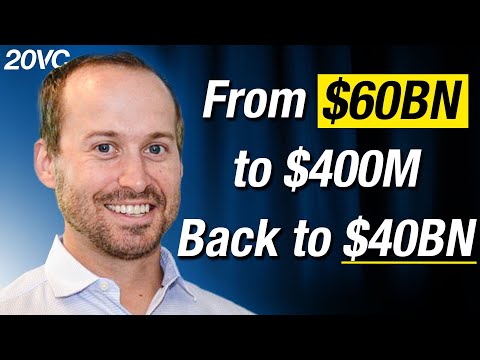
Dan Gill, CPO @Carvana: The Most Wild Story in Public Markets | E1243
Dan Gill (guest), Harry Stebbings (host)
In this episode of The Twenty Minute VC, featuring Dan Gill and Harry Stebbings, Dan Gill, CPO @Carvana: The Most Wild Story in Public Markets | E1243 explores carvana CPO Dan Gill on Grit, Product Discipline, and 99% Crashes Dan Gill, CPO of Carvana, discusses how his background as an elite gymnast shaped his extreme work ethic, resilience, and expectations for talent in high-growth companies.
Carvana CPO Dan Gill on Grit, Product Discipline, and 99% Crashes
Dan Gill, CPO of Carvana, discusses how his background as an elite gymnast shaped his extreme work ethic, resilience, and expectations for talent in high-growth companies.
He explains Carvana’s vertically integrated, unit-economics-obsessed model, detailing how financing, logistics, and software combine to turn a commodity (cars) into a defensible, high-margin business.
Gill shares hard-won lessons in product leadership: hiring for “horsepower and give a shit,” ruthless prioritization around a single highest-impact change, and restructuring from 90 fragmented teams down to 8 focused groups.
He also covers Carvana’s wild public-market journey—from $60B to $500M back to $50B—and how transparent, metric-based storytelling kept the company aligned and motivated through a 99% drawdown.
Key Takeaways
Exceptional outcomes require exceptional effort and intrinsic drive.
Gill ties his Olympic-level gymnastics background to startup building, arguing that true excellence is only possible when people are hard-wired competitors willing to endure sustained, intense effort—something he explicitly screens for when hiring.
Get the full analysis with uListen AI
Hire for “horsepower and give a shit,” not just pedigree or domain experience.
He prioritizes raw analytical depth (“horsepower”) and demonstrated willingness to work insanely hard (“give a shit”) over consulting backgrounds or prior domain expertise, using questions about favorite tech and hardest-worked moments to test both.
Get the full analysis with uListen AI
Product teams must win by moving metrics, not shipping features.
Gill insists that every initiative be grounded in unit economics, with a clear hypothesis, leading indicators, and eventual bottom-line impact; otherwise, a feature, however elegant, is considered a failure.
Get the full analysis with uListen AI
Ruthless focus beats parallelization: pick the one change with maximum leverage.
He advises founders to ask, “If you could only change one thing, what would it be? ...
Get the full analysis with uListen AI
Over-fragmented teams destroy prioritization; fewer, bigger teams create focus.
Carvana’s move from 90 small teams (with 90 separate backlogs) to 8 larger cross-functional teams forced holistic prioritization and reallocation of resources to the true company-level priorities, materially increasing execution speed and impact.
Get the full analysis with uListen AI
Vertical integration and capturing adjacent profit pools can transform margins.
By becoming a full-spectrum lender and owning logistics, reconditioning, and more, Carvana monetizes financing, trade-ins, and services that dealers typically outsource, turning a commodity product into a structurally higher-margin business.
Get the full analysis with uListen AI
Transparent, repeated storytelling around metrics can stabilize teams in crises.
During Carvana’s 99% stock drop, leadership explicitly contrasted external narratives with internal plans, then checked back every 30 days on unit economics and execution, which filtered out non-believers and deeply galvanized those who stayed.
Get the full analysis with uListen AI
Notable Quotes
“Exceptional outcomes require exceptional effort, period.”
— Dan Gill
“We do not win by shipping features. We win by moving metrics.”
— Dan Gill
“The two attributes I look for are horsepower and give a shit.”
— Dan Gill
“If you can only change one thing and everything else has to stay constant, what is the one thing you’re going to change?”
— Dan Gill
“The fun thing about dropping by 99% is that the difference between a 98% drop and a 99% drop is another 50% drop.”
— Dan Gill
Questions Answered in This Episode
How can an early-stage founder practically quantify the impact of their ‘one most important change’ on unit economics before they have much data?
Dan Gill, CPO of Carvana, discusses how his background as an elite gymnast shaped his extreme work ethic, resilience, and expectations for talent in high-growth companies.
Get the full analysis with uListen AI
Where is the line between healthy vertical integration and overreach, and how can leaders recognize when to pull back on new adjacencies?
He explains Carvana’s vertically integrated, unit-economics-obsessed model, detailing how financing, logistics, and software combine to turn a commodity (cars) into a defensible, high-margin business.
Get the full analysis with uListen AI
What concrete steps can a company take to transition from feature-shipping culture to a metrics- and unit-economics-driven product culture?
Gill shares hard-won lessons in product leadership: hiring for “horsepower and give a shit,” ruthless prioritization around a single highest-impact change, and restructuring from 90 fragmented teams down to 8 focused groups.
Get the full analysis with uListen AI
How should product leaders balance hiring domain experts versus smart generalists in industries with heavy regulation or deep legacy complexity?
He also covers Carvana’s wild public-market journey—from $60B to $500M back to $50B—and how transparent, metric-based storytelling kept the company aligned and motivated through a 99% drawdown.
Get the full analysis with uListen AI
In a world where AI is commoditizing many functional skills, what becomes the new ‘10x’ capability for product managers and operators?
Get the full analysis with uListen AI
Transcript Preview
We IPO'd at about two. We peaked at about 60 billion, we dropped back down to 500 million and we're back to 50 billion. The fun thing about dropping by 99% is that the difference between a 98% drop and a 99% drop is another 50% drop. (laughs)
Ready to go? Dan, I am so freaking excited for this. Dude, I love the Carvana business model. So thank you so much for joining me today.
It, it's really an honor. Uh, you know, I've admired what you've built and, and you've got quite a, a record of, of impressive guests. So I, I'm, uh, honored to be here.
Well, my friend flattery will get you everywhere.
(laughs)
But I, I, I do agree, it's been a fun journey. Now, I heard from, uh, a mutual friend that you were a US gymnast.
(laughs)
Uh, that's a rarity on the show. So can you actually just start with how did your time as an athlete impact your approach to growing companies first?
Gymnastics influenced me in, in every way. Um, I'm incredibly fortunate that I found it. Uh, I'm not a large human, um, and so I probably would have been pretty mediocre at almost any other sport. Um, but I am a very intense person and a, and a hard-wired competitor. And so at least I had an outlet in, in gymnastics. Um, the, the, the shortest version is I did it my whole life, I did it through college, I got to compete for the US as you mentioned, and, and I took a shot, um, at the Olympics in 2004. And, um, and, and so leading up to the Olympics, I completely shredded both of my shoulders. Like ruined them. And so I decided to stop seeing doctors so that I could take my crack at the Olympic games. Um, and so I go to try and make the Olympics in, in 2004. I finally get to the trials and, and I'm, you know, an underdog to make the team. Um, but on day one I have, like, the competition of my life. Uh, and, you know, I, I did high school in, in Northern Virginia and so the Washington Post was like, "Local kid might make the Olympics." And it was, like, this big thing. And then on day two, I fell on my best event, which you cannot do, uh, and, uh, my Olympic dreams were over. So I go back home and the doctors say, "You can't do gymnastics anymore. You've done, you know, irreparable damage and, and, uh, you just would never be able to do it again." So it was just sort of, like, taken from me. Um, and I had planned to continue competing for a while and whatever. But it ended up being just such a, a blessing in disguise, I had surgery straight away and I immediately started looking for jobs. And so sort of the full circle of gymnastics is that it gave me a work ethic and a perseverance and, and, you know, those are the attributes that, that I seek out in others and try to surround myself with when we're gonna pursue, you know, enormous goals together. Um, and so, you know, it, it just-
Install uListen to search the full transcript and get AI-powered insights
Get Full TranscriptGet more from every podcast
AI summaries, searchable transcripts, and fact-checking. Free forever.
Add to Chrome