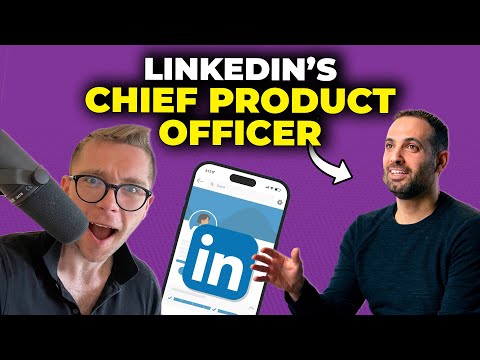
Tomer Cohen: Why LinkedIn Stories Failed; How LinkedIn's Feed Was Born; AI Startups | E1019
Tomer Cohen (guest), Harry Stebbings (host), Narrator
In this episode of The Twenty Minute VC, featuring Tomer Cohen and Harry Stebbings, Tomer Cohen: Why LinkedIn Stories Failed; How LinkedIn's Feed Was Born; AI Startups | E1019 explores linkedIn’s CPO on AI’s Future, Product Craft, and Reinventing the Feed LinkedIn CPO Tomer Cohen discusses his journey into product leadership, how he thinks about the craft of product as a blend of art, science, and execution, and the importance of clarity of vision and “jobs to be done.”
LinkedIn’s CPO on AI’s Future, Product Craft, and Reinventing the Feed
LinkedIn CPO Tomer Cohen discusses his journey into product leadership, how he thinks about the craft of product as a blend of art, science, and execution, and the importance of clarity of vision and “jobs to be done.”
He explains how LinkedIn re-architected its feed from an internal promotion channel into a member-centric engine for professional conversations, and why controversial moves like killing Stories or throttling shallow growth were necessary.
Cohen dives deep into AI’s impact on product building, organizational design, and competition between startups and incumbents, arguing that AI skills and prompt mastery are becoming core product competencies.
He also explores where AI might go next—towards generating new scientific knowledge—and wrestles with questions of responsibility, regulation, data advantage, and how work, learning, and careers will change.
Key Takeaways
Anchor product strategy in “jobs to be done,” not just user segments.
Cohen emphasizes deeply understanding functional, social, and emotional needs—like the stress and consensus-seeking in B2B buying or creators wanting opportunity, not vanity metrics—to unlock real innovation and avoid misfires like LinkedIn Stories.
Get the full analysis with uListen AI
Clarity of thought beats hedging; be “wrong but not confused.”
He argues that strong, explicit hypotheses and principles—set before building—enable decisive execution and clear learning, even when bets fail, whereas confusion leaves outcomes to luck.
Get the full analysis with uListen AI
Treat feeds and discovery surfaces as member-owned, not org-owned.
Rebuilding LinkedIn’s feed from an internal promotion channel into a space for conversations between people you care about required overruling teams’ growth dependencies and re-optimizing for trust, quality, and member jobs-to-be-done.
Get the full analysis with uListen AI
AI literacy is now a core product skill, not a nice-to-have.
Cohen insists product leaders must understand ranking, data quality, prompting, and limits of models, and reorganize teams so AI is embedded (not a horizontal afterthought), because AI is becoming the main lever steering products.
Get the full analysis with uListen AI
Startups’ AI edge lies in rethinking problems, not thin wrappers.
While incumbents have compute, customers, and proprietary data, he believes startups can win by reimagining workflows and industries end-to-end with AI, especially when they bring truly unique datasets or specialized fine-tuning—rather than shallow layers on top of GPT.
Get the full analysis with uListen AI
Measure product bets by adoption plus retention, not launch or vanity growth.
LinkedIn defines success criteria pre-launch and looks for sustained, repeat usage; early Stories usage was mediocre and failed its underlying job (creators wanted permanence and identity, not ephemerality), prompting a strategic pivot.
Get the full analysis with uListen AI
AI will force unlearning of control-oriented product habits.
Because generative models are non-deterministic, product leaders must shift from micromanaging every UI detail to setting constraints, principles, and training data, then steering outcomes via prompts and feedback rather than direct control.
Get the full analysis with uListen AI
Notable Quotes
“We might be wrong, but we’re not confused.”
— Tomer Cohen
“The feed belongs to the member. It’s not an org chart.”
— Tomer Cohen
“Stories failed because we completely misunderstood the job to be done for creators on LinkedIn. They didn’t want things to disappear; they wanted them to last.”
— Tomer Cohen
“With AI, you don’t control the experience. It’s as if you’re the chef giving ingredients and philosophy, but the AI learns how to cook.”
— Tomer Cohen
“These models are amazing at restructuring existing knowledge. The real frontier is when they start to come up with new knowledge.”
— Tomer Cohen
Questions Answered in This Episode
How should product teams practically retrain and reorganize themselves to make AI a core capability rather than a bolt-on feature?
LinkedIn CPO Tomer Cohen discusses his journey into product leadership, how he thinks about the craft of product as a blend of art, science, and execution, and the importance of clarity of vision and “jobs to be done.”
Get the full analysis with uListen AI
What safeguards and governance structures does LinkedIn use internally when deciding to deploy powerful AI models in member-facing experiences?
He explains how LinkedIn re-architected its feed from an internal promotion channel into a member-centric engine for professional conversations, and why controversial moves like killing Stories or throttling shallow growth were necessary.
Get the full analysis with uListen AI
How will LinkedIn adapt its business model and content ecosystem if AI assistants increasingly answer professional questions without users visiting LinkedIn directly?
Cohen dives deep into AI’s impact on product building, organizational design, and competition between startups and incumbents, arguing that AI skills and prompt mastery are becoming core product competencies.
Get the full analysis with uListen AI
Where is the line between useful professional personalization and unsettling surveillance when AI can access rich behavioral and network data?
He also explores where AI might go next—towards generating new scientific knowledge—and wrestles with questions of responsibility, regulation, data advantage, and how work, learning, and careers will change.
Get the full analysis with uListen AI
If AI starts generating genuinely new scientific or strategic knowledge, how should ownership, attribution, and economic value of those discoveries be handled?
Get the full analysis with uListen AI
Transcript Preview
Those models right now are very focused on existing knowledge. Right? So they learned all available public knowledge in the internet and they were able to produce a result for you that is going to predict what you're trying to answer. But then there is a question of, what about new knowledge? What happens when those models start to hypothesize? They can come up with new ideas, new scientific discoveries. You know, imagine AI coming up with answers to some of the biggest scientific mysteries in the world like, what is dark matter? What's dark energy? What causes Alzheimer's disease? What is quantum mechanics? What is oneself? And that for me is you're moving from a place of those models are amazing in rebuilding and restructuring existing knowledge to coming up with new knowledge. When you start to come up with new knowledge, you're really talking about a whole new frontier.
(instrumental music) Tomer, I am so excited for this. I've spoken to just so many of your friends before, so I know an incredible amount about you and I'm ready. So thank you so much for joining me today.
I'm excited to be here. I'm- I'm a big fan of the show and I'm excited to be on it.
Well, that is very, very kind. But I'm fascinated, CPO at LinkedIn, one of my favorite products. How- how did you come to be CPO at LinkedIn, Tomer?
Ah, that's a long journey. You know, I always think that product journeys are so idiosyncratic and they're so unique. For me, uh, ever since I was a kid I loved building. I love every aspect of building. I love the entire cycle. I love the problem-solving side, I love the design side, technology side. I love the feedback and it's my place of joy, it's where I'm in a state of flow. Uh, my first experience with cutting-edge technology was actually during my army service and I was blown away seeing what technology can do. But I started my career as an engineer actually working in semiconductors. Um, and if you ever worked on a semiconductor as a chief design engineer, it's like- it's like you're building- you're building a c- you know, a city on the size of a few millimeters. It's- it's incredible. And there's a lot of, uh, beauty in the complexity in how you build it right. And then I moved to embedded software systems, all the way to starting a company in the consumer space. My journey to LinkedIn was actually a very special one. So I became a LinkedIn fan long before I joined the company. I came to the Valley in 2008. I went to a lecture at a Stanford engineering school. It was about social networks. Now, this is 2008, social networks are a big deal, but, you know, they're not as big as they are today, uh, but they're hot. They're like the hot topic. And all the, you know, big founders of social networks that you can think about were there and it was all the rage. Uh, the hottest topic was Facebook time spent on the internet. Uh, onstage there was more of an older, uh, founder. His name was Reid Hoffman. This is where I got to meet Reid for the first time. And Reid was different. Reid talked about the power of online professional communities and how it can create economic opportunities. It's the first time I heard it and it deeply resonated with me. The idea that a professional community becomes a powerful growth engine for the economy just, uh, inspired me on a whole new level. And over time, Reid himself became a personal mentor of mine. And it was only several years later, I had a conversation with who back then was the CPO of LinkedIn, and this was early mobile days and I came from a startup. And if you came from a startup in the Valley, it was all about mobile and larger companies were still trying to deal with this, uh, mobile thing that was happening. And he asked me, he said, "How would you re- re- rebuild LinkedIn as a mobile product?" I was excited to share my thoughts. Um, and then he said, "Instead of talking about it, how about you come and build it?" And, uh, the rest is history. I joined the company in 2012 and in 2000- in 2020 I became the CPO myself. So it kind of- kind of felt- kind of came full circle since then.
Install uListen to search the full transcript and get AI-powered insights
Get Full TranscriptGet more from every podcast
AI summaries, searchable transcripts, and fact-checking. Free forever.
Add to Chrome