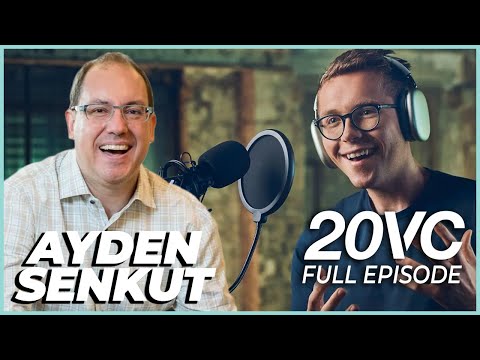
Aydin Senkut: How I Scaled from a $4M Angel Fund to $900M AUM | 20VC #890
Harry Stebbings (host), Aydin Senkut (guest)
In this episode of The Twenty Minute VC, featuring Harry Stebbings and Aydin Senkut, Aydin Senkut: How I Scaled from a $4M Angel Fund to $900M AUM | 20VC #890 explores aydin Senkut Explains Building Felicis From Scrappy Solo to $900M Aydin Senkut recounts his path from leaving Google to starting Felicis as a solo GP with a $41M debut fund and scaling it into a $900M AUM, multi-stage, global venture franchise.
Aydin Senkut Explains Building Felicis From Scrappy Solo to $900M
Aydin Senkut recounts his path from leaving Google to starting Felicis as a solo GP with a $41M debut fund and scaling it into a $900M AUM, multi-stage, global venture franchise.
He explains how unorthodox strategy, flexible ownership, and an obsession with backing the world’s best companies—rather than optimizing for price—have underpinned the firm’s performance.
The discussion covers today’s high-valuation early-stage environment, competition from crossover funds, portfolio construction, and the importance of diversification across stage, sector, geography, and vintage.
Senkut also digs into firm-building: hiring for extreme growth mindset, running with “success with empathy” as Felicis’s operating principle, learning from misses, and scaling support for founders.
Key Takeaways
Optimize to back the best companies, not to win the lowest price.
Senkut argues that over a decade-plus, paying 2–4x more on entry is inconsequential if the company ends up 10–20x bigger than expected; being in the outliers matters far more than perfect entry valuation.
Get the full analysis with uListen AI
Use flexible ownership strategies to get into great deals, then build stake.
Felicis sometimes starts with small, ‘strategic’ checks when that’s the only way in, then earns the right to increase ownership by demonstrating value and doubling or tripling down in later rounds.
Get the full analysis with uListen AI
Design fund size and pace from a model, not from LP demand or ego.
Each Felicis fund is sized via a deployment and portfolio-construction model (target number of companies, stage mix, ability to lead rounds) rather than simply raising as much as LPs will give.
Get the full analysis with uListen AI
Diversify across sectors, geographies, and vintages—not just company count.
Senkut believes 40–50 companies per fund, spread across different markets, regions, and years, creates a healthier, more resilient venture portfolio than hyper-concentrated 15–20 company strategies.
Get the full analysis with uListen AI
Hire for extreme growth mindset and cultural fit, not just pedigree.
He finds picking people even harder than picking companies and emphasizes that high talent without a growth mindset and cultural alignment does not work at Felicis.
Get the full analysis with uListen AI
Learn more from the ‘no’s than the ‘yes’s and adjust your process.
Misses like Airbnb and Uber led Senkut to systematically examine what they misjudged (e. ...
Get the full analysis with uListen AI
Balance performance with empathy to avoid internal friction that destroys energy.
Felicis’s north star is “success with empathy”: Senkut believes you can achieve top-tier returns without a purely cutthroat culture, and that internal harmony frees more energy to help founders.
Get the full analysis with uListen AI
Notable Quotes
“You cannot copy and paste your way to the top of competition.”
— Aydin Senkut
“I would rather sacrifice valuation and ownership than sacrifice being in the world’s best companies.”
— Aydin Senkut
“We think picking companies is hard; I think picking people is a hundred times harder.”
— Aydin Senkut
“Our guiding principle is success with empathy. Empathy doesn’t mean it’s all Kumbaya.”
— Aydin Senkut
“You cannot build a great franchise just turning down companies. You have to say yes to some great companies.”
— Aydin Senkut
Questions Answered in This Episode
How can an emerging manager practically design a portfolio model that balances ownership targets with the need to get into the very best companies?
Aydin Senkut recounts his path from leaving Google to starting Felicis as a solo GP with a $41M debut fund and scaling it into a $900M AUM, multi-stage, global venture franchise.
Get the full analysis with uListen AI
In a world of increasingly high entry valuations, what signals does Felicis use to distinguish truly exceptional companies from merely good ones?
He explains how unorthodox strategy, flexible ownership, and an obsession with backing the world’s best companies—rather than optimizing for price—have underpinned the firm’s performance.
Get the full analysis with uListen AI
How do you operationalize ‘success with empathy’ in compensation, decision-making, and performance management so it’s more than just a slogan?
The discussion covers today’s high-valuation early-stage environment, competition from crossover funds, portfolio construction, and the importance of diversification across stage, sector, geography, and vintage.
Get the full analysis with uListen AI
What concrete process changes did Felicis make after missing Airbnb and Uber, and how do those changes show up in today’s investment committees?
Senkut also digs into firm-building: hiring for extreme growth mindset, running with “success with empathy” as Felicis’s operating principle, learning from misses, and scaling support for founders.
Get the full analysis with uListen AI
As crossover funds move earlier, in what specific market segments or stages does Felicis see its strongest and most durable edge over them?
Get the full analysis with uListen AI
Transcript Preview
(reversing beeps) Three, two, one, zero. You have now arrived at your destination. Aydin, this is such a joy to do. I cannot believe it's been so long since our last episode. So thank you so much for joining me, first.
Thanks, Harry, I really appreciate it. It's a privilege to be here for a second time and I'm really, really proud of, uh, how far the show came and your incredible audience and your grit. Uh, so v- very excited to be here on the show with you.
I mean, uh, when we last spoke, I was actually young Aydin, so, uh, sadly some things have changed. But, uh, I do wanna start, and for those that missed our first episode, how did you make your way into the world of venture? And talk to me about the founding of Felicis and how that came together, in a brief two to three minutes. (laughs)
Yeah. I, I mean, I'll just touch on the highlights. I mean, I, I think, look, uh, uh, w- we were, we were, um... Just to mention it, this is something I always dreamt of doing. My, both my parents were entrepreneurs. Um, I just think that it's one of the coolest things one can do to start a company. It is, it is an arduous journey, but it is a very fun one. Um, I feel like everything that I've done in my life, um, until the point that I started Felicis, was really designed, uh, for me to be a great venture investor. So, the, the, the turning point really, for me, was when I left Google, where I was for roughly six years, um, a little bit as a product manager and then, uh, a strategic sales manager. And I realized when I went with the company from 30 to 3,000 people, that was getting too big for me, let alone the 100,000 plus that it is today. Um, and I wanted to do something again that is a little bit more entrepreneurial, something from scratch, also. Um, Google was Larry and Sergey's company. And after much, um, deliberation, I realized, hey, listen, this is kind of the way of Silicon Valley, right? Like, after being an operator, um, it's kind of nice to consider, you know, getting into angel investing and then, uh, I leveraged that to become a full-fledged VC. Um, most importantly, I thought, hey, I always wanted to be an investor when I was a little kid, but, you know, we didn't have the concept of venture capital when I was growing up in Istanbul. You know, it was more like being in 100% plus inflation country where, like, every night, my parents and I are like, "Okay, where are we gonna invest now? German marks? French francs?" You know? Like, "Are we gonna do something else?" Um, and then I used to read my parents' magazines. We didn't have iPads, maybe for the better. Um, you know, I would read Fortune, Time, and BusinessWeek, and I would read these articles with CEOs. I'm like, "I wanna be like that one day, and I wanna be, like, an investor one day." Um, and little did I realize that I could actually, like, combine all the things that I aspire, uh, in this little fledgling thing that started as an angel investment activity and turned into a venture firm, and, um, just really exciting. Also, um, just a really good excuse, uh, to practice something different. As a complete outsider to venture, uh, I thought, hey, uh, there is an opportunity to do something new in it. And then the last interesting thing in terms of the most important part of the founder story is, I actually was thinking maybe I should work at a firm first and learn the ropes before I started, but, um, I didn't really have a typical background and nobody really wanted to give me a job. So, it ended up being the best thing that happened to me, 'cause I literally burned the bridges, turned my, you know, back to the wall, and the only thing I could do was start and make it great.
Install uListen to search the full transcript and get AI-powered insights
Get Full TranscriptGet more from every podcast
AI summaries, searchable transcripts, and fact-checking. Free forever.
Add to Chrome