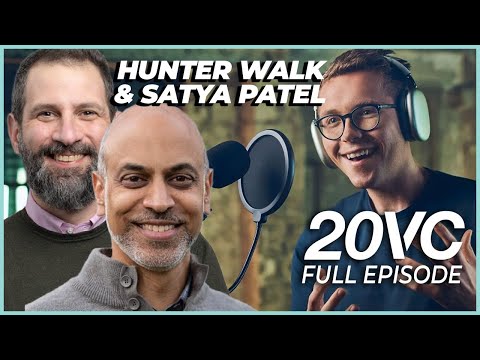
Homebrew’s Hunter Walk & Satya Patel: Why $100M is Not Enough to Execute a Seed Strategy | 20VC #972
Harry Stebbings (host), Hunter Walk (guest), Satya (Sachi) Patel (guest)
In this episode of The Twenty Minute VC, featuring Harry Stebbings and Hunter Walk, Homebrew’s Hunter Walk & Satya Patel: Why $100M is Not Enough to Execute a Seed Strategy | 20VC #972 explores why Homebrew Ditched LP Money And Rethought Seed-Stage Venture Economics Hunter Walk and Satya Patel reflect on 10 years of building Homebrew as a deeply equal, two‑person partnership, explaining how deliberate alignment on values, definitions of success, and economics prevented the usual GP conflicts.
Why Homebrew Ditched LP Money And Rethought Seed-Stage Venture Economics
Hunter Walk and Satya Patel reflect on 10 years of building Homebrew as a deeply equal, two‑person partnership, explaining how deliberate alignment on values, definitions of success, and economics prevented the usual GP conflicts.
They walk through their decision to stop raising institutional funds and instead invest their own capital in smaller, flexible checks, arguing that a $100M seed fund is now a strategic “tweener” that forces unwanted behaviors.
The conversation covers how they structure consensus-based investing, handle LP expectations, think about founder liquidity and salaries, and manage reserves, secondaries, and markups in both boom and downturn markets.
They close by assessing the current venture environment, why many 2021–2022 unicorn employees may see little equity value, and how money, when it removes basic stress, enables—rather than defines—success and happiness.
Key Takeaways
Design the partnership before you design the fund.
Walk and Patel spent extensive time aligning on definitions of success, roles, energy-giving vs. ...
Get the full analysis with uListen AI
Consensus works for very small, truly equal partnerships.
With only two GPs and no deal attribution, Homebrew requires both to be “above the yes threshold” on every deal, which unifies them in front of founders and LPs; they argue their real misses were lack of access, not consensus vetoes.
Get the full analysis with uListen AI
At seed today, $100M is a strategic no-man’s land.
They argue a $100M seed fund is now too big for flexible, small-ownership, experimental investing and too small to consistently lead and own enough; managers should either go bigger and build a firm—or smaller and embrace flexibility.
Get the full analysis with uListen AI
Using your own capital changes your constraints but not your bar.
By self-funding 100–500K checks, they drop rigid ownership/fee math and can be price-agnostic in a mechanical sense, but they keep venture-scale outcome expectations and care more about round quality, lead investors, and financing dynamics.
Get the full analysis with uListen AI
Be explicit and humane about founder and employee economics.
They advocate frank discussions about founder salaries and modest secondaries to reduce stress so founders can perform, while condemning excessive early cash-outs and reminding employees to question whether they will actually share in upside.
Get the full analysis with uListen AI
Actively manage liquidity with a clear buyer–seller framework.
For follow-ons and secondaries, they ask whether they can still earn 5–10x from here and whether they’re truly buyers or sellers on a risk‑adjusted basis, and they emphasize returning and recycling capital rather than clinging to paper marks.
Get the full analysis with uListen AI
Boom-time habits created fragile companies and expectations.
They predict significant pain for overfunded A–D stage companies that raised on momentum without product–market fit, noting many employees in 2021–2022 unicorns may see little equity value, while new, disciplined startups now have a better environment to build.
Get the full analysis with uListen AI
Notable Quotes
“If it doesn’t feel right before you write the check, it definitely doesn’t get better after.”
— Satya Patel (as recalled by Hunter Walk)
“Our goal was never to maximize fees. We wanted to design a model at the intersection of success and happiness.”
— Hunter Walk
“At the seed stage today, a $100 million fund is a bit of a tweener.”
— Satya Patel
“Over the last decade people forgot this is a relationship-driven business, not a transactional business.”
— Hunter Walk
“Success is having the freedom to spend my time the way I want, with the people I want, and leaving those people and the world better than I found them.”
— Satya Patel
Questions Answered in This Episode
How can emerging managers practically replicate Homebrew’s alignment process before launching a fund, especially if they haven’t yet achieved personal financial security?
Hunter Walk and Satya Patel reflect on 10 years of building Homebrew as a deeply equal, two‑person partnership, explaining how deliberate alignment on values, definitions of success, and economics prevented the usual GP conflicts.
Get the full analysis with uListen AI
In a world of self-funded checks and SPVs, where should LPs draw the line between healthy experimentation and unstructured, hard-to-underwrite strategies?
They walk through their decision to stop raising institutional funds and instead invest their own capital in smaller, flexible checks, arguing that a $100M seed fund is now a strategic “tweener” that forces unwanted behaviors.
Get the full analysis with uListen AI
What specific signals should founders and employees use to judge whether their equity will actually be worth anything in an overfunded, high-valuation company?
The conversation covers how they structure consensus-based investing, handle LP expectations, think about founder liquidity and salaries, and manage reserves, secondaries, and markups in both boom and downturn markets.
Get the full analysis with uListen AI
How might other seed funds redesign their fund sizes, reserve strategies, and fee structures to avoid becoming the kind of ‘tweener’ vehicle Homebrew is rejecting?
They close by assessing the current venture environment, why many 2021–2022 unicorn employees may see little equity value, and how money, when it removes basic stress, enables—rather than defines—success and happiness.
Get the full analysis with uListen AI
When should investors push founders to return capital and stop, versus encouraging them to pivot and spend down a large but misaligned war chest?
Get the full analysis with uListen AI
Transcript Preview
Hunter, Hunter, can you, can you put your arms down? Sorry. It's rubbing against your shirt. (laughs)
Oh, sorry. Sorry. I'm posing. I'm, I'm flexing. I'm li- I'm flexing verbally and physically on you, Harry.
Hey, ladies. (instrumental music) . I am so excited for this. Hunter, Sacha, it's been six and seven years. As we just discussed, Sacha was first. Uh, but first, thank you both so much for joining me again today.
Thanks so much. I, I think the-
So happy to be here.
... I think the real anniversary, Sacha, is this 10 years since we started pitching? The first fund? Did we start pitching this week 10 years ago?
That's right. January of 2013. Yeah.
Oh my word. Well, there we go. 10 years. I mean, what an incredible milestone. But I want to start with a little bit, uh, of context. Um, and so tell me, when was that, "We're gonna do this"? You know there's that moment in a partnership when it's like, "Should we take the jump? Should we..." When was that moment of, "Fuck it. Let's take the jump and let's do this together"? And either one of you can lead on this one.
Summer of 2012, Hunter and I were getting together for one of our normal breakfasts, and that's when we first started talking about doing something together. We had no idea what shape it was going to take. But I'd say the decision to work together really happened Thanksgiving of 2012, after Hunter asked his mom whether it was a good idea to work with me or not. Uh, and she signed off, and the rest is history.
Did you have any reservations when you made the decision?
By the time we got to the decision, I don't think we had any reservations. We spent so much time, even though we had had a decade of a relationship together, focused on making sure we had a shared definition of success, clarity around how we wanted to spend our time, an understanding of each other's strengths and weaknesses, that by the time we got to the decision point, uh, it was easy. And it's been easy ever since.
Yeah, I think the only question on my mind was, you know, as Sacha mentioned, we had known each other for a decade before. We always thought we were gonna do something together. But at the moment at which we finally had that blank piece of paper, right? So I was leaving, uh, Google, he had left Twitter. Um, if we hadn't come together at that time, neither one of us was thinking about venture. That was probably just the biggest gut check. Like, Sacha, who had probably was gonna start a company or, you know, sort of join another one in a, in a, in a product leadership role, you know, my question to him was, "Are you really sure, you know, you're done operating? Or is this gonna always be kind of a little bit of an itch that you wish you had one more swing, you know, at being on the org chart as opposed to the cap table?" And for me, it was just... I, I kind of thought I was done, you know, doing. I thought I was gonna be helping. Um, but I didn't know what that meant, and I, um... What I had to ask my mom was whether she thought it was better for me to take a year and just kind of polymath, right? Like write, advise, angel invest, and sort of see if that was sort of a divining rod, you know, uh, that would show me a true north to what I wanted to do next. Or if I could preempt that a little bit by joining, you know, a close friend and former colleague to do something that felt very right in the moment, but would sacrifice that sort of, you know, value of the journey.
Install uListen to search the full transcript and get AI-powered insights
Get Full TranscriptGet more from every podcast
AI summaries, searchable transcripts, and fact-checking. Free forever.
Add to Chrome