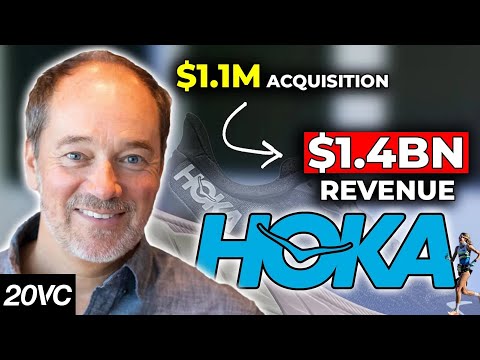
Dave Powers: The Meteoric Rise of Hoka Running | E1098
Harry Stebbings (host), Dave Powers (guest)
In this episode of The Twenty Minute VC, featuring Harry Stebbings and Dave Powers, Dave Powers: The Meteoric Rise of Hoka Running | E1098 explores how Hoka and UGG Became Billion-Dollar Powerhouses Inside Deckers Dave Powers, CEO of Deckers, explains how Hoka grew from a $1.1M acquisition into a $1.4B performance-footwear brand by obsessing over core runners, product performance, disciplined distribution, and channel strategy.
How Hoka and UGG Became Billion-Dollar Powerhouses Inside Deckers
Dave Powers, CEO of Deckers, explains how Hoka grew from a $1.1M acquisition into a $1.4B performance-footwear brand by obsessing over core runners, product performance, disciplined distribution, and channel strategy.
He contrasts Hoka’s niche-to-mass playbook with UGG’s evolution from surfer boot to global fashion staple, including the painful consequences of over-distribution and the multi-year process of rebuilding brand heat.
Powers dives into brand management, culture, hiring, and resource allocation—arguing that great brands start in niches, depend on iconic hero products, and require ruthless control of inventory, pricing, and wholesale partners.
He also critiques pure-play DTC economics, outlines where performance footwear is heading technologically, and reflects on leadership, competition with Nike and On, and the challenges of motivating teams across a multi-brand portfolio.
Key Takeaways
Start with a niche consumer and solve a real, sharp problem.
Hoka began with ultra-runners, UGG with surfers, and Teva with river guides; each brand addressed a specific unmet need before expanding, which created deep early loyalty and credibility.
Get the full analysis with uListen AI
Protect brand equity by tightly controlling distribution and inventory.
Both Hoka and UGG were at risk when growth targets drove over-distribution and markdowns; Powers stresses door-by-door forecasting, selective wholesale partners, and refusing “just on the shelf” placements without storytelling and service.
Get the full analysis with uListen AI
Hero products are the economic and strategic engine of consumer brands.
Iconic items like Hoka’s core models, UGG’s classic boot, Timberland’s Yellow Boot, and Converse’s Chuck Taylors provide scale, margin, and consistency that fund innovation—if their essence is protected and iterated, not diluted.
Get the full analysis with uListen AI
DTC-only models are fragile without truly great, self-propelling brands.
Powers argues many DTC brands depend on heavy marketing spend; when that spend is cut, revenue collapses unless the product and brand are compelling enough to sustain organic demand, repeat purchase, and word of mouth.
Get the full analysis with uListen AI
Healthy culture is “kind and competitive,” not political and siloed.
He insists on authenticity, low politics, and careful hiring for values over CV—acting as a “bouncer” for culture—while simultaneously demanding high performance and a clear will to win.
Get the full analysis with uListen AI
Sustainable growth often requires deliberately pulling back and resetting.
UGG’s UK and EU decline was reversed only by accepting lower revenues and profits for a period: cutting accounts, cleaning up off-price exposure, refreshing creative direction, and rebuilding heat with focused product and influence.
Get the full analysis with uListen AI
Resource allocation across brands and regions is a CEO’s core lever.
Powers’ biggest strategic move was shifting capital and attention from smaller brands and initiatives into Hoka and UGG, enforcing profit targets and resisting internal pressure to “give everyone a little,” which amplified winners.
Get the full analysis with uListen AI
Notable Quotes
“Great brands are meaningful and important to their consumer. You want to build a brand that your consumers can’t live without.”
— Dave Powers
“You start chasing a number versus healthy sustainable growth… and you end up with extra inventory in the channel that you have to mark down.”
— Dave Powers
“At the end of the day, the goal here is let people just be themselves and work how they want to work… and don’t try to make them fit into a mold that is unnatural.”
— Dave Powers
“The DTC model is hard to keep sustained because you’re spending so much on marketing. The minute you pull that marketing away to make profit, your sales line drops like a rock.”
— Dave Powers
“If some brands win and others don’t, Deckers is still winning. You’re part of Deckers first, you’re part of your brand second.”
— Dave Powers
Questions Answered in This Episode
How would you know, in real time, that your brand is tipping from aspirational to over-exposed and at risk of decline?
Dave Powers, CEO of Deckers, explains how Hoka grew from a $1. ...
Get the full analysis with uListen AI
What specific leading indicators does Deckers track to decide when to pull back distribution or inventory for a growing brand?
He contrasts Hoka’s niche-to-mass playbook with UGG’s evolution from surfer boot to global fashion staple, including the painful consequences of over-distribution and the multi-year process of rebuilding brand heat.
Get the full analysis with uListen AI
How far can Hoka stretch into lifestyle and casual wear without eroding its performance credibility with core runners?
Powers dives into brand management, culture, hiring, and resource allocation—arguing that great brands start in niches, depend on iconic hero products, and require ruthless control of inventory, pricing, and wholesale partners.
Get the full analysis with uListen AI
If you had to design a new brand from scratch today, what niche problem and community would you choose, and why?
He also critiques pure-play DTC economics, outlines where performance footwear is heading technologically, and reflects on leadership, competition with Nike and On, and the challenges of motivating teams across a multi-brand portfolio.
Get the full analysis with uListen AI
Given the rising technology in performance footwear (carbon plates, compounds), where is the ethical line between fair innovation and engineered disposability?
Get the full analysis with uListen AI
Transcript Preview
Who's your biggest competitor, Dave? Is it Nike? Is it Adidas?
You know, it's (censored) . That's the one that really drives us internally.
Hoka shoes was bought for 1.1 million in 2012. Now it's doing $1.4 billion in revenue in 2023. This is Dave Powers. He is the president and CEO of Deckers Brands, the parent company of brands like Hoka, UGG, and Teva.
The DTC model is hard to keep sustained because you're spending so much on marketing. The minute you pull that marketing away to make profit, your sales line drops.
How fast is brand decline, do you think?
It's quick. It catches you off guard. And the worst thing is you have all the inventory planned for growth, and all of a sudden, it slows down, and that's when you're in real trouble.
If you can be CEO of any other company for a day, what would it be and why? (laughs)
(laughs) This is gonna sound stupid, but...
Dave, I am so excited for this. You don't understand. I normally interview, you know, uh, software founders or venture capitalists. Now I get to interview, you know, bloody one of the kind of h- I don't know how to say this, but one of the people behind my favorite brands. So thank you so much for joining me today.
Yeah. No, thank you, Harry. It's a pleasure to be here, and, um, it- it's even better to know that you're such a fan of Hoka.
I mean, for sure. Uh, now, my question to you is, we had a little chat, and you said, um, that you maybe didn't know (laughs) what you wanted to do early in your career in terms of it starting at 28, but when you were a child, what did you wanna do when you grew up?
Oh man, you know, I don't know that I had one thing. I remember early on thinking I wanted to be a race car driver. Like, I was really into, you know, race cars a- as a kid and stuff, but I don't think that was a serious... Looking back on it now, I always did have a creative side to me, and I was always building things and creating things. Um, and then when I got into like, you know, a little bit older and heading into high school, I started really paying attention to music and fashion, and then I started my own magazine and in, uh, college around punk music and, and, uh, was really into like what people were wearing, and then that just kind of progressed. But I had no idea that I could build a career out of any of these things, and so they were just kind of side hobbies that I, you know, I knew I liked but I didn't think I could build a, uh, a career out of them, and that didn't happen until my mid-20s where I realized, "Hey, I actually can, can focus on this stuff and make, make a living out of it."
Install uListen to search the full transcript and get AI-powered insights
Get Full TranscriptGet more from every podcast
AI summaries, searchable transcripts, and fact-checking. Free forever.
Add to Chrome