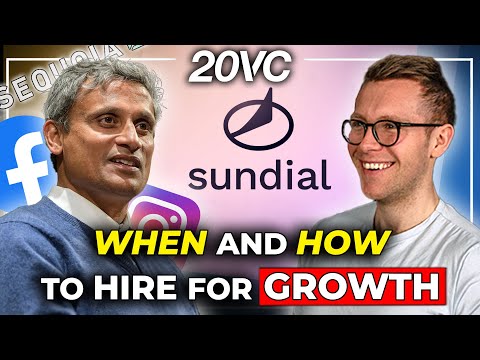
Chandra Narayanan: Top 5 Lessons from Leading Analytics at Facebook | E1126
Chandra Narayanan (guest), Harry Stebbings (host), Narrator
In this episode of The Twenty Minute VC, featuring Chandra Narayanan and Harry Stebbings, Chandra Narayanan: Top 5 Lessons from Leading Analytics at Facebook | E1126 explores from Facebook Analytics to Sequoia: Building High-Impact Growth Machines Chandra Narayanan reflects on lessons from leading analytics and growth at Facebook and later driving data efforts at Sequoia, emphasizing character, impact, and rigorous thinking over raw activity. He contrasts motion vs. progress, outlines practical frameworks for defining and measuring impact, and explains why North Star metrics and counter-metrics matter. A major theme is how to build and scale world-class growth and analytics teams: hiring for slope vs. asymptote, centralizing growth early, and focusing on impact per capita. He also dives into influence as an art, executive failure modes, and why growth is far harder in practice than most founders realize.
From Facebook Analytics to Sequoia: Building High-Impact Growth Machines
Chandra Narayanan reflects on lessons from leading analytics and growth at Facebook and later driving data efforts at Sequoia, emphasizing character, impact, and rigorous thinking over raw activity. He contrasts motion vs. progress, outlines practical frameworks for defining and measuring impact, and explains why North Star metrics and counter-metrics matter. A major theme is how to build and scale world-class growth and analytics teams: hiring for slope vs. asymptote, centralizing growth early, and focusing on impact per capita. He also dives into influence as an art, executive failure modes, and why growth is far harder in practice than most founders realize.
Key Takeaways
Prioritize character-building over quick exits from hard situations.
Staying at PayPal to ‘fix things before quitting’ taught Chandra resilience; that muscle later helped him withstand political pressure and near-firing at Facebook when he insisted on telling uncomfortable truths with data.
Get the full analysis with uListen AI
Optimize for impact, not activity—avoid confusing motion with progress.
Chandra defines impact as moving a key metric, influencing product decisions, or improving processes; if work doesn’t fit one of these, you’re likely just ‘busy’ without creating real value.
Get the full analysis with uListen AI
Use a clear impact framework and North Star metric, but keep it movable.
At Facebook, impact was structured around moving a North Star (e. ...
Get the full analysis with uListen AI
Centralize growth early; decentralize only after patterns and culture are strong.
In early stages, a small, centralized growth team concentrates scarce talent, codifies best practices, and transfers learnings across surfaces; as surface area expands, embedding growth into product teams makes more sense.
Get the full analysis with uListen AI
In analytics, excel at indexing and ‘so what’ questions to create action.
Most analysis reduces to benchmarking (over/under-indexing vs. ...
Get the full analysis with uListen AI
Hire for slope (growth trajectory) as much as asymptote (current capability).
Chandra’s biggest hiring mistakes came from over-weighting impressive past achievements instead of how fast someone was still learning; fast learners with high slope tend to compound and overtake static high-performers over time.
Get the full analysis with uListen AI
Influence is an art: tailor how you present data to different decision-makers.
He distinguishes between the ‘what’ (truth in the data) and the ‘how’ (storytelling style, level of detail, and medium), stressing that effective influence requires understanding each stakeholder’s mindset and preferred mode of thinking.
Get the full analysis with uListen AI
Notable Quotes
“You never want to be a quitter. Set things right, fix things.”
— Chandra Narayanan
“Impact is making sure you don’t confuse motion with progress.”
— Chandra Narayanan
“If you’re not doing one of these—moving a metric, influencing a product decision, or changing a process—you’re probably not having impact.”
— Chandra Narayanan
“Every large data problem can be reduced to a small data problem.”
— Chandra Narayanan
“The more senior you are, the main skill I look for is: can you simplify?”
— Chandra Narayanan
Questions Answered in This Episode
How can an early-stage startup practically distinguish between ‘motion’ and ‘progress’ when they don’t yet have rich data or clear baselines?
Chandra Narayanan reflects on lessons from leading analytics and growth at Facebook and later driving data efforts at Sequoia, emphasizing character, impact, and rigorous thinking over raw activity. ...
Get the full analysis with uListen AI
What concrete steps should a founder take to define and validate the right North Star metric—and when is it time to change it?
Get the full analysis with uListen AI
How do you balance being a ‘truth-teller’ with maintaining trust and influence when senior leaders resist uncomfortable data?
Get the full analysis with uListen AI
For a Series A company with limited budget, what is the minimum viable centralized growth team Chandra would design, and in what order would he hire the roles?
Get the full analysis with uListen AI
How can leaders systematically build a culture that values impact per capita instead of simply adding headcount to increase total output?
Get the full analysis with uListen AI
Transcript Preview
You never want to be a quitter. Set things right, fix things. If you think about why anyone comes to work, four different reasons. One is, they love what they do. Number two, they love the people they work with. Number three, they feel like they can learn from the people that they work with. And four, the company is going up and to the right. If one of these four does not work, they will leave.
(instrumental music) Chandra, I am so excited for this. I heard many good things from Alex Schultz before the show, but thank you so much for joining me today.
Thank you so much, Harry. Uh, it's really my honor. I, I love this show. I would say this is my favorite podcast show, and I have listened to so many amazing people saying amazing things. And I, I've learned so much from this show, so it's truly an honor.
Uh, listen, I've, I've learned just as much, so, uh, (laughs) I, I think it's a pretty cool job that I have.
Mm-hmm.
I, I would love to start, though, with some chronology. I heard you got some seminal advice, uh, early on from one of your managers at PayPal, uh, Rohan. So, I'd love to start with this. What was the advice from Rohan at PayPal and how did it change your mindset?
Yeah. So, I was actually, uh, Rohan was my manager, and, uh, I, I think he went on to lead, uh, a bunch of different teams at, at, at PayPal. And, uh, I was, uh, uh, working in, at, at, at PayPal and was primarily on risk management and doing a bunch of different analysis. I actually got caught in a crossfire between two senior leaders, and what ended up happening was it became really, really frustrating for me, and, uh, I couldn't actually do my work. And, uh, basically, what I did at that point was I was, uh, so frustrated that I wanted to quit. And, uh, rather than address the problem, I wanted to quit, and I went and told Rohan, and said, "You know what? I don't want to stay here. I actually want t- to quit." And for which he basically said, "You know what? You never want to be a quitter." And he said, "Set things right, fix things, and then when you're in a better state of mind, come back to me, and I'll see what I can do." So, I stayed on for another six to nine months, and at that point, I got into a much better state of mind, fixed all the issues I had with the senior management, and then fixed the problems there was, and tried to get our, uh... and actually got, uh, the, the PayPal trajectory back on track. And then I went back to Rohan six to nine months later, and then basically told him, "Okay, man, I fixed a bunch of different stuff, and I still feel like PayPal is not the right place for me for several reasons." And, uh, and I told him, "I want to go to a different company." And he actually reached out to Facebook and literally got me a job there.
Install uListen to search the full transcript and get AI-powered insights
Get Full TranscriptGet more from every podcast
AI summaries, searchable transcripts, and fact-checking. Free forever.
Add to Chrome