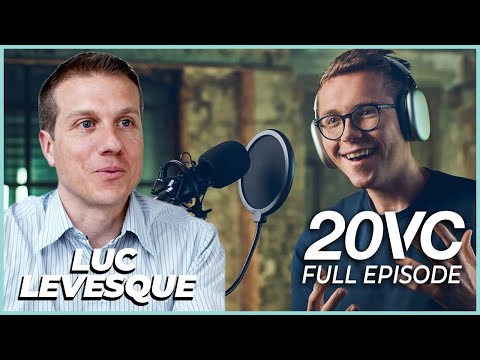
Luc Levesque: The Biggest Mistakes Founders Make When Hiring for Growth | 20VC #906
Harry Stebbings (host), Luc Levesque (guest)
In this episode of The Twenty Minute VC, featuring Harry Stebbings and Luc Levesque, Luc Levesque: The Biggest Mistakes Founders Make When Hiring for Growth | 20VC #906 explores shopify’s Luc Levesque Reveals How to Hire Elite Growth Leaders Luc Levesque, VP of Growth at Shopify and former Facebook/TripAdvisor growth leader, explains how he thinks about growth, viral loops, and building world‑class growth organizations.
Shopify’s Luc Levesque Reveals How to Hire Elite Growth Leaders
Luc Levesque, VP of Growth at Shopify and former Facebook/TripAdvisor growth leader, explains how he thinks about growth, viral loops, and building world‑class growth organizations.
He defines growth as “whatever it takes to move the one critical metric,” and stresses the importance of choosing a clear North Star and structuring a standalone, empowered growth org.
A major focus of the conversation is how founders should hire for growth: what to look for, how to interview, common mistakes, early red flags, and how to tightly align growth with product and marketing.
Levesque also covers experimentation culture, preventing morale collapse when tests fail, the limits of funnel tweaks, and why the growth talent pool is so constrained—and how advisors can fill the gap.
Key Takeaways
Define a single, high‑impact North Star metric and align everything to it.
Growth is not a narrow function; it’s ‘whatever it takes’ to move one core metric (e. ...
Get the full analysis with uListen AI
Structure growth as a standalone org, as close to the CEO as possible.
Levesque prefers a separate growth org with its own engineering, product, and analytics, tightly partnered with product and marketing. ...
Get the full analysis with uListen AI
Hire for seniority, pattern‑matching, and ‘signs of excellence’—and backchannel hard.
Because growth intuition takes many experiments and years to build, aim for the most senior leader you can find. ...
Get the full analysis with uListen AI
Use deep craft interviews to separate true growth experts from passengers.
Ask candidates to walk their career from the bottom of their LinkedIn, dig into why they left roles, and press for ‘Tell me something I don’t know about growth. ...
Get the full analysis with uListen AI
Empower growth with engineering and surface ownership, or it will stall.
High‑impact growth often depends on engineering-driven systems (algorithms, scalable loops), not just analysis. ...
Get the full analysis with uListen AI
Velocity, relationships, and early impact are key signals in a new growth hire’s first 60–90 days.
Within 30–60 days you should see increased experimentation speed, better hiring (they act as a talent magnet), and early wins. ...
Get the full analysis with uListen AI
Celebrate learning, not just wins, and know when marginal funnel tweaks have bottomed out.
Growth cultures need grit: a long run of ‘failed’ experiments can be survivable if you explicitly frame and celebrate the learnings. ...
Get the full analysis with uListen AI
Notable Quotes
“I don’t define growth very crisply; it’s basically whatever it takes to move that one metric you’re trying to increase.”
— Luc Levesque
“The biggest mistake you can make as a founder is hiring the wrong person for the role.”
— Luc Levesque
“The best way to learn growth is to have a lot of reps—to have taken a lot of shots on goal.”
— Luc Levesque
“I try to look for what I call signs of excellence. Past performance is the best predictor of future performance.”
— Luc Levesque
“Growth is one of those things where if you make the right hire, it’s not a 0.5% increase. It’s literally a 10 or 100x increase.”
— Luc Levesque
Questions Answered in This Episode
How can an early‑stage founder with limited budget realistically attract a truly senior growth leader or high‑caliber advisors?
Luc Levesque, VP of Growth at Shopify and former Facebook/TripAdvisor growth leader, explains how he thinks about growth, viral loops, and building world‑class growth organizations.
Get the full analysis with uListen AI
What practical steps can a team take to choose and validate the right North Star metric when their business model is still evolving?
He defines growth as “whatever it takes to move the one critical metric,” and stresses the importance of choosing a clear North Star and structuring a standalone, empowered growth org.
Get the full analysis with uListen AI
How should growth and product leaders resolve conflicts when an experiment clearly boosts a key metric but harms perceived product quality or brand?
A major focus of the conversation is how founders should hire for growth: what to look for, how to interview, common mistakes, early red flags, and how to tightly align growth with product and marketing.
Get the full analysis with uListen AI
In a world of changing platforms and privacy rules, how should teams balance long‑term SEO/owned loops with paid growth dependence?
Levesque also covers experimentation culture, preventing morale collapse when tests fail, the limits of funnel tweaks, and why the growth talent pool is so constrained—and how advisors can fill the gap.
Get the full analysis with uListen AI
Given the scarcity of seasoned growth talent, what are the most efficient ways to ‘grow’ high‑potential juniors into strong growth leaders internally?
Get the full analysis with uListen AI
Transcript Preview
Three, two, one, zero. You have now arrived at your destination. Luke, this is such a joy to do. I heard so many great things before the show. I so enjoyed our chat before the show. So thank you so much for having, like, the time to come on the show, and I really appreciate you joining me.
Tha- thanks, Harry. Thanks for having me.
Not at all. I want to start there. You've got a pretty fascinating background, so I want to start with how you made your way into the world of some of the most powerful growth orgs with the likes of Facebook and most recently Shopify. And what was that entry into growth for you?
So I originally started as an entrepreneur, kind of bouncing between product and growth for a really long time, which I think is pretty common for a lot of growth people. I originally started building my first product when I was 21. I built a travel blogging network called TravelPod that I sold to TripAdvisor. And when I did TravelPod, I really focused on building the best product in the world and not on growing it, which, you know, had its- its own issues, uh, later that I discovered. But what happened was during the acquisition process with TripAdvisor, the CEO of TripAdvisor, I remember he was asking these really deep technical questions like, "What are your meta tags? What- what does the SCO configuration look like? How much traffic do you get from different sources like Google or Google Images?" And I was really thinking, "Why is this guy, the CEO of TripAdvisor, asking so many technical questions about SCO?" And this is, you know, quite a while ago, and back when SCO was a dark art, and growth in general. But that's a moment where I realized how important growth was and really realized that building a great product is important, but if you don't have a strong growth loop for it, it doesn't matter 'cause you can't scale a product. So from that, that was a pretty pivotal moment for me, and one where I really started focusing on viral loops and SCO and paid search and funnel optimization to grow the products that I was building. So after TravelPod, built a Facebook app called the Traveler IQ Challenge. That grew to about 100 million users on the Facebook platform. Also built a travel photo product called TripWow, which grew to 65 million users. Those products were- were very much about viral loops and- and- and growth on the Facebook platform. After that, moved on to growing TripAdvisor itself, which was mainly about SCO. We built a pretty sophisticated SCO growth engine and grew TripAdvisor to be the largest, uh, site on the internet, travel site on the internet, uh, which was a ton of fun. Um, after that, went on to advise a bunch of companies. So I worked with Pinterest, uh, Patreon, Twitter, and shared some of my- my growth playbook with them. And kind of through that, got connected with Mark at Facebook. And, you know, met with Mark, had a- a 15-minute meeting that turned into an hour meeting, and really hit it off, frankly, and, uh, had a- a great chat. And, you know, originally, he was trying to convince me to come down to California to work at Facebook. I was in Canada, wasn't, uh, all that, um, not- not so much interested, but it was a difficult leap to- to make, uh, to leave Canada. So it took a while, uh, and, you know, had a- a long kind of discussion with him. He... The experience was actually pretty im- im-, like, it was quite the experience. We, flew me out to- to California with my wife, we had dinner with him and his wife, and we ended up playing Oculus Rift all night actually. And this is before the Oculus was- was released, so it's pretty cool. So I was, you know, just really having a good time there. And I remember after doing that, he just pulled an envelope out of his pocket with an offer, and I flew back home with an offer to join Facebook, and eventually ended up leaving Canada, coming down to California and working at Facebook.
Install uListen to search the full transcript and get AI-powered insights
Get Full TranscriptGet more from every podcast
AI summaries, searchable transcripts, and fact-checking. Free forever.
Add to Chrome