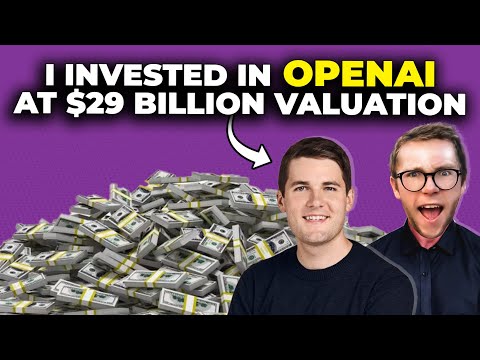
Vince Hankes: Why We Put $300M into OpenAI; Sam Altman's Pitch; Lessons from Josh Kushner | E1009
Vince Hankes (guest), Harry Stebbings (host)
In this episode of The Twenty Minute VC, featuring Vince Hankes and Harry Stebbings, Vince Hankes: Why We Put $300M into OpenAI; Sam Altman's Pitch; Lessons from Josh Kushner | E1009 explores why Thrive Backed OpenAI: Inside Vince Hankes’ High-Conviction AI Bet Vince Hankes, partner at Thrive Capital, explains his evolution from financial rigor at Tiger Global to founder- and product-centric investing at Thrive. He walks through Thrive’s decision to invest roughly $300M in OpenAI at a $29B valuation, emphasizing instinct, technological discontinuity, and potential to rival search-scale opportunities over precise TAM modeling. Hankes discusses how he evaluates AI’s hype versus reality, why he expects most value to accrue at the application layer, and how OpenAI’s ecosystem and infrastructure orientation can defend against commoditization. He also reflects on trust-building with founders, internal culture at Thrive under Josh Kushner, lessons from missing Canva, and how great investing blends empathy for customers with quantitative discipline.
Why Thrive Backed OpenAI: Inside Vince Hankes’ High-Conviction AI Bet
Vince Hankes, partner at Thrive Capital, explains his evolution from financial rigor at Tiger Global to founder- and product-centric investing at Thrive. He walks through Thrive’s decision to invest roughly $300M in OpenAI at a $29B valuation, emphasizing instinct, technological discontinuity, and potential to rival search-scale opportunities over precise TAM modeling. Hankes discusses how he evaluates AI’s hype versus reality, why he expects most value to accrue at the application layer, and how OpenAI’s ecosystem and infrastructure orientation can defend against commoditization. He also reflects on trust-building with founders, internal culture at Thrive under Josh Kushner, lessons from missing Canva, and how great investing blends empathy for customers with quantitative discipline.
Key Takeaways
Anchor on two core questions: who is the customer and what is the product?
Hankes stresses that clarity on the end user and the exact product/job-to-be-done underpins everything—from go-to-market to financials—yet many founders and investors can’t answer these simply and precisely.
Get the full analysis with uListen AI
Balance financial rigor with imaginative upside, especially in new technology paradigms.
For OpenAI, traditional TAM models looked “insane” on paper; Thrive deliberately reduced reliance on spreadsheets and emphasized historical analogs (iPhone, AWS, Google) and the potential to disrupt search- and workflow-scale markets.
Get the full analysis with uListen AI
In fast-moving AI markets, back exceptional founders in rich sandboxes rather than over-optimizing on short-term market structure.
Given daily shifts in AI tooling and infrastructure, Hankes prefers to partner early with adaptable, high-learning-rate founders who can pivot into emergent opportunities rather than wait for perfect clarity.
Get the full analysis with uListen AI
OpenAI’s defensibility will come as much from ecosystem and infrastructure as from raw model quality.
He expects differentiation to center on reliability, scalability, tooling (e. ...
Get the full analysis with uListen AI
Most AI value is likely to accrue at the application layer, not infrastructure.
Hankes compares AI to cloud: infrastructure providers operate lucrative toll roads, but the aggregate value of software and applications built on top is likely an order of magnitude larger.
Get the full analysis with uListen AI
Avoid over-reliance on pattern matching; every great company is its own pattern.
His regret over passing on Canva came from forcing enterprise SaaS heuristics (churn, workflow depth) onto a fundamentally different, product-led design platform—illustrating how rigid patterns can blind investors to outliers.
Get the full analysis with uListen AI
Trust with founders is built through predictability and shared ownership language.
He focuses on being consistent in reactions and decision criteria, increasing ‘reps’ with founders, and using inclusive language (“we” vs “you”) so entrepreneurs feel a true partnership rather than top-down judgment.
Get the full analysis with uListen AI
Notable Quotes
“There’s only two questions that matter for a company: Who is the customer? And what is the product?”
— Vince Hankes (citing a mentor)
“Things are never as good as they seemed and they’re never as bad as they appeared.”
— Vince Hankes
“We’re not talking about building the next unicorn or decacorn. We’re talking about disrupting search… that’s a trillion dollar opportunity.”
— Vince Hankes
“A financial model is a tool to help you make a decision. You need many tools to make a decision.”
— Vince Hankes
“When you get too pattern matchy on why companies should be the way they are, I think it leads to a lot of mistakes.”
— Vince Hankes
Questions Answered in This Episode
How should founders building on OpenAI today think about long-term dependence on a single model provider versus adopting open-source alternatives?
Vince Hankes, partner at Thrive Capital, explains his evolution from financial rigor at Tiger Global to founder- and product-centric investing at Thrive. ...
Get the full analysis with uListen AI
What concrete signals can distinguish an AI hype-driven product from one that genuinely creates durable, compounding customer value?
Get the full analysis with uListen AI
How can early-stage investors practically adjust their processes to avoid the kind of pattern-matching error that led to missing Canva?
Get the full analysis with uListen AI
If incumbents capture a large share of AI value, what specific niches or categories remain most promising for new startups?
Get the full analysis with uListen AI
What would effective AI regulation actually look like in practice, and how can investors and founders proactively participate in shaping it without stifling innovation?
Get the full analysis with uListen AI
Transcript Preview
There's only two questions that matter for a company: Who is the customer? And what is the product? And you'd be shocked at how many folks can't really answer that question with clarity.
(instrumental music) Vince, I am so excited for this. I've heard so many good things from Kareem, from Josh, from Jack Altman, from Brad at OpenAI. I've clearly got far too much free time. But thank you so much for joining me today.
Thank you so much for having me, Harry. I'm really excited to be here. I'm a big fan of the show.
That is very, very kind of you. But I want to start with a little bit of context. I always like to understand how someone makes their way into this glorious world of venture. So how did you make your way to Thrive and become a partner at Thrive where you are today?
Well, I don't know if it's that interesting of a story, but I started my career like many folks. I studied business and accounting in undergrad. I went to a big bank out of school, which was Goldman. And in a lot of ways, going to these big banks is like doing an MBA. It's a two-year program for the most part, and if you go there, you want to work on these really complicated big companies. And so, uh, most of what I worked on were th- was that. It was things like AT&T and Verizon, or actually, you know, Dell announced it was gonna merge with EMC at the time, and so they shipped us down to Austin. And we worked on carving out a bunch of software companies to go finance that big transaction. And after doing that for about 18 months, I ended up wanting to do something different and I got staffed on Flipkart, which is this e-commerce business in India. And lo and behold, the la- largest shareholder was Tiger. And so I worked pretty closely with the folks at Tiger on Flipkart for about three or four months. And as I was gonna leave Goldman, the stars kind of aligned and I ended up joining Tiger to go work, uh, really on private company investing for this guy, Lee Fixel. Um, and as luck would have it, the first company he handed to me was a software company. And so I spent the first three years of my career with him looking at lots of software companies and trying to really find what were the next generational big companies there. You know, Lee ended up leaving Tiger and I was also, uh, chasing Airtable at the time, and the folks at Thrive, Josh and Miles, had led a round at the company. And, you know, I, what I've learned from Thrive is always be recruiting. You know, one coffee chat led to another coffee chat and, you know, that was about four years ago, I ended up joining, uh, the team at Thrive.
Install uListen to search the full transcript and get AI-powered insights
Get Full TranscriptGet more from every podcast
AI summaries, searchable transcripts, and fact-checking. Free forever.
Add to Chrome