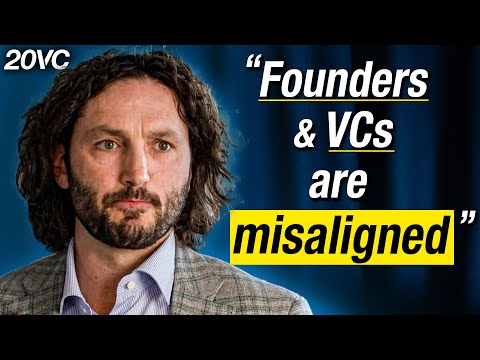
Zachary Bookman: Why Valuations and Fundraising are BS | E1235
Zachary (Zac) Bookman (guest), Harry Stebbings (host), Narrator
In this episode of The Twenty Minute VC, featuring Zachary (Zac) Bookman and Harry Stebbings, Zachary Bookman: Why Valuations and Fundraising are BS | E1235 explores zachary Bookman Exposes Venture Capital Myths, Vertical SaaS Truths, Timelines Zachary Bookman, founder and CEO of OpenGov, explains why venture valuations, fundraising headlines, and standard VC expectations are often disconnected from how enduring software businesses actually get built. He contrasts the slow, 15–20 year reality of company building with the power‑law, $10B‑outcome requirements of modern venture funds, arguing that most founders dramatically misunderstand investor incentives.
Zachary Bookman Exposes Venture Capital Myths, Vertical SaaS Truths, Timelines
Zachary Bookman, founder and CEO of OpenGov, explains why venture valuations, fundraising headlines, and standard VC expectations are often disconnected from how enduring software businesses actually get built. He contrasts the slow, 15–20 year reality of company building with the power‑law, $10B‑outcome requirements of modern venture funds, arguing that most founders dramatically misunderstand investor incentives.
He dives into the hard-won lessons from building OpenGov selling into government — a slow, unsexy but extremely sticky vertical — including pricing strategy, product suite expansion, M&A as innovation, and the centrality of high gross retention over flashy growth. Bookman also details his mistakes: overspending before product‑market fit, expanding TAM too early, raising too much money, and going remote‑first.
The conversation culminates with the $1.8B sale of OpenGov to Cox Enterprises and an unusual deal structure that cashed out investors and employees while keeping Bookman heavily invested and operating for the long term. Interwoven through the business discussion are candid reflections on founder psychology, money, safety, work-life tradeoffs, and why he believes many VC returns and private markets are far weaker than the industry admits.
Key Takeaways
Venture funds really run on 15–20 year timelines, not 7–10.
Bookman argues that meaningful software outcomes typically take 15–20 years, which means LP capital is locked far longer than marketing decks suggest, and many VC portfolios are nowhere near distributing real cash despite paper markups.
Get the full analysis with uListen AI
Understand that your investor’s business is a power law – you may never ‘move the needle’.
Modern mega-funds need $10B+ outcomes; a $500M–$2B exit that can transform a founder’s life often doesn’t materially impact a large VC fund, so founders must stop assuming perfect alignment and optimize first for their company and common shareholders.
Get the full analysis with uListen AI
In enterprise SaaS, small ACVs and long human-driven sales motions are a broken model.
Selling $5–10K deals with expensive enterprise sales and deployment teams is structurally upside-down; you either need true PLG economics or you must drive ASPs dramatically higher, often through multi-product suites and deeper verticalization.
Get the full analysis with uListen AI
High gross retention is “the whole game” in enterprise SaaS, especially in govtech.
Bookman emphasizes that gross retention in the mid-to-high 90s turns revenue into near-annuity streams and underpins durable, compounding growth even if headline growth rates never hit flashy 70–100% levels.
Get the full analysis with uListen AI
Raising too much, too early, before real product-market fit is often fatal.
Easy early money led OpenGov to overspend on sales and marketing before the product and packaging were right; once he cut spend, narrowed ICP, and focused on suite expansion, growth actually improved — “cut more, grow faster.”
Get the full analysis with uListen AI
M&A can be a form of innovation, not just a buy-revenue shortcut.
Acquiring high-quality, adjacent products with real but early product-market fit let OpenGov skip years of painful discovery in complex government workflows, then double down on R&D to scale them as part of a coherent suite.
Get the full analysis with uListen AI
Remote-by-default hurt culture, performance, and retention; in-office collaboration still matters.
After going fully distributed in 2020, Bookman concluded productivity, connection, and commitment suffered; bringing people back has been painful but, in his view, clearly superior, and he now ‘wishes remote’ on his competitors.
Get the full analysis with uListen AI
Notable Quotes
“Your business runs on a power law. Your business is about finding the next Coinbase.”
— Zachary Bookman (to Harry Stebbings about venture funds)
“OpenGov's been quite successful, but it doesn't move the needle. It's a couple of billion dollar type exit. That's not what you're in the game for.”
— Zachary Bookman
“Real companies measure revenue, not logos.”
— Marc Andreessen (as recounted by Zachary Bookman)
“Spend less, grow faster. It's a weird law.”
— Zachary Bookman
“I grew up, I never felt safe. I never felt safe at home… There’s a sense of security that's come from some of this that I often will walk around and just try to tell myself, ‘You're okay. It's safe.’”
— Zachary Bookman
Questions Answered in This Episode
If most venture funds truly require 15–20 years to return capital, how should LP expectations, fee structures, and reporting norms change to reflect that reality?
Zachary Bookman, founder and CEO of OpenGov, explains why venture valuations, fundraising headlines, and standard VC expectations are often disconnected from how enduring software businesses actually get built. ...
Get the full analysis with uListen AI
For founders in unsexy but sticky verticals like govtech, how should they decide whether to pursue venture scale or optimize for sustainable, moderately-sized but highly profitable outcomes?
He dives into the hard-won lessons from building OpenGov selling into government — a slow, unsexy but extremely sticky vertical — including pricing strategy, product suite expansion, M&A as innovation, and the centrality of high gross retention over flashy growth. ...
Get the full analysis with uListen AI
What leading indicators can a founder use to know they are overspending ahead of product-market fit, and how aggressively should they cut before they harm growth?
The conversation culminates with the $1. ...
Get the full analysis with uListen AI
How can a CEO practically balance the benefits of M&A-driven innovation with the cultural and integration risks that often derail acquisitions?
Get the full analysis with uListen AI
Given Bookman’s experience with remote work reversals, what specific roles or functions, if any, can remain fully distributed without sacrificing performance and cohesion?
Get the full analysis with uListen AI
Transcript Preview
I'm an LP in legit funds. Where's the money? Where's the money? How many years has to go by? People think these companies take like five, seven, nine, 10 years. Not true. They take like 15 to 20. That means your venture fund takes 15 to 20 years to distribute the money. Your business runs on a power law. Your business is about finding the next Coinbase. OpenGov's been quite successful, but it doesn't move the needle. It's a couple of billion dollar type exit. That's not what you're in the game for.
Ready to go? Zach, dude, I am so excited for this. Listen, when we first had our call, it's quite rare to have the rapport that we did straight off. So first, thank you so much for joining me today, man.
I'm really happy to be here. Thanks for having me, Harry.
Listen, not at all. But I wanna dive right in and I wanna start at kind of the company creation point. You said before when it comes to starting a company that it takes too long. I wanna start with, what did you mean by it takes too long in that respect?
There's like a wilderness period and the- some companies come out of the gate and these entrepreneurs they, they, they get the, the, the kudos rightfully if they just shoot off, and there's a lot of companies that just bobble along in the wilderness. We were one of them. As I look back on our first few years, I don't know what we were doing. It was a learning period. W- it was confusing because we were s- we actually came out of the gates selling about a year in, but we were selling $5,000 software, $10,000 software, transparency, reporting. It was kind of a political sale. Governments would buy it to show off the data in their 30, 40-year-old ERP green screen systems and I got tricked into thinking it was 1999, you're gonna sell it for a loss and make it up on volume. And I realized at year end, "Oh my god, we, we've got to broaden the suite. We've gotta get average selling prices higher." And it wasn't really until probably five years into the company that things started working. So when you're selling enterprise software, you're basically breaking into organizations. Organizations are filled with people and people disagree with each other, and when you're building a business, alignment is the most important thing you can get for execution. And when you're looking at a customer, how do you get them aligned on buying your product? Well, you have salespeople, you have marketing, you might have customer success or professional services. You're breaking down the walls, you're trying to create alignment, and that's expensive. People are super expensive, especially, you know, good-looking salespeople wearing sport jackets and wearing Breitling watches and what have you. These are expensive and you're not gonna make up the cost of sales and marketing by selling 10K software unless you're like a Dropbox where you can, you know, or some product-led growth phenomenon, and there are a few of those, and I think we all wish we'd had a company like that. If you can do that, more power to you. But even when they get to a certain size, they start trying to break down the enterprise, and that means you've gotta have an enterprise motion, which means salespeople, which means expensive, which means sale cycles, and the ASPs have to go up.
Install uListen to search the full transcript and get AI-powered insights
Get Full TranscriptGet more from every podcast
AI summaries, searchable transcripts, and fact-checking. Free forever.
Add to Chrome