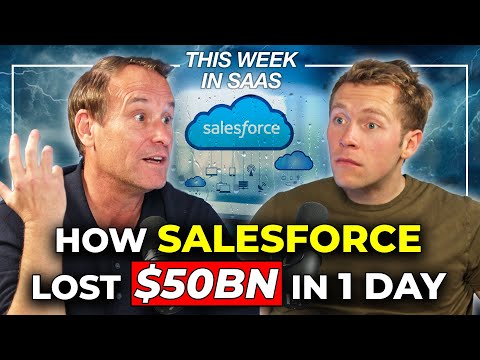
Jason Lemkin: PluralSight S*** the Bed & The Next IPO Candidates | E1160
Jason Lemkin (guest), Harry Stebbings (host)
In this episode of The Twenty Minute VC, featuring Jason Lemkin and Harry Stebbings, Jason Lemkin: PluralSight S*** the Bed & The Next IPO Candidates | E1160 explores saaS Turbulence: PE Wipeouts, Slowing Giants, But New Winners Rising Harry Stebbings and Jason Lemkin dissect a brutal but revealing week in SaaS: Vista’s Pluralsight write‑off, Salesforce and Mongo’s growth resets, and compressed public market multiples. They argue that the private equity ‘savior’ narrative is cracking, liquidity is scarce, and public markets are demanding profitability at the expense of R&D. At the same time, a cohort of non‑tech, vertical, and B2B2C SaaS companies—like Canva, Toast, Samsara, Zscaler, and Klaviyo—are still growing 30–40%+ at scale, showing SaaS is not universally “broken.” The conversation also covers AI as largely substitutional spend, venture dynamics (TVPI vs DPI, secondaries, fund strategy), and the future IPO pipeline, alongside Lemkin’s candid reflections on being both an investor and SaaStr operator.
SaaS Turbulence: PE Wipeouts, Slowing Giants, But New Winners Rising
Harry Stebbings and Jason Lemkin dissect a brutal but revealing week in SaaS: Vista’s Pluralsight write‑off, Salesforce and Mongo’s growth resets, and compressed public market multiples. They argue that the private equity ‘savior’ narrative is cracking, liquidity is scarce, and public markets are demanding profitability at the expense of R&D. At the same time, a cohort of non‑tech, vertical, and B2B2C SaaS companies—like Canva, Toast, Samsara, Zscaler, and Klaviyo—are still growing 30–40%+ at scale, showing SaaS is not universally “broken.” The conversation also covers AI as largely substitutional spend, venture dynamics (TVPI vs DPI, secondaries, fund strategy), and the future IPO pipeline, alongside Lemkin’s candid reflections on being both an investor and SaaStr operator.
Key Takeaways
Private equity is no guaranteed exit path for SaaS anymore.
Vista writing Pluralsight down from a $3. ...
Get the full analysis with uListen AI
Classic B2B SaaS selling into tech is in a structural downcycle.
Salesforce, Mongo, Workday, and others are ratcheting down growth expectations, with Salesforce projecting mid‑single‑digit growth and weak NRR as customers cut seats and shrink deal sizes; selling B2B software to tech buyers (“B2B2B”) remains brutal, even as broader macro indicators are fine.
Get the full analysis with uListen AI
Non‑tech, vertical, and B2B2C SaaS are still growing aggressively.
Canva (~$2. ...
Get the full analysis with uListen AI
AI spend is largely substitutional, not net‑new budget—yet.
Enterprises are funding AI by killing existing tools (e. ...
Get the full analysis with uListen AI
Founders must know exactly where their budget comes from and ask.
In a world of constrained and reallocated spend, strong enterprise sellers explicitly ask early in discovery whether a project is budgeted and from which line; founders who don’t understand the budget source—and what must be cut to fund them—risk being swapped out to free up AI or other priorities.
Get the full analysis with uListen AI
Over‑raising is an unforced fundraising error that quietly kills deals.
Founders still show up with 2021‑style asks (e. ...
Get the full analysis with uListen AI
Compressed multiples threaten venture math unless they reflate.
Even strong new IPOs like Klaviyo and Rubrik trade around ~6x revenue instead of 15–20x, and Lemkin argues venture economics require a 30–40% multiple rebound (to ~8x average for quality SaaS) for rounds above ~$100M post‑money to make sense; otherwise, many late‑stage investments simply can’t return funds.
Get the full analysis with uListen AI
Notable Quotes
““If a lot of these big PE deals can’t service their debt, we’re writing off tens of billions. This is not a trillion‑dollar industry.””
— Jason Lemkin
““Everyone on Twitter thinks there’s one root cause. But if Canva’s at $2.3 billion growing 40%, Samsara’s growing 40% at over a billion, and Zscaler’s growing 40% at two billion, you can’t say all is bad.””
— Jason Lemkin
““So far the evidence is no: incumbents will build great AI products, but it’s not clear they’ll get any revenue boost from it.””
— Jason Lemkin
““I think we’ve made a terrible pact with the devil in public SaaS: the market wants 30–40% margins, but there’s no money left for R&D.””
— Jason Lemkin
““One large accidental mistake founders make in fundraising is asking for too much money.””
— Jason Lemkin
Questions Answered in This Episode
If PE exits become less reliable and IPO windows stay narrow, what new liquidity mechanisms or structures could emerge for late‑stage SaaS companies?
Harry Stebbings and Jason Lemkin dissect a brutal but revealing week in SaaS: Vista’s Pluralsight write‑off, Salesforce and Mongo’s growth resets, and compressed public market multiples. ...
Get the full analysis with uListen AI
How should a B2B startup selling into tech decide whether to pivot toward non‑tech, vertical, or SMB segments where budgets are healthier?
Get the full analysis with uListen AI
What concrete metrics or signals should founders track to know whether AI is actually expanding their revenue versus just cannibalizing existing features and SKUs?
Get the full analysis with uListen AI
Given today’s multiples, at what valuation and stage does it *no longer* make sense for founders to raise additional growth capital versus focusing on profitability?
Get the full analysis with uListen AI
How can founders balance the need to aggressively cut burn and hit efficiency targets while still funding enough R&D—especially AI—so they don’t get out‑innovated by competitors?
Get the full analysis with uListen AI
Transcript Preview
Salesforce lost $50 billion in market cap. The issue is that Salesforce said, "We have fallen to single digit growth and we're not coming back." (guitar music plays) Ready to go?
Jason, I am so excited for this, dude. First, this is the first one we've ever done in person.
I- I am so excited. Uh, it- it is great. The studio's great. Um, this is better. I'm- I'm just so proud of the team, everything at 20VC. It's great. So it's great to be here.
Dude, it is so lovely to make it happen in person.
Yes.
Now, this is, like, a new show in the way that we're calling it This Week in SaaS. I want to do a-
Yes. You're gonna do it 52 weeks for this?
Oh, we're gonna do 52 weeks, and you are too.
Okay, very good.
Yeah. No, you didn't... You didn't get the memo? (laughs)
(laughs) I did not. I- the- the Google Doc share did not work properly, but okay.
Oh, right. Okay, well, so basically it's like This Week in SaaS.
Yeah.
We go through the biggest stories from the prior week in SaaS-
Okay.
... and unpack them. Okay?
All right. You picked a heck of a week.
I picked one hell of a week.
(laughs)
And so we're gonna start at, like, all positivity in mind.
Go ahead.
Pluralsight, right?
Pluralsight.
Yeah. Uh, so-
Okay. (laughs)
So the Pluralsight news was that Vista wrote down their three and a half billion dollar buyout of Pluralsight last week to zero.
Crazy. Crazy.
Crazy.
Yeah.
Can you unpack just what actually happened, for those that didn't hear about it?
I mean, they- they bought Pluralsight for, you know, three and a half billion, and they couldn't service the debt. They raised one point-... They used 1.5 billion of debt, which is the PE playbook, right? And I assume, I assume they had to refinance it, right? So let's... They said, the press said that Pluralsight had about almost 30% operating margins now. So let's say they're doing 300 million in ARR.
Yeah.
So they're generating 100 million of free cash. Maybe let's handicap it to 80. But the debt service on a billion and a half was too much, right? The debt service. So they walked away. The story seems odd, and I also read that they put some of their IP in another, second company, so there may be some other odd things going. But literally, to mark down three and a half billion out of, what, a $20 billion fund probably, something like that, right? That's- that's- that's devastating. More- more worrisome is, you had Mark Suster on the show recently, right?
Mm-hmm.
And he was talking about how PE is gonna be the big savior.
Install uListen to search the full transcript and get AI-powered insights
Get Full TranscriptGet more from every podcast
AI summaries, searchable transcripts, and fact-checking. Free forever.
Add to Chrome