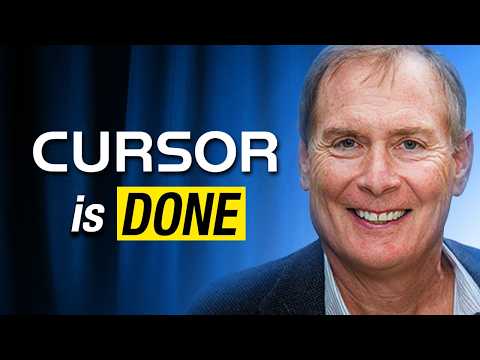
The SaaS Apocalypse: Who Lives & Who Dies | Insight Partners Co-Founder, Jerry Murdock
Jerry Murdock (guest), Harry Stebbings (host)
In this episode of The Twenty Minute VC, featuring Jerry Murdock and Harry Stebbings, The SaaS Apocalypse: Who Lives & Who Dies | Insight Partners Co-Founder, Jerry Murdock explores autonomous agents trigger SaaS upheaval, reshaping investing, work, and infrastructure Murdock frames autonomous agents as an approaching tsunami: manageable at a distance, destructive once they “hit the beach,” with multiple waves and messy second-order effects.
Autonomous agents trigger SaaS upheaval, reshaping investing, work, and infrastructure
Murdock frames autonomous agents as an approaching tsunami: manageable at a distance, destructive once they “hit the beach,” with multiple waves and messy second-order effects.
He claims agentic coding is already making today’s AI-dev tooling (even high-valued products like Cursor) feel quickly obsolete, and predicts an emerging open-source “agent stack” akin to the LAMP stack era.
He expects an orchestration layer that routes workloads across multiple models (closed and open source), which in turn accelerates commoditization pressure on models and catalyzes specialized compute (ASICs) to complement/pressure Nvidia—depending on execution and CUDA’s portability.
Beyond tech, he predicts agents will become “employees” with identities and credentials, shifting software go-to-market toward consumption pricing and creating major labor-market and political consequences, including serious momentum toward UBI/minimum viable income.
Key Takeaways
Autonomous agents are the real discontinuity, not “AI features.”
Murdock treats agent autonomy (acting without constant review) as the step-change that turns AI from helpful tooling into a force that rewires software creation, purchasing, and operations—like a tsunami that matters most at the shoreline.
Get the full analysis with uListen AI
AI-native posture beats “bolt-on” AI in durability.
Adding AI may buy time or even an exit, but he argues long-term winners will be built around agent-first assumptions and deeply plugged into fast-moving developer/open-source ecosystems.
Get the full analysis with uListen AI
Open-source agent ecosystems may create the next “LAMP stack.”
He expects a standardized, widely adopted agent stack (he references “Claw stack”) driven by sheer community integration volume—analogous to how LAMP enabled the 2004–2005 website and commerce explosion.
Get the full analysis with uListen AI
The orchestration layer will decide which models win workloads.
Rather than developers hard-coding allegiances, agents will triage tasks across models (e. ...
Get the full analysis with uListen AI
ASIC adoption is a logical downstream effect of agent-driven workload routing.
As workloads become modular and measurable, specialized chips that embed/tune models for specific tasks become attractive on cost/performance—posing a threat to Nvidia unless CUDA and execution keep Nvidia central.
Get the full analysis with uListen AI
Speed and infrastructure details matter more when the ‘user’ is an agent.
He highlights E2B sandboxes dropping latency from ~400ms (human-noticeable) to ~80ms (agent-noticeable), because agents can spin up massive parallel sandboxes—turning previously ‘minor’ performance gaps into major productivity levers.
Get the full analysis with uListen AI
Systems of record won’t vanish overnight, but their value becomes execution-dependent.
He frames Salesforce as a “Mount Everest” that persists, yet its value will be judged by the health of companies built atop it; similarly, Carta could become far more valuable if it captures tokenization workflows—or be bypassed if new records emerge.
Get the full analysis with uListen AI
Selling software will shift from human-centric GTM to agent-centric consumption.
As agents become credentialed “employees,” buying becomes usage-driven and policy-governed; Murdock points to consumption models (e. ...
Get the full analysis with uListen AI
Labor displacement hits hiring first, then headcount—SMBs first, enterprises last.
He predicts a near-term hiring slowdown for white-collar, computer-mediated roles (assistants, marketing, junior devs), with SMBs adopting faster due to immediate ROI, while regulated/complex enterprises lag but will be heavily targeted by major AI labs.
Get the full analysis with uListen AI
In venture, timing remains the strongest correlate—plus intuition without wishful thinking.
He argues fund vintage/timing dominates outcomes (e. ...
Get the full analysis with uListen AI
Notable Quotes
““It’s harmless when it’s out at sea. It’s only dangerous when it hits the beach.””
— Jerry Murdock
““Autonomous agents is, in my opinion, what the tsunami’s about, not just AI in general.””
— Jerry Murdock
““For most of the companies… their view… is Cursor is obsolete.””
— Jerry Murdock
““You’ve gone from an assistant to actual employee.””
— Jerry Murdock
““Timing… is the most important thing.””
— Jerry Murdock
Questions Answered in This Episode
What exactly are “OpenClaw” and “NanoClaw” in this conversation—products, frameworks, or a broader agent pattern—and what capabilities make them feel like a step-change?
Murdock frames autonomous agents as an approaching tsunami: manageable at a distance, destructive once they “hit the beach,” with multiple waves and messy second-order effects.
Get the full analysis with uListen AI
You predict a ‘Claw stack’ analogous to LAMP: what are the concrete layers (identity, sandboxing, memory, orchestration, tool-use, eval/monitoring) and who is best positioned to own each?
He claims agentic coding is already making today’s AI-dev tooling (even high-valued products like Cursor) feel quickly obsolete, and predicts an emerging open-source “agent stack” akin to the LAMP stack era.
Get the full analysis with uListen AI
If agents route workloads across Claude/Gemini/open-source models, where does pricing power concentrate: the orchestration layer, proprietary data, distribution, or hardware?
He expects an orchestration layer that routes workloads across multiple models (closed and open source), which in turn accelerates commoditization pressure on models and catalyzes specialized compute (ASICs) to complement/pressure Nvidia—depending on execution and CUDA’s portability.
Get the full analysis with uListen AI
What would have to be true for Nvidia to *not* be structurally threatened by ASICs—does CUDA portability fully protect them, or does value inevitably leak to chip designers and hyperscalers?
Beyond tech, he predicts agents will become “employees” with identities and credentials, shifting software go-to-market toward consumption pricing and creating major labor-market and political consequences, including serious momentum toward UBI/minimum viable income.
Get the full analysis with uListen AI
In an agent-driven world, what moats remain for application SaaS—workflow ownership, data/network effects, compliance, embedded distribution, or systems-of-record gravity?
Get the full analysis with uListen AI
Transcript Preview
Most of the companies, their view, as they've told me, is Cursor is obsolete. That's where the product is today. What we have with the tsunami happening is a wake-up call to move to higher ground. Don't get caught on the beach when the damn thing hits the beach.
Jerry Murdock is one of the most influential venture capitalists of the last three decades. He's a co-founder of Insight, which now manages more than ninety billion dollars. He led one of the most eminent rounds for Twitter, and today we sit down to discuss his biggest lessons from thirty years of investing.
If I have any wisdom at all, it's because I've [censored] up so much, and I've learned from it. You really don't know the edge unless you go over it. Here's the secret, the real secret: I never left the game. I was lucky because I was losing money every year I've been in this business. [laughing] I've failed. Money does not come with instructions.
Ready to go? [upbeat music] Jerry, I've known you for years.
[laughs]
I've wanted to make this happen literally since we first had that lunch, so thank you so much for joining me today.
Hey, happy to be here.
Now, I think it's such an interesting time because bluntly, me and a generation of investors are going, "Hang on a minute. Is everything that we've been taught for the last five to ten years completely irrelevant?" And now I get to sap on your wisdom for the next hour. When we chatted the other day, you said about tsunamis as an analogy for where we are with the AI wave that we currently face.
Right.
What, what did you mean by the tsunamis, and how do you-
Well, fir-first, the first thing to think about a tsunami is that it's harmless when it's out at sea. It's only dangerous when it hits the beach. Um, that's number one. Number two, it's messy. You're gonna get maybe an earthquake or two, you know, notifying [laughs] there's something possibly coming. And it's not just one wave. There's, there's these pre-peak waves and post-peak waves, but there's an event coming that is more than a single product, and in this case, it's autonomous agents. Autonomous agents is, is in my opinion what the tsunami's about, um, not just AI in general.
So autonomous agents is the big wave that comes. And so where are we now? We're in the anticipatory period where we can see it coming, and that's why we're seeing the SaaSica or the SaaS apocalypse. Is that the case?
I, I'm not a doomsayer. I, I'm-- but I am one to say, "Look, change is coming fast, and you need to, you need to anticipate that. You need to be on top of that." And, you know, the idea of, "Oh, I can just bolt on AI to my company," it's possibly true. You can maybe get an exit. But being AI native and thinking that way is gonna make you a better company, and thinking deeply about what, what is going on in the, in the communities that are, that are, that are driving the tsunami, right? And, uh, those, those open source communities that are popping up in massive amounts, they're the ones that are gonna have the big impact.
Install uListen to search the full transcript and get AI-powered insights
Get Full TranscriptGet more from every podcast
AI summaries, searchable transcripts, and fact-checking. Free forever.
Add to Chrome