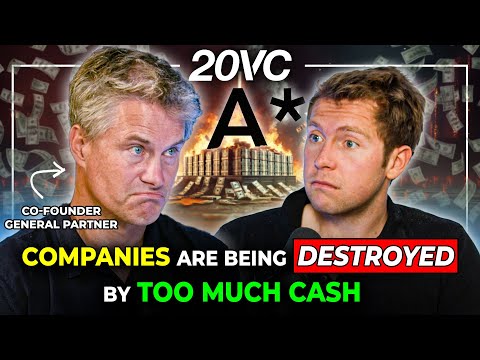
Kevin Hartz: "How I Lost Airbnb at Seed Because of an Exploding Term Sheet" | E1180
Kevin Hartz (guest), Harry Stebbings (host), Narrator
In this episode of The Twenty Minute VC, featuring Kevin Hartz and Harry Stebbings, Kevin Hartz: "How I Lost Airbnb at Seed Because of an Exploding Term Sheet" | E1180 explores kevin Hartz on Talent, Venture Discipline, and Missing Airbnb’s Seed Lead Kevin Hartz joins Harry Stebbings to unpack his journey from angel investor and founder (Eventbrite, early Airbnb, Pinterest, Uber, Bitcoin) to running a $300M seed fund, A*. He explains how he evaluates exceptional founders, the dangers of too much capital too early, and why he rarely sells his winners despite extreme price spikes. Hartz contrasts different venture styles (Sequoia vs. Founders Fund), discusses ownership, exploding term sheets, and capital concentration, and argues that venture is entering a massive AI-driven bubble with huge upside. The conversation also turns personal, as Hartz talks candidly about his daughter’s eating disorder, mental health, and why neurological illness will be a defining medical challenge.
Kevin Hartz on Talent, Venture Discipline, and Missing Airbnb’s Seed Lead
Kevin Hartz joins Harry Stebbings to unpack his journey from angel investor and founder (Eventbrite, early Airbnb, Pinterest, Uber, Bitcoin) to running a $300M seed fund, A*. He explains how he evaluates exceptional founders, the dangers of too much capital too early, and why he rarely sells his winners despite extreme price spikes. Hartz contrasts different venture styles (Sequoia vs. Founders Fund), discusses ownership, exploding term sheets, and capital concentration, and argues that venture is entering a massive AI-driven bubble with huge upside. The conversation also turns personal, as Hartz talks candidly about his daughter’s eating disorder, mental health, and why neurological illness will be a defining medical challenge.
Key Takeaways
Power laws reward extreme patience; default to holding winners.
Hartz argues that if you simply hold all positions, most go to zero but a tiny number of outliers (Airbnb, Bitcoin, Uber) dominate returns so completely that selling early, even at huge paper multiples, often destroys long-term upside.
Get the full analysis with uListen AI
Excess capital early can quietly kill great companies.
He likens fundraising to Boyle’s Law: whether a startup raises $1M or $10M, it tends to expand spending to fill the account but still reaches similar milestones; too much money plus too little oversight erodes discipline and focus.
Get the full analysis with uListen AI
The spikiest individual founder matters more than the perfect founding team combo.
Echoing Matt Clifford, Hartz prioritizes the single most exceptional person—the ‘Paul McCartney or John Lennon’—over balanced skill matrices, especially in first-time founders who are young, fearless, and highly creative.
Get the full analysis with uListen AI
Hands-on, thoughtful investors can materially improve outcomes.
While admiring Founders Fund’s ‘just give them money’ model for Elons and Zucks, Hartz leans toward the Sequoia style: active help in hiring, go-to-market, and judgment, which he’s seen prevent avoidable mistakes and accelerate growth.
Get the full analysis with uListen AI
Exploding term sheets are usually a symptom of trust and process failure.
He admits using an exploding term sheet with Airbnb and being reprimanded by Paul Graham; Hartz now sees that while investors fear being shopped, founders reasonably need time to diligence partners, and both sides can behave badly.
Get the full analysis with uListen AI
Conviction and capital concentration drive fund outcomes.
Drawing on Founders Fund examples, he emphasizes going ‘all in’ on a few companies, pushing past artificial per-company caps, because great funds are remembered as ‘the Airbnb fund’ or ‘the SpaceX fund,’ not for broad but shallow diversification.
Get the full analysis with uListen AI
Neurological and mental health disorders are the next major therapeutic frontier.
Prompted by his daughter’s severe eating disorder, Hartz notes how underdeveloped and barbaric current treatments are, and believes the next big medical push—akin to the war on cancer—will target brain and psychiatric conditions.
Get the full analysis with uListen AI
Notable Quotes
“I’m not in the practice of selling. I’m in the practice of finding and building companies and sitting on these things for life.”
— Kevin Hartz
“If you raise a million dollars, you’ll build a company with that million. If you raise ten, you’ll spend it just the same and get to the same milestones.”
— Kevin Hartz
“I don’t think you should win a deal. I think you should earn the right to work with a founder for many, many years.”
— Kevin Hartz
“NVIDIA becoming the most valuable company on the planet is just the precursor towards the bubble of all bubbles of the AI bubble.”
— Kevin Hartz
“Everyone always answers insincerely about what their weakness is, but like, what is your mental illness? Is it depression, anxiety, bipolar, addiction?”
— Kevin Hartz
Questions Answered in This Episode
How should founders decide how much capital to raise at seed without undermining future discipline and optionality?
Kevin Hartz joins Harry Stebbings to unpack his journey from angel investor and founder (Eventbrite, early Airbnb, Pinterest, Uber, Bitcoin) to running a $300M seed fund, A*. ...
Get the full analysis with uListen AI
In practice, how can an investor distinguish between a merely charismatic storyteller and the ‘spiky’ outlier founder worth betting the fund on?
Get the full analysis with uListen AI
What concrete governance and support structures best balance founder freedom with the oversight Hartz believes prevents drift?
Get the full analysis with uListen AI
Given his experience with OpenSea and Facebook-era secondaries, what specific framework would Hartz now use to decide when to sell part of a winner?
Get the full analysis with uListen AI
What kinds of startups or therapeutic approaches does Hartz believe could finally make eating disorders and other neurological illnesses tractable—and investable?
Get the full analysis with uListen AI
Transcript Preview
NVIDIA becoming the most valuable company on the planet is just the precursor towards the bubble of all bubbles. If you look historically over the decades, that if you just sit on all the companies, you know, and m- most will go to zero. Your power law winners will be so massive, they'll just dwarf everything else. I'm not in the practice of selling. I'm in the practice of finding and building companies and sitting on these things for life.
Ready to go? Kevin, I cannot believe that we have not done this in person before. First, it's wonderful to have you in London. Second, thank you so much for joining me today.
Thank you, Harry. It's wonderful to be here in London.
That is so kind of you. And as I said, I love doing this in person. It's so much nicer for me. Dude, I think so much of who we are is shaped by our childhoods. I remember when my mother got MS, and it really was, it was hard, but it was very defining moment for me. When you think back to your childhood, what was a really defining moment for you that sticks out in making you the person that you are?
Harry, you know I always look for founders that have overcome some incredible obstacles or kind of moved mountains. And, uh, my childhood was fairly uneventful. I just had an idyllic childhood all the way through, you know, wonderful parents, um, and went on to Stanford University. I'd say I, I hit my kind of life sort of crisis or, or uncertainty post, uh, university.
What was that?
I would just say I had a, a crisis of, of how I wanted to have an impact on the world. And very fortunately happened to be in the right place at the right time, and that is in Silicon Valley, uh, during this incredible first wave of technology innovation and the internet boom. And so I, I was lucky.
Can I ask you a weird question? But did you think that you would be successful when you were young? Often people have sometimes inevitability of success. They, they knew that they would be successful.
Most, uh, f- people I talk to that are founders that have gone on always knew from the very beginning. And I would look up at my father, who is now a retired attorney, and I would say like, "Wow, how am I ever gonna be, do better than my dad? He's, he's a la- a partner at a law firm. Wow."
(laughs) I, I love that. And it also goes against the like, what you hear, which is like, "I always knew I would be in this inevitability," which is almost quite hard for people listening, because it's sometimes insurmountable. Do you know what I mean?
It is. Um, and I think it wasn't a drive for success. It was a drive for learning and really not to be bored. And that's why Silicon Valley ... And Harry, when I say Silicon Valley, I'm no longer kind of referencing the geography. It's the wider technology ecosystem-
Install uListen to search the full transcript and get AI-powered insights
Get Full TranscriptGet more from every podcast
AI summaries, searchable transcripts, and fact-checking. Free forever.
Add to Chrome