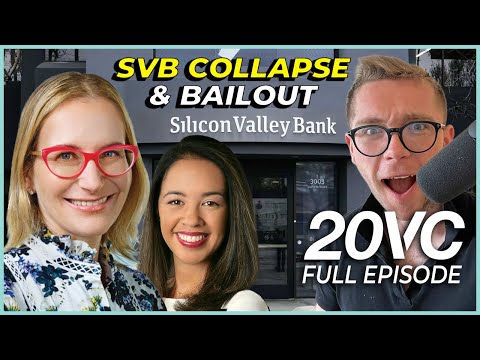
Jackie Reses & Kris Dickson: What Happened with SVB? Are VCs to Blame? | E988
Jackie Reses (guest), Harry Stebbings (host), Kris Dickson (guest), Narrator
In this episode of The Twenty Minute VC, featuring Jackie Reses and Harry Stebbings, Jackie Reses & Kris Dickson: What Happened with SVB? Are VCs to Blame? | E988 explores inside SVB’s Collapse: Risk, Rumors, Regulation, And Venture Capital Fallout The conversation unpacks why Silicon Valley Bank (SVB) failed, centering on its outsized interest-rate bet, concentrated tech/VC depositor base, and a disastrous capital-raise communication that triggered a rapid bank run.
Inside SVB’s Collapse: Risk, Rumors, Regulation, And Venture Capital Fallout
The conversation unpacks why Silicon Valley Bank (SVB) failed, centering on its outsized interest-rate bet, concentrated tech/VC depositor base, and a disastrous capital-raise communication that triggered a rapid bank run.
Jackie Reses and Kris Dickson explain how social media, instant messaging, and electronic banking accelerated depositor flight and turned a solvable balance-sheet problem into a liquidity crisis.
They outline the FDIC’s playbook: seizing the bank, assessing assets, paying insured deposits, making an advance dividend to uninsured depositors, and ideally engineering a fast sale to a larger bank.
The discussion also explores whether VCs caused the collapse, what founders should do now to manage banking risk, and why preserving a diverse community and regional banking system matters for the broader economy.
Key Takeaways
SVB’s core mistake was a massive duration and concentration risk bet.
SVB invested over $90B in long-dated, low-yield securities while funding them with a highly concentrated, flighty tech/VC depositor base; when rates rose and tech funding dried up, the mark-to-market losses and deposit outflows became lethal.
Get the full analysis with uListen AI
The capital raise announcement was sequenced and framed in a way that fueled panic.
Announcing a capital raise and exposing a funding hole before securing the money signaled weakness to a tightly networked VC community, prompting ‘no one wants to be last’ behavior and a rapid run instead of calming markets.
Get the full analysis with uListen AI
Psychology and social media can now topple a bank far faster than fundamentals alone.
Instant communication across VC portfolios, combined with electronic banking, allowed tens of billions to attempt to exit in a day; this speed changes how founders, boards, and regulators must think about liquidity and communication risk.
Get the full analysis with uListen AI
VCs were acting as fiduciaries, but many underestimated concentration and counterparty risk.
While pulling deposits was rational at the company level, many startups and funds had dangerously concentrated exposure to a single bank; going forward, VCs are likely to impose tighter rules on where and how portfolio companies hold cash.
Get the full analysis with uListen AI
The FDIC has tools to protect depositors, but speed and confidence are critical.
Typical steps include seizing the bank, paying insured deposits, selling liquid assets to fund an advance dividend to uninsured depositors, and orchestrating a sale; the best outcome is a buyer assuming deposits at par to avoid broader contagion.
Get the full analysis with uListen AI
Founders must treat treasury and banking as a core risk-management function.
Companies should diversify banking relationships (systemically important banks, strong regionals, possibly local banks), understand which bank sits under any neobank, avoid mixing corporate and personal funds, and build contingency plans for access to cash and data.
Get the full analysis with uListen AI
Over-concentration into ‘too-big-to-fail’ banks threatens the real economy’s credit flow.
If fear pushes deposits predominantly to the top few megabanks, community and regional banks lose funding capacity, starving local businesses, real estate, and Main Street economies that depend on local credit channels.
Get the full analysis with uListen AI
Notable Quotes
“At their core, banks are in the business of managing risk.”
— Kris Dickson
“That announcement did the exact opposite of what it intended to do, and it created immediate fears around the tech community.”
— Jackie Reses
“No one wants to be the last man standing in that bank with your deposits as the FDIC shows up.”
— Jackie Reses
“The real danger in SVB’s failure is a crisis of confidence among depositors more generally.”
— Kris Dickson
“If the outcome of all of this is a super concentration of funding and control of the banking system into systemically important institutions, that would be a travesty.”
— Kris Dickson
Questions Answered in This Episode
To what extent should bank regulators adjust capital and liquidity rules specifically for institutions with highly concentrated, tech-heavy depositor bases?
The conversation unpacks why Silicon Valley Bank (SVB) failed, centering on its outsized interest-rate bet, concentrated tech/VC depositor base, and a disastrous capital-raise communication that triggered a rapid bank run.
Get the full analysis with uListen AI
How can boards and founders design treasury policies that realistically balance operational convenience with diversification and counterparty risk?
Jackie Reses and Kris Dickson explain how social media, instant messaging, and electronic banking accelerated depositor flight and turned a solvable balance-sheet problem into a liquidity crisis.
Get the full analysis with uListen AI
What guardrails, if any, should exist around real-time social amplification (e.g., VC WhatsApp groups, Twitter) during bank stress events?
They outline the FDIC’s playbook: seizing the bank, assessing assets, paying insured deposits, making an advance dividend to uninsured depositors, and ideally engineering a fast sale to a larger bank.
Get the full analysis with uListen AI
How can policymakers preserve a robust community and regional banking ecosystem while still satisfying depositors’ understandable preference for perceived ‘too-big-to-fail’ safety?
The discussion also explores whether VCs caused the collapse, what founders should do now to manage banking risk, and why preserving a diverse community and regional banking system matters for the broader economy.
Get the full analysis with uListen AI
If a fast sale of SVB had not been possible, what alternative backstops or mechanisms could have prevented mass payroll failures and knock-on damage to the broader economy?
Get the full analysis with uListen AI
Transcript Preview
There are tons of rumors out there. There are three groups of people who know what's happening: the FDIC, the folks at SVB, and-
(jazzy music playing) Jackie, Chris, I'm so excited for this. Now I wanna start with a little bit of context, just on each of you and your role and position within the industry. So Jackie, we're gonna start with you. S- uh, well, tell me in, in the most polite and elegant way, how are you so relevant and well placed to speak on the current situation and the situation with SVB?
Well, I think that's kind of you, first of all. I currently am the chairman and CEO of Lead Bank, and we are a community bank in Kansas City that also provides infrastructure to the fintech industry. And so we work in depth with a lot of venture firms and companies in Silicon Valley to help build their products. I also have been the chairman of the Economic Development Council of the Federal Reserve in San Francisco. I was on that council for eight years. Um, and before that, I've worked in financial services for 30 years in all different kinds of capacities, helping to run a private equity firm, um, investing. You name it, I've worked across the board. Um, so that's my background.
You are such an OG, Jackie. I have to say-
(laughs)
... I was des- I was describing you to my mother before this. I was like, "She's just so cool." Um, anyway, uh, Chris, I wanna dive into your career. Tell me, quick context, what makes you so well placed?
Well, I joined Jackie at Lead Bank as the CFO late last summer. But for the 10 years before that, I was the CAO and then the CFO of the Lehman Brothers post-bankruptcy parent estate. Um, through the end of 2022, that estate had liquidated and distributed over $129 billion of assets. Uh, it's unfortunate that we're now in this place where that kind of experience is now weirdly relevant.
It is indeed relevant. And so I wanna dive kind of straight into the events, because I think there's still a lot of unknowns around why this happened and essentially where we're going from here. So I want to start on why this happened. Chris, if we start with you, why did this happen, and what's the cause of SVB going bust in this way?
We'll start with basic principles. At their core, banks are in the business of managing risk. They take in customer deposits and they pay interest on those deposits. Then they invest those funds at a higher yield to make a spread, and there are risks that have to be carefully balanced and managed on both sides of that equation, and those risks are super dynamic. They can evolve over time, like say, fed rates, or in today's hyper-connected media verse, of which you are a significant part, they can convulse almost spontaneously. Depositors can pull funds at any time, and banks have to manage investments for both yield and liquidity. And that balance is every bank's primary challenge. For SVB, this challenge was particularly acute, as their deposit base and their loan portfolio were heavily concentrated in the VC tech startup ecosystem. At the, at the height of the recent tech boom in 2021, SVB was awash in deposits while interest rates were near zero. Uh, and at the time, the fed messaging was that rates were going to be, uh, kept pretty low. So SVB invested heavily in long-dated securities, over $90 billion, mostly in MBS with maturities greater than 10 years. So again, just take that in, because that's a huge bet. They held these securities in their balance sheet as held-to maturity, which means they were signaling they had no intent to sell these, uh, to meet liquidity needs. And because of that, they were not required to reflect any mark-to-market adjustments on these securities in their financials. That's a huge bet on the sustainability of low rates and continued tech momentum. Then 2022 happened and momentum flipped on both. The Fed changed course toward aggressive rate hikes to try to staunch inflation, and VC funding slowed, and many once cash-happy, uh, tech startups became cash burners. And so for SVB, that meant deposits shrunk, interest expenses ballooned, and their giant investment portfolio, which now have yields way less than the fed rate, uh, was worth less and less. At the end of '22, they reported $91 billion of held-to-maturity securities with a val- an actual value of 76 billion. That 15 do- $15 billion gap was bigger than their market cap for most of the fourth quarter. So that mark-to-market gap and the fear about what that gap could mean about the bank's soundness is what ultimately led to the bust. SVB's depositors, which were super concentrated in this hyper-connected VC tech ecosystem, started pulling their funds en masse. SVB had to sell some of those securities, which they had held to maturity at a hefty loss to meet those demands. But then that loss led to a capital hole, and they tried to fill, unsuccessfully, that capital hole with a last-minute $2 billion capital raise. When that didn't materialize, depositors panicked and attempted to withdraw over $40 billion in a single day. And when SVB couldn't meet those with- uh, withdraw- withdrawal requests, they had no choice but to hand the keys to the FDIC. It's a tough story.
Install uListen to search the full transcript and get AI-powered insights
Get Full TranscriptGet more from every podcast
AI summaries, searchable transcripts, and fact-checking. Free forever.
Add to Chrome