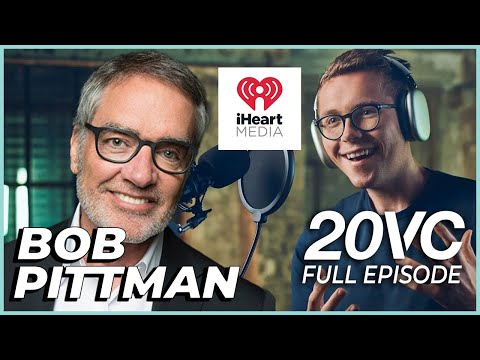
Bob Pittman: How I Went from Creator of MTV to CEO of iHeartMedia | 20VC #958
Harry Stebbings (host), Bob Pittman (guest)
In this episode of The Twenty Minute VC, featuring Harry Stebbings and Bob Pittman, Bob Pittman: How I Went from Creator of MTV to CEO of iHeartMedia | 20VC #958 explores from Small-Town DJ to Media Visionary: Bob Pittman’s Playbook Bob Pittman traces his journey from a 15‑year‑old small‑town radio DJ to building MTV, scaling AOL, and leading iHeartMedia, emphasizing serendipity, curiosity, and underappreciated assets like audio. He explains his leadership philosophy: obsessive focus on clear goals, building complementary teams, worshipping dissent, making fast decisions, and ruthlessly killing non‑winners. Pittman dives deeply into consumer psychology and messaging, arguing that convenience beats quality, that positioning and category choice often matter more than product, and that great storytelling combines rigorous audience understanding (“math”) with emotional magic. He also reflects on money, parenting, and work–life integration, stressing that careers and companies should be guided by curiosity and learning rather than rigid life plans or legacy goals.
From Small-Town DJ to Media Visionary: Bob Pittman’s Playbook
Bob Pittman traces his journey from a 15‑year‑old small‑town radio DJ to building MTV, scaling AOL, and leading iHeartMedia, emphasizing serendipity, curiosity, and underappreciated assets like audio. He explains his leadership philosophy: obsessive focus on clear goals, building complementary teams, worshipping dissent, making fast decisions, and ruthlessly killing non‑winners. Pittman dives deeply into consumer psychology and messaging, arguing that convenience beats quality, that positioning and category choice often matter more than product, and that great storytelling combines rigorous audience understanding (“math”) with emotional magic. He also reflects on money, parenting, and work–life integration, stressing that careers and companies should be guided by curiosity and learning rather than rigid life plans or legacy goals.
Key Takeaways
Relentlessly focus on clear goals, but stay flexible on tactics.
Pittman’s GHOST framework (Goals, Objectives, Strategy, Tactics) keeps direction stable while allowing constant tactical adjustment; plans are reworked weekly, but the fundamental mission rarely changes.
Get the full analysis with uListen AI
Build teams around complementary strengths and encourage dissent.
He deliberately hires people unlike himself and “worships dissent,” insisting teams surface and examine objections (X, Y, Z) so those constraints become the to‑do list for making ideas actually work.
Get the full analysis with uListen AI
Make decisions fast, accept you’ll be wrong often, and kill the ‘in‑between.’
Assuming even great leaders are right roughly half the time, Pittman pushes for a 24‑hour decision bias, quick course corrections, and the courage to kill everything that isn’t a clear winner—“weeding the garden” of mediocre projects.
Get the full analysis with uListen AI
Category positioning can be more powerful than product comparison.
At Six Flags, he intentionally compared the parks to Disney—not regional competitors—so being a ‘not‑quite‑Disney’ still put them in the premium category, similar to Pepsi aligning itself with Coke rather than lesser colas.
Get the full analysis with uListen AI
Convenience usually beats quality in consumer behavior.
From microwaves to mobile phones to AOL’s ‘so easy, even my dad can do it,’ Pittman argues consumers reliably trade down on quality if something is easier or closer, and product design and UX should center on reducing friction (fewer clicks, shorter trips).
Get the full analysis with uListen AI
Great messaging marries rigorous audience insight with emotional “magic.”
He uses data to know who the audience is and what they want, then relies on creativity, intuition, and subconscious incubation (e. ...
Get the full analysis with uListen AI
A great product isn’t enough; you must see the business on the back of an envelope.
Pittman is skeptical of convenience services or media businesses without clear profit paths; he evaluates ventures by whether a few lines of math—revenue, costs, margins, free cash flow—can plausibly add up, and refuses podcast or content deals that can’t be truly profitable.
Get the full analysis with uListen AI
Notable Quotes
“If everybody agrees on something, it's a bad idea.”
— Bob Pittman
“The real courageous people kill everything that's not a clear winner.”
— Bob Pittman
“Convenience beats quality. If quality won, everyone would still have a wired line instead of a mobile phone.”
— Bob Pittman
“A failure and a success are exactly the same thing: a stepping stone.”
— Bob Pittman
“There are no legacies. You should do what you want to do, but anybody who's trying to build something for legacy is kidding themselves.”
— Bob Pittman
Questions Answered in This Episode
How can smaller creators or founders practically apply Pittman’s ‘kill everything that isn’t a clear winner’ rule when they have few bets and long build times?
Bob Pittman traces his journey from a 15‑year‑old small‑town radio DJ to building MTV, scaling AOL, and leading iHeartMedia, emphasizing serendipity, curiosity, and underappreciated assets like audio. ...
Get the full analysis with uListen AI
In an era of algorithmic distribution, what does it look like to be the ‘keeper of the vision’ for a brand or show, and how do you protect that vision from data‑driven drift?
Get the full analysis with uListen AI
If convenience reliably beats quality, where—if anywhere—does it make sense to deliberately optimize for quality and accept lower convenience?
Get the full analysis with uListen AI
How can companies institutionalize ‘worshipping dissent’ without slowing decisions or creating internal conflict that paralyzes execution?
Get the full analysis with uListen AI
Given Pittman’s skepticism of uneconomic growth, what warning signs should media and tech founders look for to know their growth story won’t translate into durable free cash flow?
Get the full analysis with uListen AI
Transcript Preview
Bob, this is such a joy to do. I heard so many good things, especially from our friend Brad Gerstner before. But thank you so much for joining me today.
Oh, I'm delighted to be here. Thank you.
Not at all. But I heard from a little buddy that you started in radio at 15. Can you just talk to me, how did you start in radio at the tender age of 15?
Well, I wa- I grew up in a very small town in Mississippi and, uh, and I needed a job to pay for flying lessons and I tried every place in town. I tried the men's clothing store, they said I was too young. I tried the high-paying job in town which was bagging groceries at Piggly Wiggly.
(laughs)
No jobs. And I walked into this little radio station and, uh, asking a guy named Bill Jones, who owned the station, if I could have a job. And he said, uh, he said, "You know, uh, do you get... You got good grades?" I said, "Yeah, I have pretty good grades." He said, "You get in trouble." I go, "Not really." He goes, "Okay, come in this room." He put on a tape, he gave me some wire copy. Back in the days all the wire came off teletype machines. He tore some off, said, "Read this," and a minute or so, he came back in and said, "That's good enough. Uh, you're hired."
(exhales) .
And that began my career in radio. And back in those days, technology was such that there was no way to bring in signals from outside your market, so in little towns, they hired high school kids to be on the air.
(laughs)
And it's stunning the number of people who got their start doing that. Tom Brokaw, one of the great newscasters on NBC, started in Yankton, South Dakota as a, as an on-air disc jockey, so, so it s- it was a great way to get into the business.
Can I ask, did you love it from the very first minute or was there a moment where you were like, "This is what I really have a passion for"?
No. At first, I loved airplanes, and this was a way to get there. What I did love is that I found all the kids in town would call me on the request line, including girls, which age 15 is very important to you, um, and, uh, but it...
(laughs) .
But I fo- I actually began to fall into radio, and by the time I was sort of 17 or 18, I was just mesmerized by it.
(smacks lips) Can I ask, Bob, I always think careers have inflection points, big break moments where, for some reason, you're given more opportunity, chance than maybe one should at a young age. When you think back over your career, what would you isolate as a big break point in your career where you really scaled trajectory fast?
Install uListen to search the full transcript and get AI-powered insights
Get Full TranscriptGet more from every podcast
AI summaries, searchable transcripts, and fact-checking. Free forever.
Add to Chrome