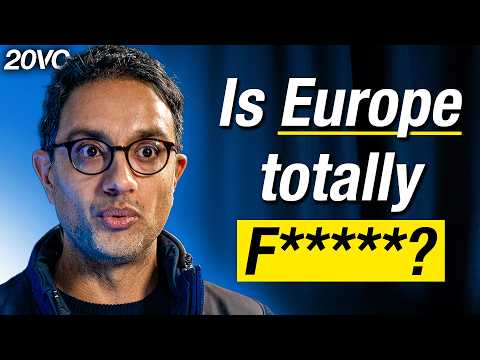
Hussein Kanji, Founder @Hoxton Ventures: Why AI Means London Can Compete with the US | E1248
Hussein Kanji (guest), Harry Stebbings (host)
In this episode of The Twenty Minute VC, featuring Hussein Kanji and Harry Stebbings, Hussein Kanji, Founder @Hoxton Ventures: Why AI Means London Can Compete with the US | E1248 explores why Hoxton Bets Big: Contrarian Seed, AI, And European Ambition Hussein Kanji, founder of Hoxton Ventures, explains how his firm evolved from a scrappy, unfundable European seed fund into a concentrated, high‑conviction investor backing outlier companies like Deliveroo and Darktrace.
Why Hoxton Bets Big: Contrarian Seed, AI, And European Ambition
Hussein Kanji, founder of Hoxton Ventures, explains how his firm evolved from a scrappy, unfundable European seed fund into a concentrated, high‑conviction investor backing outlier companies like Deliveroo and Darktrace.
He argues most venture has drifted into momentum and markup-chasing, while true returns still come from power-law outcomes, deep involvement, and ensuring companies are properly capitalized—often in the US.
Kanji outlines Hoxton’s portfolio construction philosophy (larger funds, concentrated bets, aggressive follow‑ons, SPVs, and disciplined sell programs) and why he thinks Europe can compete in AI despite macro and capital-market weaknesses.
He also critiques European policy (LSE obsession, pension fund structure), discusses fund-raising pain, partner separation, and diversity hiring, and lays out his ambition to build Hoxton into one of Europe’s few truly generational venture franchises.
Key Takeaways
Raise funds on time, not target size, and start investing sooner.
Kanji regrets spending 39 months raising Hoxton’s first fund; he now advises emerging managers to cap fund-raising at ~90 days, deploy whatever they raise, build a track record, then return to market with proof instead of a pitch.
Get the full analysis with uListen AI
Design your fund for concentrated ownership and aggressive follow-ons.
Hoxton runs roughly 20 core positions, aims for 15–20% ownership in winners, and now allocates 50–65% of capital into the top third of companies, often using SAFEs or pro‑rata-plus to quietly increase stakes at reasonable prices.
Get the full analysis with uListen AI
Pre‑plan downside scenarios, including specific acquirers, before you need them.
Each quarter, Hoxton builds a “shopping list” for portfolio companies—exact buyers, divisions, and people to call if a founder is incapacitated or a business hits a wall—so they can move fast to salvage value under stress.
Get the full analysis with uListen AI
Institutionalize exit discipline instead of relying on gut feel.
After holding Darktrace through its post‑IPO peak and leaving a 10x‑net outcome on the table, Hoxton adopted a rule-of-thumb for IPOs: sell one-third at lock‑up expiry, another third six months later, and the final third within the following 6–12 months.
Get the full analysis with uListen AI
Ensure your contrarian bets are still fundable and well-capitalized.
Kanji stresses there’s a strong correlation between total capital raised (~$300M on average) and unicorn odds; being contrarian is only viable if you can shepherd companies into larger US rounds and avoid undercapitalized “orphan” winners.
Get the full analysis with uListen AI
Use SPVs and secondary to scale exposure to true outliers.
Hoxton ran sizable SPVs around Darktrace, deploying more than the original fund size into a known winner and delivering net IRRs of 66–154% to SPV investors, illustrating how side vehicles can transform economics when used sparingly and late.
Get the full analysis with uListen AI
Europe should focus less on local exchanges and more on AI and capital flow.
Kanji argues policymakers obsess over reviving the LSE instead of making it easier for European AI and deep-tech companies to access large US-style growth rounds; he views DeepMind, Meta Paris, and similar hubs as proof Europe can win horizontally in AI.
Get the full analysis with uListen AI
Notable Quotes
“We write the check largely to get the next markup, not to build the long-term, durable, big company of tomorrow.”
— Hussein Kanji
“Do not do a fundraise for a size of the fund. Do a fundraise for time of the fund. Give yourself 90 days. Whatever you get, go start investing.”
— Hussein Kanji (via advice from Mike Maples)
“The venture industry is all about the power law, all about the outliers… and Europe doesn’t have them.”
— Hussein Kanji
“There is a correlation between how much money goes into a company and what the probability of success is… the average is about 300 million to get to a unicorn.”
— Hussein Kanji
“We want monopolies. The regulator doesn’t want monopolies, but we want companies with increasing returns to scale and deep, defensible moats.”
— Hussein Kanji
Questions Answered in This Episode
How can a seed fund practically balance being contrarian with ensuring its companies are still attractive to downstream US investors?
Hussein Kanji, founder of Hoxton Ventures, explains how his firm evolved from a scrappy, unfundable European seed fund into a concentrated, high‑conviction investor backing outlier companies like Deliveroo and Darktrace.
Get the full analysis with uListen AI
What concrete policies would most effectively help European AI startups access the scale of capital they need without over-reliance on US markets?
He argues most venture has drifted into momentum and markup-chasing, while true returns still come from power-law outcomes, deep involvement, and ensuring companies are properly capitalized—often in the US.
Get the full analysis with uListen AI
How should emerging managers decide the “right” fund size and portfolio count for their strategy, given the tension between concentration and diversification?
Kanji outlines Hoxton’s portfolio construction philosophy (larger funds, concentrated bets, aggressive follow‑ons, SPVs, and disciplined sell programs) and why he thinks Europe can compete in AI despite macro and capital-market weaknesses.
Get the full analysis with uListen AI
In an increasingly commoditized AI landscape, what specific signals would Kanji look for to indicate a model or application has true moat potential?
He also critiques European policy (LSE obsession, pension fund structure), discusses fund-raising pain, partner separation, and diversity hiring, and lays out his ambition to build Hoxton into one of Europe’s few truly generational venture franchises.
Get the full analysis with uListen AI
How should founders and early investors think about secondary sales and SPVs ethically and strategically, so they align with building long-term category leaders?
Get the full analysis with uListen AI
Transcript Preview
There is a correlation between how much money goes in to a company and what the probability of success is. The average is about, like, 300 million to get to a unicorn status. And your best path to scale, from a financing perspective, is America. The rounds are bigger. Do not do a fundraise for a size of the fund. Do a fundraise for time of the fund. Give yourself 90 days. Whatever you get, go start investing.
... are saying, "Dude, we did this nine years ago. It was a webcam on Skype," which is aging both of us. Thank you so much for joining me today.
Yeah. I think I remember. I was like, I had my laptop on a pillow in my bedroom, staring up, and was like, "Who's this Harry kid, like, interviewing me?"
(laughs) I think everyone was thinking, "Who the fuck is this Harry kid? Why won't he leave us alone?" Um, listen, I want to dive right in. I remember Keith Rabois telling me in a show, "Every fund needs, like, a right to exist." When we think about Hoxton, how do you think about your answer for what our right to exist is?
Yeah, it's a good question. Um, I mean, when we, when we first... By the way, I think the venture world does not need yet another fund. Like, we have a lot of them, right? They're coming down in numbers, but the, the world, we have a lot of V- like, a lot of people playing VCs. 11, 13 years ago when we first started, we were 11 years old, but we started fundraising a little bit before then. The world did not have that many VCs in Europe. Had a lot of them in the US, had a lot of them in China, had a lot of them in India, but nobody was here in Europe. In fact, the seed funds of record here, you won't even remember the names. There were Eden and Pond. They're like a bygone, right? The people raised money in the dot-com boom, mismanaged their capital all the way through the collapse, and kinda left. And so the world really needed a venture player in Europe. And that was the thesis of Hoxton. And then if you look at where we are today, the world now has quite a bit of venture funds i- in Europe. But there are not that many old-fashioned venture funds left in this industry. I think most of us become momentum investors in this industry. We write the check largely to get the next markup, not to build the long-term, durable, big company of tomorrow. And I don't think there are that many people in Europe who do those kinds of things.
Why do you think that is? Why have we shifted to this heavy momentum?
Well, we went into a market where money was effectively free. And the way you get promoted inside of most firms... Remember, we are, we're, we're, we're exceptions to the rule, right? 'Cause we own our own firms. Like, these are our businesses. So we think like business owners, not like employees. If you're the general employee, you optimize for getting to the next career ladder. And how do you show that you can get to the next career ladder? You do a deal, and then General Catalyst or Index or Kleiner or Sequoia or, or Andreessen, I mean, there are so many of these great firms, mark it up at a significant premium. And then someone else, Tiger, et cetera, marks it up after that. And all of a sudden, doesn't make a difference if you've not made any money. You look like you've picked a hot company.
Install uListen to search the full transcript and get AI-powered insights
Get Full TranscriptGet more from every podcast
AI summaries, searchable transcripts, and fact-checking. Free forever.
Add to Chrome