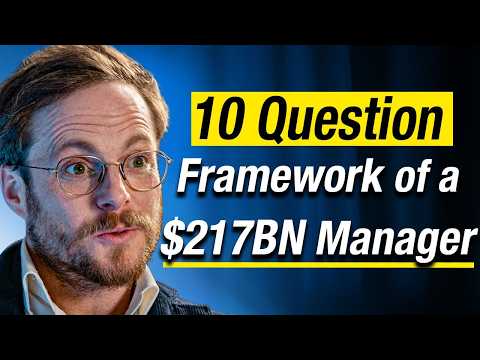
Peter Singlehurst: Lessons from Turning Down Stripe, Coinbase and Losing Money on Northvalt
Peter Singlehurst (guest), Harry Stebbings (host)
In this episode of The Twenty Minute VC, featuring Peter Singlehurst and Harry Stebbings, Peter Singlehurst: Lessons from Turning Down Stripe, Coinbase and Losing Money on Northvalt explores inside Baillie Gifford’s Growth Bets: Discipline, Misses, Anduril, ByteDance Peter Singlehurst, who leads private company investing at Baillie Gifford, explains how the firm approaches late-stage growth investing using public-market style rigor, focusing on businesses with proven products, scalable models, and high return-on-equity potential.
Inside Baillie Gifford’s Growth Bets: Discipline, Misses, Anduril, ByteDance
Peter Singlehurst, who leads private company investing at Baillie Gifford, explains how the firm approaches late-stage growth investing using public-market style rigor, focusing on businesses with proven products, scalable models, and high return-on-equity potential.
He distinguishes between bad outcomes and true mistakes, dissecting painful cases like Northvolt and Intarcia, as well as major missed or underweighted winners like Coinbase and Stripe.
Singlehurst details why Baillie Gifford has avoided the headline LLM companies so far, how they think about AI layers, valuation, and probability-weighted 5x return scenarios, and why he’s more excited about select fintech, global outliers, and companies like Anduril, Databricks, Bending Spoons, and ByteDance.
The conversation also covers staying private longer, the broken state of UK and European public markets, liquidity through secondaries, the institutionalization of growth investing, and why he remains optimistic about the next decade for global growth-stage companies.
Key Takeaways
Differentiate between bad outcomes and genuine analytical mistakes.
Some losing investments (like Intarcia) were known-risk bets where downside scenarios simply materialized, while others (like Northvolt) revealed misjudgments in areas such as team execution and round structure; only the latter should be treated as true process errors to correct.
Get the full analysis with uListen AI
Focus growth investing on de-risked products and business model scalability.
Baillie Gifford typically enters around $200M revenue, high growth (~70% YoY), and modest losses, avoiding product risk and concentrating on whether the model can scale profitably with high long-run return on equity, as seen with Wise.
Get the full analysis with uListen AI
Use structured, probabilistic upside modeling instead of rigid valuation rules.
They model every deal to a 5x outcome but vary the probability and assumptions, seeking situations where the chance of a 5x (often 30–50%, versus a base-rate ~5%) justifies paying up; discipline is about when to accept high prices, not never paying them.
Get the full analysis with uListen AI
Enduring competitive advantage often lies beyond the product itself.
Singlehurst emphasizes advantages rooted in culture, organizational playbooks, and business systems—e. ...
Get the full analysis with uListen AI
Avoid consensus hype zones unless you have a sharp edge on where value accrues.
Baillie Gifford owns AI-related infra and chip plays like Databricks and Tenstorrent but has avoided big LLM names (OpenAI, Anthropic, xAI) because they don’t yet see a clear, durable moat at the model layer amid open-source and commoditization pressures.
Get the full analysis with uListen AI
Staying private longer can improve business quality but requires new liquidity mechanisms.
Companies increasingly prefer the focus and privacy of staying private, while employees and investors receive liquidity via large, company-facilitated secondaries, and potentially future private dividends, rather than traditional IPOs.
Get the full analysis with uListen AI
Global breadth and contrarian geography can be a real edge when priced correctly.
Singlehurst argues there is attractive risk–reward in under-loved regions like China, Brazil, and India—despite macro and exit concerns—provided investors demand sufficient return for the added risk and lean into fear-driven dislocations rather than follow the herd.
Get the full analysis with uListen AI
Notable Quotes
“Not all of our bad investments are necessarily mistakes.”
— Peter Singlehurst
“Being a disciplined investor doesn’t mean I will never pay more than X multiple.”
— Peter Singlehurst
“The concept of return on equity is almost an anathema within the venture world.”
— Peter Singlehurst
“We haven’t taken the plunge into any of the big AI LLM companies because we still are trying to define what we think competitive advantage will look like at the large language model level.”
— Peter Singlehurst
“I think what people realize today is that you can build a better business by staying private for longer.”
— Peter Singlehurst
Questions Answered in This Episode
How would Singlehurst’s 10-question framework evaluate a breakout AI application company that is growing extremely fast but has unclear long-term margins?
Peter Singlehurst, who leads private company investing at Baillie Gifford, explains how the firm approaches late-stage growth investing using public-market style rigor, focusing on businesses with proven products, scalable models, and high return-on-equity potential.
Get the full analysis with uListen AI
What specific early execution or cultural signals would he now watch for to avoid repeating the Northvolt-type mistake?
He distinguishes between bad outcomes and true mistakes, dissecting painful cases like Northvolt and Intarcia, as well as major missed or underweighted winners like Coinbase and Stripe.
Get the full analysis with uListen AI
Given the firm’s hesitance on LLMs, what concrete milestones or structural shifts would convince Baillie Gifford to invest in a major model company?
Singlehurst details why Baillie Gifford has avoided the headline LLM companies so far, how they think about AI layers, valuation, and probability-weighted 5x return scenarios, and why he’s more excited about select fintech, global outliers, and companies like Anduril, Databricks, Bending Spoons, and ByteDance.
Get the full analysis with uListen AI
How should founders calibrate the right amount of capital to take—avoiding the “foie gras” effect—while still competing effectively in hot sectors?
The conversation also covers staying private longer, the broken state of UK and European public markets, liquidity through secondaries, the institutionalization of growth investing, and why he remains optimistic about the next decade for global growth-stage companies.
Get the full analysis with uListen AI
If UK and European public markets remain weak, what alternative listing or liquidity structures does he believe will emerge as the new default for large European tech companies?
Get the full analysis with uListen AI
Transcript Preview
(instrumental music plays) I think what people realize today is that you can build a better business by staying private for longer. You're starting to see the evolution of these very large, company-facilitated secondary rounds. I can see those starting to become more of a feature. There's lots of investments we've made that have been painful experiences. But ironically, I would say not all of our bad investments are necessarily mistakes. We haven't taken the plunge into any of the big AI LLM companies 'cause we still are trying to define what we think competitive advantage will look like at the large language model level.
Ready to go? (instrumental music plays) Peter, we last did this on Zoom. I'm so pleased that we get to do this in person. Thank you so much for joining me today.
It's a pleasure, Harry. Really nice to see you again.
It's so good to have you here. But listen, I actually scrapped the, like, "How did you get into venture?" question 'cause it was bluntly very obvious for a lot of people who went to Stanford and studied CS that they would then, you know, become what they did. But we were just chatting now, and you said about how you got into private company investing, and it was so cool. I wanted to ask it on the show. So, how-
(laughs) .
... did you get into private company investing at Baillie Gifford? What was that moment?
Well, so, so the specific moment was, um, I was on a, a public market strategy. It's called the Long-Term Global Growth Strategy. It's a $50 billion public market strategy. And this was in 2014. I was working with, uh, three very senior investment partners within the firm, James Anderson, Mark Urquhart, Tom Slater. And we were starting to see these private companies, uh, of real scale, the sorts of companies that we'd always invested in. And back then, it was, like, you know, businesses like Airbnb and Spotify. And, uh, and Tom, and Mark, and James, like, they kind of had their hands full looking after these tens of billions of dollars of our clients' capital. And so we were sat in a, a room, and, uh, and, uh, James said, "Well, like, who, who's, who's going to do this? Who's going to look at these private companies?" And I just put my hand up, and I said, "Well, I'll, I'll do it." And, uh, that's sort of how it all started.
Were you nervous?
Um, no. Maybe I should have been. If I'd known what I was letting myself in for, I would have been nervous.
What would you advise yourself now, knowing all that you do, telling that younger self entering the position you were?
That's a really hard question because the, the natural tendency there is to give advice that would help you avoid all the mistakes that you made. But the mistakes that you made are the things that have helped you learn, right? So, I'm not sure I would give myself specific advice about the, the craft of investing because I, I, I think that's something you can only learn by experience. I think what I would say to myself is, when it comes to thinking about how you can bring this capability and this offering to more of our clients, I would say to myself, "Be a little bit less purist." We, we were, um, you know, when we first started doing this, we were doing it from within these permanent capital vehicles, and we continued to do that. And it's amazing for being super long-term. Um, but the result of that was that we had a lot of our clients who wanted, uh, to be investing with us in the kinds of companies that we were investing in, these kind of high-growth, you know, often quite large private companies, but they just couldn't do these permanent capital vehicles. And they were sort of saying, "Look, can you just do a more traditional fund structure?" And I wish we'd compromised, or not compromised, we'd been aware of some of those trade-offs earlier on.
Install uListen to search the full transcript and get AI-powered insights
Get Full TranscriptGet more from every podcast
AI summaries, searchable transcripts, and fact-checking. Free forever.
Add to Chrome