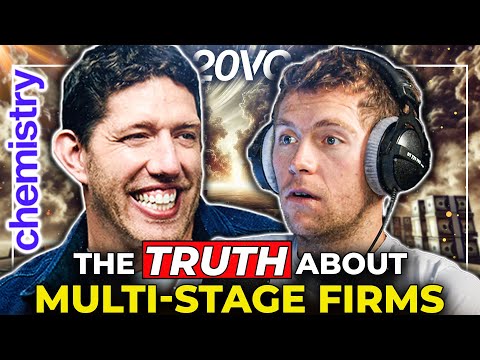
Mark Goldberg: Why Politics is Rife & Decision-Making is Broken in Large VCs | E1219
Mark Goldberg (guest), Harry Stebbings (host)
In this episode of The Twenty Minute VC, featuring Mark Goldberg and Harry Stebbings, Mark Goldberg: Why Politics is Rife & Decision-Making is Broken in Large VCs | E1219 explores inside Chemistry: Fixing Broken VC Decisions And Founder Misalignment Mark Goldberg, co-founder of new firm Chemistry and former Index Ventures partner, explains why he believes large multi-stage VC platforms have become bureaucratic, politicized, and misaligned with founders. He argues for a return to small, focused, boutique-style partnerships where experienced partners spend most of their time on early-stage founders rather than managing internal organizations. Chemistry’s model centers on a concentrated seed/Series A strategy, light reserves, single-partner decision authority, and deep founder relationships, explicitly rejecting consensus ICs and heavy platform-service structures. The conversation also covers fundraising from LPs, portfolio construction, AI and fintech investing, and why brutal feedback, independent thinking, and founder quality matter more than brand names or market fashion.
Inside Chemistry: Fixing Broken VC Decisions And Founder Misalignment
Mark Goldberg, co-founder of new firm Chemistry and former Index Ventures partner, explains why he believes large multi-stage VC platforms have become bureaucratic, politicized, and misaligned with founders. He argues for a return to small, focused, boutique-style partnerships where experienced partners spend most of their time on early-stage founders rather than managing internal organizations. Chemistry’s model centers on a concentrated seed/Series A strategy, light reserves, single-partner decision authority, and deep founder relationships, explicitly rejecting consensus ICs and heavy platform-service structures. The conversation also covers fundraising from LPs, portfolio construction, AI and fintech investing, and why brutal feedback, independent thinking, and founder quality matter more than brand names or market fashion.
Key Takeaways
Small, focused funds can realign incentives between GPs and founders.
Goldberg argues that as funds grow large and multi-stage, senior partners spend more time on internal management and politics than on new deals and founders, so Chemistry was intentionally designed as a $350M, early-stage-focused boutique partnership.
Get the full analysis with uListen AI
Portfolio services at big platforms often primarily serve the VC, not the founder.
He contends that talent, BD, and other platform teams evolved from a genuine innovation into a scaling crutch that justifies larger AUM, while often disintermediating the direct founder–partner relationship that actually matters most.
Get the full analysis with uListen AI
Consensus early-stage decision-making produces consensus portfolios.
Chemistry uses a single-trigger model where any GP can greenlight a deal, based on the belief that legendary outliers usually start as non-consensus bets that would die in a committee-driven IC process.
Get the full analysis with uListen AI
Light, selective reserves may be healthier than automatic pro rata.
Instead of “peanut buttering” follow-on capital across all existing companies, Chemistry runs a light-reserve model that doubles down only where conviction remains very high, which Goldberg sees as better for both LPs and founders.
Get the full analysis with uListen AI
Founder quality and relationship trump market fashion or category risk.
Goldberg repeatedly insists that great founders can iterate into great markets, even in “bad” categories like lending, and that the most valuable VC work is being present for “magic moments” (e. ...
Get the full analysis with uListen AI
Industrialization of VC has shifted firms from craftspeople to asset managers.
He and many LPs feel that some legacy firms have drifted into low-margin, highly-scaled asset management; LP appetite is re-emerging for small, high-conviction partnerships that behave more like founders than institutions.
Get the full analysis with uListen AI
Brutally honest, timely feedback is more valuable than polite non-answers—for founders and LPs alike.
Having been a GP fundraising himself, Goldberg says the experience convinced him to stop giving vague, protective rejections; clear reasons and direct feedback help counterparties actually improve and build trust.
Get the full analysis with uListen AI
Notable Quotes
“One of the dirty secrets of multi-stage investing is that portfolio services teams are not for founders, they're for the VCs.”
— Mark Goldberg
“The biggest mistake is when you try to make consensus decisions at the early stage; I think you end up with consensus funds.”
— Mark Goldberg
“The world doesn't need another venture fund. It needs a new venture fund.”
— Mark Goldberg
“Do no harm should be beating 80% of the industry.”
— Mark Goldberg
“Every VC should have to fundraise just to be table stakes as a VC.”
— Mark Goldberg
Questions Answered in This Episode
If portfolio services primarily serve VCs, what would a truly founder-centric support model look like in practice?
Mark Goldberg, co-founder of new firm Chemistry and former Index Ventures partner, explains why he believes large multi-stage VC platforms have become bureaucratic, politicized, and misaligned with founders. ...
Get the full analysis with uListen AI
How far can a small, boutique partnership scale before it inevitably recreates the bureaucracy and politics it set out to avoid?
Get the full analysis with uListen AI
In a world of sky-high AI and fintech valuations, how should early-stage founders decide when paying up for a marquee investor is actually rational?
Get the full analysis with uListen AI
What mechanisms or market innovations could realistically solve the liquidity problem for early-stage investors in companies that stay private for 15+ years?
Get the full analysis with uListen AI
How can founders discern between a non-consensus, high-upside contrarian bet and a simply bad idea that sophisticated investors are rightly avoiding?
Get the full analysis with uListen AI
Transcript Preview
I think one of the dirty secrets of multi-stage investing is that portfolio services teams are not for founders, they're for the VCs. They are a way to make something unscalable, scale. So we have a very light reserve model. Peanut buttering all of your reserves in every pro rata round that gets done is not a good thing for a founder. The biggest mistake is when you try to make consensus decisions at the early stage, I think you end up with consensus funds.
Ready to go? Mark, dude, I am so excited for this. When we last did one, I was actually young, so this is a joy and, uh, I really appreciate our friendship. So thank you for joining me.
Harry, it's a total pleasure. And, you know, it has been so fun to watch you launch your new fund. Uh, I think I read online that it was a 10-year overnight success, and I think that's what most resonated with me. You've been, you know, just doing such a good job crushing it, and I'm- I'm thrilled for you. So it's fun to be doing- doing new funds at the same time.
Dude, it is great fun. And there's nothing like having your own shop. I always say this to people, like having your name above the door is the most special thing, and building your own is- is just so special. So I- I do just want to start with that, which is like, there are so many venture firms, respectfully. Why did you feel like the world needed another one? And- and what was that kind of realization with the founding of Chemistry?
The world doesn't need another venture fund. It needs a new venture fund. Um, there are too many VCs right now. Um, but we wanted to do something different. And what Christina, Ethan, and I started talking about was, and we've been talking about this for a long time, is if you were going to design a fund where you fully aligned the values of the investors with the founders, what would it look like? That was kind of the question that was the jumping point to getting started here. And what we thought about is, first off, it would be smaller, it would be focused, it would be a combination of experienced investors from some of the biggest multi-stage platforms coming tog- together, Avenger style, and seeing if you could do something different. And you just talked about, you know, what it feels like to be an owner. I wanted that, Christina and Ethan wanted that. And we felt like the combination of experience and hustle was something that would kind of be the blueprint for a new fund. Um, so that was kind of the- the origin of how we started talking about this. And- and it's been a huge amount of fun so far.
Okay. Why does fund size correlate to alignment to founders?
Install uListen to search the full transcript and get AI-powered insights
Get Full TranscriptGet more from every podcast
AI summaries, searchable transcripts, and fact-checking. Free forever.
Add to Chrome