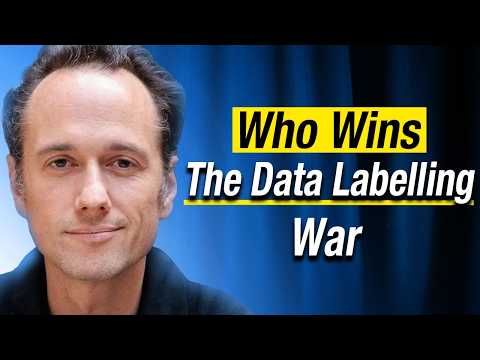
Matt Fitzpatrick: Who Wins the Data Labelling Race & Why Al Needs Forward-Deployed Engineers
Matt Fitzpatrick (guest), Harry Stebbings (host)
In this episode of The Twenty Minute VC, featuring Matt Fitzpatrick and Harry Stebbings, Matt Fitzpatrick: Who Wins the Data Labelling Race & Why Al Needs Forward-Deployed Engineers explores why AI deployment fails: Invisible’s CEO on data, FDEs, trust Matt Fitzpatrick, CEO of Invisible and former McKinsey senior partner, explains why enterprise AI adoption badly lags model performance and how Invisible is positioning as both an AI training platform and enterprise deployment partner. He argues most GenAI projects fail because enterprises treat them like SaaS apps rather than workflow, data, and change‑management problems that require forward-deployed engineers (FDEs) and rigorous validation. Invisible’s model hinges on modular software, human-in-the-loop data labeling at scale, and a "prove it first" go-to-market where customers don’t pay until systems actually work. Fitzpatrick also challenges myths around synthetic data, remote work, and out‑of‑the‑box agents, while outlining why he’s long‑term optimistic about AI’s impact on healthcare, energy, and education.
Why AI deployment fails: Invisible’s CEO on data, FDEs, trust
Matt Fitzpatrick, CEO of Invisible and former McKinsey senior partner, explains why enterprise AI adoption badly lags model performance and how Invisible is positioning as both an AI training platform and enterprise deployment partner. He argues most GenAI projects fail because enterprises treat them like SaaS apps rather than workflow, data, and change‑management problems that require forward-deployed engineers (FDEs) and rigorous validation. Invisible’s model hinges on modular software, human-in-the-loop data labeling at scale, and a "prove it first" go-to-market where customers don’t pay until systems actually work. Fitzpatrick also challenges myths around synthetic data, remote work, and out‑of‑the‑box agents, while outlining why he’s long‑term optimistic about AI’s impact on healthcare, energy, and education.
Key Takeaways
Enterprise AI is failing not because of weak models, but because of weak deployment.
Despite huge improvements in LLM benchmarks and mass consumer usage, only ~5% of enterprise GenAI deployments work; most organizations underestimate the need for data infrastructure, workflow redesign, ownership, observability, and trust processes like model risk management.
Get the full analysis with uListen AI
External, outcome-driven builds often outperform internal AI teams.
MIT data cited by Fitzpatrick suggests externally driven builds are roughly twice as effective as internal ones, largely because vendors are forced into ROI, milestones, and accountability in ways internal teams typically are not.
Get the full analysis with uListen AI
Forward-deployed engineers are becoming essential for real enterprise AI impact.
You can’t just sell an agent and walk away; to change workflows and embed AI deeply, you need FDEs who configure modular platforms to each customer’s specific processes and keep models fine-tuned as reality (e. ...
Get the full analysis with uListen AI
“Pay when it works” will pressure traditional SaaS-style pricing in AI.
Invisible does free 8‑week solution sprints and only charges once software passes user acceptance and delivers operational KPIs, reflecting a shift from license-first SaaS toward performance- and outcome-based pricing for AI deployments.
Get the full analysis with uListen AI
Human feedback and expert data won’t be replaced by synthetic data anytime soon.
For complex, multimodal, domain-specific reasoning (e. ...
Get the full analysis with uListen AI
The winning AI platforms will be hyper-personalized, not generic SaaS boxes.
Fitzpatrick expects a shift from one-size-fits-all SaaS to “systems of agility” that sit atop systems of record, using each customer’s own data and custom workflows rather than shipping the same out‑of‑the‑box app to everyone.
Get the full analysis with uListen AI
AI success depends as much on culture and talent as on strategy decks.
In a world where core tech changes every 3 months, Fitzpatrick downplays long-range strategy in favor of recruiting great people, empowering edge teams, keeping culture enjoyable, and building institutional memory around deploying AI in messy real contexts.
Get the full analysis with uListen AI
Notable Quotes
““If there’s an app for everything, how come nothing works?””
— Matt Fitzpatrick (quoting Invisible founder Francis Pedraza)
““Externally driven builds are 2X as effective as internal team builds.””
— Matt Fitzpatrick
““Out-of-the-box software has always been a lie to some degree.””
— Matt Fitzpatrick
““In the AI world at least, strategy is a somewhat overrated concept.””
— Matt Fitzpatrick
““The only risk is if you don’t take this and the amount of regret you’ll have not giving it a go.””
— Somesh Khanna (as recounted by Matt Fitzpatrick)
Questions Answered in This Episode
What concrete steps should a large enterprise take in the first 90 days to move from AI ‘science projects’ to a focused, outcome-driven roadmap?
Matt Fitzpatrick, CEO of Invisible and former McKinsey senior partner, explains why enterprise AI adoption badly lags model performance and how Invisible is positioning as both an AI training platform and enterprise deployment partner. ...
Get the full analysis with uListen AI
How can a mid-size startup realistically build a forward-deployed engineering function without blowing up their unit economics?
Get the full analysis with uListen AI
Where is the real breaking point between what synthetic data can handle and where human-labeled or expert data becomes indispensable?
Get the full analysis with uListen AI
How might Invisible’s ‘pay when it works’ model pressure incumbents like Accenture, large SIs, or traditional SaaS vendors to change their pricing and delivery?
Get the full analysis with uListen AI
If strategy cycles are effectively quarterly in AI, what does good board-level governance and planning actually look like for AI-native companies?
Get the full analysis with uListen AI
Transcript Preview
MIT just released this report that 5% of gen AI deployments are working in any form. You've seen Gartner saying 40% of enterprise projects will likely be canceled by 2027. And I think the reason for that is, externally driven builds are 2X as effective as internal team builds. I don't think that that discipline exists in the same way in internal builds. They spent 25 million bucks building this agent. And what ended up happening was a couple months later, they shut it down and moved back to a deterministic flow. We don't actually sell anything. When we meet a customer, we say, "We will do it for free for eight weeks and prove to you the tech works." The minute you had to bring in FDs in a SaaS context, your economics broke im- instantly, right?
Are there any other big misnomers that you think are pronounced in the industry?
Look, I, I think the biggest one is just the view that synthetic data will take over and you just will not need human feedback. It's interesting, from first principles, that actually doesn't make very much sense if you think through it. In the AI world at least, strategy is a somewhat overrated concept. And what I mean by that is, it-
Ready to go? Matt, I am so excited for this, dude. I think Invisible is one of the most incredible, but also, I'm sorry to say this, like under-discussed businesses when I look at the incredible achievements that you've had over the last few years. So thank you so much for joining me.
Thank you for having me. I really enjoy the show.
Can you just talk to me about how does like a 10-year McKinsey, uh, stalwart warrior-
(laughs)
... become CEO of like one of the fastest growing data companies in tech? How does that transition happen?
Yeah, so, um, I would say my McKinsey journey was non-traditional. Um, I spent 12 years there, I was a senior partner and I led a group called Quantum Black Labs, which is the firm's global tech development group. So about 10 years ago, McKinsey actually started hiring engineers, like, and I was a, a big part of this and a pretty big quantum. And I think we went from, I, when I started, we had about 100 engineers total in the firm. By the time I left, we had 7,000. Uh, I oversaw about a fifth of that group, uh, and all the application development, all of the data warehouse infrastructure and all of the, uh, gen AI builds globally. And so, uh, that journey was, was really interesting and it, and it, you know, over the course of it, spent a variety of my time competing with other large enterprise, um, AI businesses. And I got to know the found- the founder, Francis, really well, um, about three years or four years ago now. Uh, we actually met totally not work-related in a, uh, kind of social context where we were discussing... It was a, it was basically a forum called Dialog. I don't know if you've heard it, but you-
Install uListen to search the full transcript and get AI-powered insights
Get Full TranscriptGet more from every podcast
AI summaries, searchable transcripts, and fact-checking. Free forever.
Add to Chrome