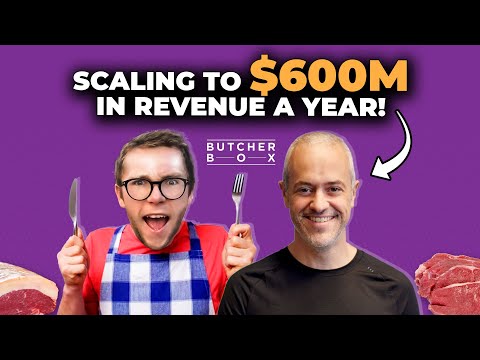
Mike Salguero: How I Grew ButcherBox to $600M/year in Revenue; Tips for Influencer Marketing | E998
Mike Salguero (guest), Harry Stebbings (host), Narrator
In this episode of The Twenty Minute VC, featuring Mike Salguero and Harry Stebbings, Mike Salguero: How I Grew ButcherBox to $600M/year in Revenue; Tips for Influencer Marketing | E998 explores bootstrapping ButcherBox: From Hobby Idea to $600M Meat Empire Mike Salguero, founder and CEO of ButcherBox, explains how he bootstrapped a meat subscription business from a ‘hobby’ concept into a ~$600M revenue company without venture capital. He contrasts a lifestyle‑first approach with the traditional VC growth model, emphasizing constraints, profitability discipline, and extreme operational detail. Mike breaks down the economics of subscription DTC (CAC, payback, margin per box), the evolution of influencer marketing, and why many VC‑backed DTC brands have struggled. The conversation also touches on his personal psychology as a leader, the broken meat industry, and what it really takes to scale and sustain a consumer subscription company today.
Bootstrapping ButcherBox: From Hobby Idea to $600M Meat Empire
Mike Salguero, founder and CEO of ButcherBox, explains how he bootstrapped a meat subscription business from a ‘hobby’ concept into a ~$600M revenue company without venture capital. He contrasts a lifestyle‑first approach with the traditional VC growth model, emphasizing constraints, profitability discipline, and extreme operational detail. Mike breaks down the economics of subscription DTC (CAC, payback, margin per box), the evolution of influencer marketing, and why many VC‑backed DTC brands have struggled. The conversation also touches on his personal psychology as a leader, the broken meat industry, and what it really takes to scale and sustain a consumer subscription company today.
Key Takeaways
Design your life before you design the business model.
Mike argues entrepreneurs should first define a vivid 3‑year life vision—daily schedule, roles, priorities—then build a company that serves that vision, rather than contorting their life around an investor‑driven business plan.
Get the full analysis with uListen AI
Bootstrap constraints force healthier unit economics and creativity.
Because ButcherBox had no VC money, they insisted on box‑one profitability early, obsessed over dollars per box, renegotiated tiny costs (like tape and box pricing), and used residual influencer commissions instead of upfront fees, which later became a moat.
Get the full analysis with uListen AI
Outsourcing core operations can beat vertical integration early on.
Instead of copying heavily funded competitors that built their own facilities, ButcherBox partnered with 100‑year‑old distribution and logistics firms, avoiding huge capex and complexity while still holding partners to high performance via tight oversight.
Get the full analysis with uListen AI
Subscription success hinges on CAC-to-payback, not just LTV theory.
Mike focuses on simple, blended CAC and payback periods (now ~5 months), rather than abstract LTV; he continually recycles operational savings into marketing to maintain acceptable CAC:LTV ratios as CPAs rise over time.
Get the full analysis with uListen AI
Channel concentration then expansion beats shallow, omnichannel dabbling.
ButcherBox rode one main channel at a time—first affiliates/influencers, then Facebook—only adding new ‘oil fields’ after the previous channel was resourced and “rigged,” instead of spreading limited dollars thinly across many unproven channels.
Get the full analysis with uListen AI
Most DTC brands overbuilt, over‑owned, and under‑profited.
He sees many VC‑backed DTCs as having raised too much, built capital‑intensive infrastructure, relied on cheap Facebook arbitrage, and now face rising CPAs and weak margins, making the category often misaligned with venture return expectations.
Get the full analysis with uListen AI
Ethical differentiation in meat requires long time horizons and real audits.
ButcherBox wants to be the “Patagonia of meat,” scrutinizing animal welfare, environment, farmers, and workers; Mike notes it’s still nearly impossible to get credible third‑party worker‑welfare audits on US meat facilities, underscoring how early this movement is.
Get the full analysis with uListen AI
Notable Quotes
“The VC train is not one you can get off of.”
— Mike Salguero
“Most people are chasing a lifestyle, not a business.”
— Mike Salguero
“If you’re overfunded or if growth is big, you don’t have time to look at waste—and there’s a ton of money in the details.”
— Mike Salguero
“I think one of the lies of entrepreneurship is that you need to raise money.”
— Mike Salguero
“We want to build the Patagonia of meat.”
— Mike Salguero
Questions Answered in This Episode
How would ButcherBox’s trajectory and culture have differed if it had raised venture capital early on?
Mike Salguero, founder and CEO of ButcherBox, explains how he bootstrapped a meat subscription business from a ‘hobby’ concept into a ~$600M revenue company without venture capital. ...
Get the full analysis with uListen AI
At what point does it make sense for a DTC company to start insourcing parts of its operational stack for margin expansion?
Get the full analysis with uListen AI
Given rising CPAs and iOS changes, what ‘new oil fields’ in marketing does Mike believe will be viable over the next five years?
Get the full analysis with uListen AI
How can consumers realistically push for better worker and animal welfare in meat without significantly increasing their food budgets?
Get the full analysis with uListen AI
What concrete frameworks can founders use to decide whether their idea should be a bootstrapped lifestyle business or a VC‑backed rocketship?
Get the full analysis with uListen AI
Transcript Preview
... we can't just do what we're doing anymore. We're too big. We'll do about $600 million in revenue this year. The old tactics, like, we're just gonna blanket Facebook and do influencer, it doesn't work anymore. Like, we need a new oil field. (instrumental music)
Mike, I am so excited for this. I think your story is fantastic, fascinating, worrying, that you actually don't need venture investors to scale to huge-
(laughs)
... re- profitable businesses. I'm terrified for my career, but thank you so much for joining me.
Yeah. Thank you for having me. I'm super excited to be here and, uh, chat, chat and disagree.
Well, I look forward to it too. But I wanna start with, uh, a little bit of context. So we're all a function of our histories. Clearly, I'm a failed psychologist. Um, and it means we're all running from something. Mike, on reflection, what do you think you're running from?
What am I running from? I mean, I, (sighs) I think that our past is what kind of creates the people that we are today. And, uh, what I spend a lot of my time... I'm 41. What I spend a lot of my time trying to do is actually notice it and not run from it. Like, a lot of my past, like, life, and shadows, and triggers, and stuff, like, come up constantly. I mean, I shared with you that I grew up without a father, so the fear of abandonment is, like, really, really... runs really deep to me. And whereas in the past, I've, like, run from those emotions and run from my past, uh, my work now is t- kind of to sit there and take it, and to notice and allow. And, you know, feel the feelings in my body and then let them, let them be.
Can I ask you, what is the result of the fear of abandonment? So what I mean by that is, like, I was bullied a lot as a child for being more like Augustus Gloop than, you know, I am today.
(laughs)
Um, but it means that I just wanted everyone to like me.
Yeah.
And it's led to a bad trait in leadership, which is I'm a people pleaser.
Yup.
When you think about, like, the abandonment, what's the impact of that on how you act?
Yeah. So on the positive side, it certainly drove me. Like, yeah, I, I was very driven to accomplish. And I think deep down, that was to, like, make my father, uh, come back, which was never gonna happen. On the negative side, I mean, in my personal relationship, I have a really hard time advocating for myself, like, with my wife or with my friends, 'cause I'm worried that they'll leave me. I've oftentimes been made fun of by my friends where I'm like, "Guys, don't leave," and they're like, "We're not gonna leave you." Like, "We're..." (laughs) "Don't worry, you're fine." And in my professional life, yes, I, I think, uh, I can tend to be overly generous and overly accommodating, uh, with this... because of this fear that, like, people are just gonna go. And that's something that I've had to work hard on through the past 16 years of CEOing.
Install uListen to search the full transcript and get AI-powered insights
Get Full TranscriptGet more from every podcast
AI summaries, searchable transcripts, and fact-checking. Free forever.
Add to Chrome