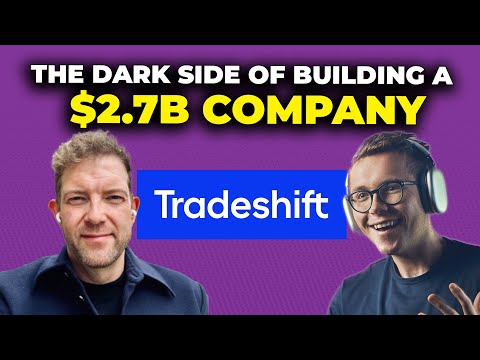
Christian Lanng: "How Being a Founder Almost Killed Me" | E1065
Christian Lanng (guest), Harry Stebbings (host), Narrator
In this episode of The Twenty Minute VC, featuring Christian Lanng and Harry Stebbings, Christian Lanng: "How Being a Founder Almost Killed Me" | E1065 explores founder burnout, brutal tradeoffs, and redefining work with AI automation Christian Lanng, co-founder and former CEO of Tradeshift, describes how 14 years of hyper-growth leadership led to severe burnout, health crises, and a painful but necessary decision to step down. He details the psychological traps founders fall into: sacrificing health, relationships, and identity while feeling unable to show weakness to employees, investors, or family. The conversation then pivots to lessons from building and financing a large SaaS company, including misaligned incentives with VCs, over-optimizing valuation, hiring discipline, and the realities of ‘hustle culture.’ Finally, Lanng outlines his new company, Beyond Work, which aims to use AI to automate routine knowledge work, remove traditional app-centric UX, and put humans back at the center of meaningful work.
Founder burnout, brutal tradeoffs, and redefining work with AI automation
Christian Lanng, co-founder and former CEO of Tradeshift, describes how 14 years of hyper-growth leadership led to severe burnout, health crises, and a painful but necessary decision to step down. He details the psychological traps founders fall into: sacrificing health, relationships, and identity while feeling unable to show weakness to employees, investors, or family. The conversation then pivots to lessons from building and financing a large SaaS company, including misaligned incentives with VCs, over-optimizing valuation, hiring discipline, and the realities of ‘hustle culture.’ Finally, Lanng outlines his new company, Beyond Work, which aims to use AI to automate routine knowledge work, remove traditional app-centric UX, and put humans back at the center of meaningful work.
Key Takeaways
Burnout creeps in slowly and often masquerades as ‘just a rough patch.’
Lanng only recognized his burnout after hating the work and logo he once loved, losing his social personality, and getting external reality checks from his partner and his own health crisis; founders need to watch for broad, persistent aversion to their company, not just to specific meetings.
Get the full analysis with uListen AI
Founders routinely sacrifice health and relationships far beyond what’s rational.
He nearly died from anemia because he ‘didn’t have time’ to see a doctor and lost most friendships outside work over 14 years; he now sees fitness and medical monitoring as essential, not optional, and urges founders to treat health as a core asset, not fuel to burn.
Get the full analysis with uListen AI
You can’t lead well if you’re the exhausted cynic in the room.
Lanng realized he had become the cynic who’d seen every strategy before, violating his own ‘be critical, not cynical’ principle; he argues that when you’re no longer excited to try anything new in the company, it’s a strong signal to consider transitioning out.
Get the full analysis with uListen AI
Over-optimizing valuation early creates long-term pressure and structural pain.
Tradeshift raised very high-multiple rounds (e. ...
Get the full analysis with uListen AI
Fundraising and VC management are games of leverage, framing, and relationship-building.
He removes slides (e. ...
Get the full analysis with uListen AI
Hiring bar and iteration speed matter more than headcount and comfort.
At one point Tradeshift fired half its VPs with no loss of output, underscoring how easily standards slip in hyper-growth; he advises never compromising on talent quality, charging more (high price can speed enterprise sales), and killing failed efforts much faster.
Get the full analysis with uListen AI
AI will shift value from ‘selling software’ to ‘selling work done’ and better experiences.
With Beyond Work, Lanng wants to remove rigid app UIs like Salesforce and let users describe tasks in natural language, with AI orchestrating systems in the background; he believes copilots are a transitional “Clippy 2. ...
Get the full analysis with uListen AI
Notable Quotes
“There’s something really, really wrong when the thing you’re supposed to love is the thing you can’t bear thinking about.”
— Christian Lanng
“Grit alone doesn’t make you happy; it just gets the job done.”
— Christian Lanng
“I almost died of anemia because I just didn’t have time to go to the doctor.”
— Christian Lanng
“VCs get pissed off when founders use exactly the same strategies they do.”
— Christian Lanng
“User interfaces are stupid. They’ve turned humans into robots clicking buttons in a certain order.”
— Christian Lanng
Questions Answered in This Episode
How can founders realistically share their mental health struggles with teams and investors without destabilizing the company or harming future fundraising?
Christian Lanng, co-founder and former CEO of Tradeshift, describes how 14 years of hyper-growth leadership led to severe burnout, health crises, and a painful but necessary decision to step down. ...
Get the full analysis with uListen AI
Where should a founder draw the line between necessary sacrifice for a company and unacceptable damage to health, family, and identity?
Get the full analysis with uListen AI
If high early valuations are so dangerous, how should ambitious startups think about the right balance between dilution, speed, and investor quality?
Get the full analysis with uListen AI
What would a truly AI-first work environment look like day to day for a mid-level employee, and how would it change their sense of meaning in their job?
Get the full analysis with uListen AI
As AI erodes traditional app-centric UX and data moats concentrate power, what new kinds of moats and differentiators can startups realistically build and defend?
Get the full analysis with uListen AI
Transcript Preview
... I almost died of anemia (laughs) actually, because I just didn't have time to go to the doctor. I went off to Las Vegas. And when I stepped down from stage, there's a text message from my doctor that says, "Go immediately to the nearest ER and tell them your hemoglobin is 5.4." And arriving in the ER, I tell them, "Hey, uh, my doctor told me my hemoglobin is 5.4." And she's like, "No it's not, because you'd be, you'd be l- laying in a coma on the floor." So yeah, you absolutely sacrifice your health over, over this process.
Christian, when we first did this, I was, I don't know, Charlie and the Chocolate Factory age, probably about 15.
(laughs)
Uh, thank you so much for joining me once again on the show.
Thank you so much for having me, yeah.
No, listen, the pleasure's all mine. I would love to start though with actually the announcement that you made a week or so ago about Tradeshift and your position there. Can you start by just telling us about the position change there and what's going on?
I've been CEO, co-founder, and, and chairman for, for Tradeshift for 14 years. It, it sounds crazy even saying that number. You know, it was inseparable for, for my life, I think, in every way. And I think this year especially, um, I have done a lot of reflection over how the last few years has been, and, and also reflection of not being happy. And I think as founders, and, and often as founders and CEOs, we think we just have to keep doing the job no matter what. Uh, for me, it was really important to get the company to a place where it was in really good shape. But I also made the decision, I think, a long time, like earlier this year, that I would find, uh, and figure out a transition and, and, you know, move to what's next. It's probably the hardest decision in my life, and I had no i- clue how to do it. There was very few people you can talk to about, like, how do you do this, how do you exit this thing you built?
Can I ask you the first question, which is like, I think a lot of people misuse the word burnout.
Mm-hmm.
Or actually have it, but don't know they have it. When did you first realize that actually the feelings that you had were not maybe right?
You know, it probably started during, honestly during the pandemic, right? We were, you know, I'm a very, um, I'm a very social person. I loved coming into office, I loved having all of the engagement with everyone, seeing the creativity of what we're building. And suddenly, I was just sitting, uh, you know, for 14, 16 hours in front of a screen every day, no breaks. Uh, I remember having to do sort of like scheduled bio breaks just to (laughs) be able to run to the restroom, and, and the rest was just one continuous stream. And I, I remember, this sounds bad and for everyone who works at Tradeshift don't think about it that way, but like, I end up hating looking at that screen. I end up hating, uh, I mean, even seeing, uh, at some points the logo, right? And, and it doesn't mean I don't do the work and I didn't, you know, believe in the company and, and didn't wanna get home. Like, I have so much drive towards that. But there's something really, really wrong when the thing you're supposed to love is actually thing that y- you almost, like, you can't bear thinking about it, right?
Install uListen to search the full transcript and get AI-powered insights
Get Full TranscriptGet more from every podcast
AI summaries, searchable transcripts, and fact-checking. Free forever.
Add to Chrome