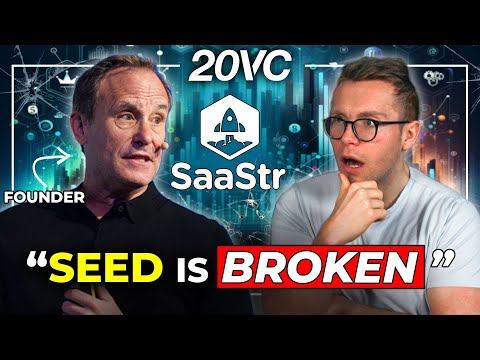
Jason Lemkin: Why Pricing is Worse Than Ever and There is More Funding Than Ever | E1157
Jason Lemkin (guest), Harry Stebbings (host), Harry Stebbings (host)
In this episode of The Twenty Minute VC, featuring Jason Lemkin and Harry Stebbings, Jason Lemkin: Why Pricing is Worse Than Ever and There is More Funding Than Ever | E1157 explores jason Lemkin Dissects Broken Seed Investing, Dilution, and Founder Grit Jason Lemkin joins Harry Stebbings to deconstruct his best and worst SaaS investments, what actually drove returns, and why today’s seed market is structurally broken for most funds.
Jason Lemkin Dissects Broken Seed Investing, Dilution, and Founder Grit
Jason Lemkin joins Harry Stebbings to deconstruct his best and worst SaaS investments, what actually drove returns, and why today’s seed market is structurally broken for most funds.
He centers on founder quality—especially a hyper-committed CEO/CTO “binary pair”—alongside brutal standards on growth, churn, and product velocity as the non‑negotiables of venture‑scale outcomes.
Lemkin argues that pricing and round dynamics are worse than ever: too much capital is flooding into too few truly fast‑growing companies, with insiders inflating valuations and obscuring weak fundamentals.
He also lays out practical heuristics for evaluating CTOs, financial integrity, product quality, and SMB churn, while warning against holding too long after founders leave or doubling down reflexively on follow‑on rounds.
Key Takeaways
Prioritize ultra‑committed founder pairs over everything else.
Lemkin’s best outcomes all share a CEO/CTO (or equivalent) pair who are 110% committed, technically strong, and relentlessly product‑ and sales‑oriented; without that, even strong early metrics rarely compound into fund‑returners.
Get the full analysis with uListen AI
Do early, deep diligence on the CTO and the product.
He now insists on a second call with the CTO immediately, asking them to demo, show what delights and frustrates them, and expose feature gaps; world‑class CTOs are proud, hyper‑transparent, and visibly obsessed with shipping better, faster software.
Get the full analysis with uListen AI
Use strict growth and churn thresholds to screen for venture scale.
For SaaS to IPO, he still expects “triple, triple, double, double” growth; at ~$1M ARR, 8–10% monthly growth is the bar, enterprise NRR must be >110%, and SMB churn above ~3–4% per month means it’s effectively not recurring software.
Get the full analysis with uListen AI
Avoid overfunded, insider‑inflated and structurally bad follow‑ons.
Lemkin’s largest cash loss came from reflexively writing a third check based only on top‑line growth; he now treats follow‑ons like new investments—re‑underwriting finances, customers, and integrity rather than assuming momentum equals quality.
Get the full analysis with uListen AI
Sell when founders leave or strongly want to sell.
He’s concluded that when founders exit or push hard for a sale (as at SalesLoft or Pipedrive), investors should largely follow; professional CEOs rarely sustain founder‑level agility and intensity, and holding for “one more card” often destroys optionality.
Get the full analysis with uListen AI
Respect market size, but don’t automatically flee competition.
Competitive categories can still yield Datadog‑ or Rippling‑scale winners if you back hyper‑agile product teams; big markets usually come with many vendors, and competitors can help educate and expand the category while a superior product steadily pulls away.
Get the full analysis with uListen AI
Seed economics are broken when ownership is too small and prices too high.
With YC‑style $25M+ seed valuations and heavy dilution to IPO, a traditional seed fund needs multiple multi‑billion‑dollar exits plus ≥10% ownership to matter; tiny stakes in hot deals rarely move the needle, even if the company becomes iconic.
Get the full analysis with uListen AI
Notable Quotes
“Seed investing is systemically broken today. There's just as much capital, chasing fewer and fewer folks that can grow at triple-digit rates.”
— Jason Lemkin
“If the churn is anything more than three or four percent a month, it's not even software anymore.”
— Jason Lemkin
“The best investments go one to ten million in five quarters or less… You can't IPO unless you triple, triple, double, double.”
— Jason Lemkin
“When the founders leave, I'm pretty much out. I would like to sell when the founders leave. Always.”
— Jason Lemkin
“I don't think the best founders bullshit. You can build a unicorn bullshitting, but I don't think the best founders bullshit.”
— Jason Lemkin
Questions Answered in This Episode
How should founders balance the pressure for triple‑digit growth with building sustainable products and cultures, especially in tougher macro conditions?
Jason Lemkin joins Harry Stebbings to deconstruct his best and worst SaaS investments, what actually drove returns, and why today’s seed market is structurally broken for most funds.
Get the full analysis with uListen AI
What practical steps can early‑stage founders take to become the kind of “binary pair” (CEO/CTO) investors like Lemkin won’t compromise on?
He centers on founder quality—especially a hyper-committed CEO/CTO “binary pair”—alongside brutal standards on growth, churn, and product velocity as the non‑negotiables of venture‑scale outcomes.
Get the full analysis with uListen AI
Given Lemkin’s skepticism about insider‑driven rounds and inflated valuations, how should founders think about the right amount and structure of capital to raise?
Lemkin argues that pricing and round dynamics are worse than ever: too much capital is flooding into too few truly fast‑growing companies, with insiders inflating valuations and obscuring weak fundamentals.
Get the full analysis with uListen AI
In highly competitive categories, how can startups realistically assess whether they have the product velocity and team quality to become the Datadog, not the also‑ran?
He also lays out practical heuristics for evaluating CTOs, financial integrity, product quality, and SMB churn, while warning against holding too long after founders leave or doubling down reflexively on follow‑on rounds.
Get the full analysis with uListen AI
For investors, where is the realistic line between rigorous financial/CTO diligence and moving fast enough not to lose all the best early‑stage deals?
Get the full analysis with uListen AI
Transcript Preview
Seed investing is systemically broken today. There's just as much capital, chasing fewer and fewer folks that can grow at triple-digit rates. The best investments go one to 10 million in five quarters or less, the very best ones. The one... You can't IPO unless you triple, triple, double, double. As you approach 10% market share in your core ICP, your core market, you gotta expand. If the churn is anything more than three or 4% a month, it's not even software anymore.
Ready to go? Jason, I always love our chats. This is such a joy to do. And our shows always do so well. I always get notes from founders being like, "Whenever Jason's on, I literally get pen and paper out, and these are the ones that I have to listen to." So I'm-
Yes.
... so glad to have you back, man.
It's ve- very exciting, um, Harry, so, so great to be here. And, um, so proud of everything that's happened with 20VC Empire. It's, it's great to have been, uh, been there on the sidelines since being, uh, guest number 50.
Dude, I remember when I was at university and you were like, "Should we do the SaaStr podcast?" And I was like-
Yeah.
... "Yeah, (laughs) this is great."
(laughs)
I remember you had that... I don't know if you still have it, but you had that, like, picture of you, is it in a helicopter with the, like, happy one?
Oh yeah, that, that, that one. Yes. Yeah, yeah.
Out of that one, I thought that was so cool as an 18-year-old, but I wa-
(laughs)
... I wanna dive in. This is a new type of show.
Okay.
So I'm calling it 20VC The Review, which is like-
The Review.
... analyzing the best and maybe the less well-performing deals, or worst, in other words, and then highlighting, hey, lessons and the story behind them. If we start on the best, Jason, what is the best deal that you've done, and what did you learn?
Yeah, you know, I'll, I'll answer that, uh, but, uh, I bro- I made two best lists for you. Um, one was the best by cash, by cash back, which we all thought was no big deal in 2021, but the last couple of years, cash has looked scarce. (laughs) It's like two IPOs in B2B in two and a half years. And, and by NAV, which is what we report to our LPs, on paper, what are the best three? And so far, for me, I'm 10 years in, I had a little bit of a break for a year, right? Um, maybe I should have invested faster. But it's interesting, is... And I'll answer your question. My best by cash and best by NAV are not... There's no overlap yet. Maybe, hopefully in three to four years, they will, they will flip, and the ones that on paper are worth the most will become the most in cash. But the best three for cash I've, I've done, and y- we can take the conversation where you want. The number one was SalesLoft, which was the last big deal of the 2021 era. It closed, I think, December 23rd, 2021. HashiCorp was the last IPO, and SalesLoft sold for two and a half billion of cash and about 100 million in ARR. Um, the second one was Pipedrive, which I don't know what that one would be worth today. That was a billion and a half in cash as well. And the third one, ironically, was smaller, Harry, um, which was a company that got sold, Logikall, for 300 million. But I learned a lot from being multiple times the largest investor, because we all brag on Twitter and X how much, how, or how we were early in this and that. But if you own a 10th of a percent in a fund, it's not gonna (laughs) get you that far, is it?
Install uListen to search the full transcript and get AI-powered insights
Get Full TranscriptGet more from every podcast
AI summaries, searchable transcripts, and fact-checking. Free forever.
Add to Chrome