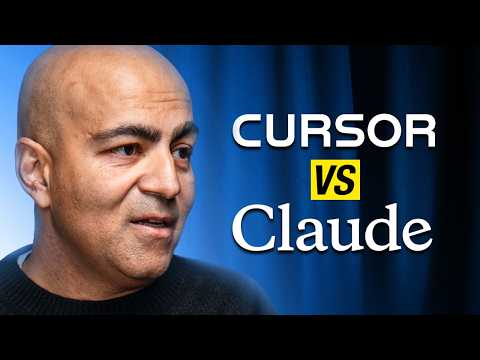
a16z, Anish Acharya: Is SaaS Dead? Do Margins Still Matter? Why We Are Not in an AI Bubble?
Anish Acharya (guest), Harry Stebbings (host)
In this episode of The Twenty Minute VC, featuring Anish Acharya and Harry Stebbings, a16z, Anish Acharya: Is SaaS Dead? Do Margins Still Matter? Why We Are Not in an AI Bubble? explores aI won’t kill SaaS; it rewires moats, markets, and pricing Acharya argues the “SaaS apocalypse” narrative is overstated: enterprise software is only ~8–12% of enterprise spend, so rebuilding core systems via “vibe coding” is irrational versus applying AI to the other 90% of costs and differentiation.
AI won’t kill SaaS; it rewires moats, markets, and pricing
Acharya argues the “SaaS apocalypse” narrative is overstated: enterprise software is only ~8–12% of enterprise spend, so rebuilding core systems via “vibe coding” is irrational versus applying AI to the other 90% of costs and differentiation.
AI’s real near-term impact on incumbents is lowered switching and integration costs (fewer “hostages”), plus a shift from seat-based pricing toward outcome/consumption models—changing LTV/CAC and margin interpretation.
He expects multi-model reality to persist, creating durable value for aggregation/application layers (e.g., coding IDEs orchestrating multiple models), while big model labs may ship primitives but often won’t prioritize deep, opinionated feature surfaces.
The conversation also covers UI evolution (browse remains important), defensibility (networks + proprietary/live data), why this isn’t an AI bubble (demand absorbing supply), and a16z’s Series A and “win-the-deal” operating philosophy.
Key Takeaways
Rewriting SaaS isn’t where AI’s biggest ROI sits.
Because software is ~8–12% of enterprise spend, even perfect “vibe-coded ERP” only saves a small slice; the larger opportunity is using AI to improve the remaining 90% (labor, operations, decisioning, productivity) and extend a company’s core advantage.
Get the full analysis with uListen AI
AI agents mainly attack switching costs, not software existence.
Coding agents reduce systems-integration time/risk, making migrations (e. ...
Get the full analysis with uListen AI
Capable incumbents will improve existing categories; startups win new ones.
Acharya expects Microsoft/Google/Adobe-style incumbents to ship “better versions of what they already do,” while startups capture AI-native categories that previously didn’t exist (e. ...
Get the full analysis with uListen AI
Multi-model reality creates room for aggregation apps and IDEs.
With foundation models largely substitutable for many tasks but specialized for others, orchestration layers (e. ...
Get the full analysis with uListen AI
The developer/tools market will look more like cloud than Uber/Lyft.
Rather than pure substitutes racing margins to zero, Acharya expects an oligopoly-like structure with meaningful differentiation (workflow preference: rich IDE vs “closer to metal” CLI) and multiple winners.
Get the full analysis with uListen AI
UI won’t collapse into chat; browsing remains a primary consumer mode.
Many users want to “spend time,” discover, and can’t fully articulate intent; browse-based interfaces persist, while chat/voice fits intent-heavy flows (voice especially as an enterprise wedge).
Get the full analysis with uListen AI
In AI, gross margin compression can be “CAC in disguise.”
Free/low-margin trials are often an acquisition subsidy (paid in inference credits) that converts to high-paying power users; investors should separate trial inference costs (CAC) from the durable margin profile of retained users.
Get the full analysis with uListen AI
Power users are now monetizable at 10x prior consumer price ceilings.
Where consumer subscriptions historically capped around $20–25/mo, AI has normalized $200–$300 tiers plus usage-based revenue—making acquisition spend on power users more rational and durable.
Get the full analysis with uListen AI
This doesn’t look like a classic bubble because demand is absorbing supply.
Acharya cites capacity expansions being “spoken for,” rising customer prices, and “intelligent subsidization” from labs that benefits users/startups—unlike past bubbles with supply far ahead of demand.
Get the full analysis with uListen AI
Legal and customer support aren’t single markets—they’re industries.
The proliferation of funded startups isn’t necessarily irrational if the real prize is transforming a $500B industry (not just attaching to $50B software spend), enabling many specialized winners rather than one monopoly.
Get the full analysis with uListen AI
Notable Quotes
““The general story that we’re gonna vibe code everything is flat wrong, and the whole market is oversold software.””
— Anish Acharya
““Some companies have hostages, not customers.””
— Anish Acharya
““Price is a measure of product market fit.””
— Anish Acharya
““Inference is the new sales and marketing.””
— Anish Acharya
““Just be right a lot.””
— Marc Andreessen (recounted by Anish Acharya)
Questions Answered in This Episode
If AI lowers integration costs, which SaaS categories become most vulnerable first: systems of record, engagement layers, or analytics/BI? What concrete signals would you watch?
Acharya argues the “SaaS apocalypse” narrative is overstated: enterprise software is only ~8–12% of enterprise spend, so rebuilding core systems via “vibe coding” is irrational versus applying AI to the other 90% of costs and differentiation.
Get the full analysis with uListen AI
Acharya says incumbents win by improving existing categories while startups win new ones—what are the clearest examples of “AI-native categories” you expect in 2026, and what makes them impossible pre-2024 reasoning models?
AI’s real near-term impact on incumbents is lowered switching and integration costs (fewer “hostages”), plus a shift from seat-based pricing toward outcome/consumption models—changing LTV/CAC and margin interpretation.
Get the full analysis with uListen AI
How should a startup quantify “trial inference as CAC” in practice—what metrics (M2 retention, conversion, payback) would you require before scaling spend?
He expects multi-model reality to persist, creating durable value for aggregation/application layers (e. ...
Get the full analysis with uListen AI
If multi-model orchestration is valuable, what prevents model labs from bundling orchestration into their own products and commoditizing apps like Cursor—distribution, UX surface area, or neutrality across models?
The conversation also covers UI evolution (browse remains important), defensibility (networks + proprietary/live data), why this isn’t an AI bubble (demand absorbing supply), and a16z’s Series A and “win-the-deal” operating philosophy.
Get the full analysis with uListen AI
Acharya predicts browse-based UIs persist; where specifically does chat replace browsing (shopping, education, entertainment, enterprise knowledge work), and where does it fail?
Get the full analysis with uListen AI
Transcript Preview
you have this innovation bazooka with these models. Why would you point it at rebuilding payroll or ERP or CRM? The general story that we're gonna vibe code everything is flat wrong, and the whole market is oversold software.
I'm so excited to welcome Anish Acharya, GP at Andreessen, where he leads consumer and fintech investing at Series A.
Now, an interesting topic that's not discussed is the cost of transitioning from one SaaS provider to another going dramatically down, so systems integration. I don't think we're allowed to believe in luck at Andreessen. We have to see a hundred percent of the deals in our domain, and that we win a hundred percent of the deals that we go after.
[clapperboard clapping] Ready to go? [upbeat music] Anish, dude, I've wanted to do this for a while. We've been going back and forth.
Yes, we have.
And so I'm so glad that we can do this in person. Thank you for joining me.
Of course. Thank you for having me.
I'm diving right in. We were just chatting now-
Yeah
... and I was saying, "I think it's better to build in, in London than in SF or in other places other than SF. Talent is cheaper. It retains for longer."
Yes.
"Uh, you don't have the promiscuity of people jumping from role to role."
Yes.
And you've built a company now, both in Canada and in SF.
Mm-hmm.
How do you reflect on what I just said?
I disagree with you. I wish it was true. I simply wish it was true, and I want it to be true, and maybe it will be true, that it will be, you know, the whole thing that we always love to say to ourselves around sort of talent and opportunity not being... You know, talent is equally distributed, opportunity is not. The truth is that cities are the original network effect, and for technology, there is a network effect for builders in SF and for this moment in technology, right? Where so many of the secrets are these sort of things whispered down shadowy hallways, the benefit of being in SF is enormous. There's also-- we just talked about this, there's a selection bias quest- question: Do you care enough to make it happen in SF? You can make it happen anywhere, New York, London, Toronto, Tel Aviv, you name it, but there's something different about saying, "I'm gonna give everything else up and be singular in my focus and move everything to SF to make it happen."
Are there any other locations where you think there is actually positivity associated with them being located there?
Tel Aviv. I think Tel Aviv, you can be incredibly ambitious and uncompromising on that ambition and have a really, really good reason to be there. I think the other nice thing about the Tel Aviv ecosystem is that the country's so small, it's ten million people, that you can't possibly fool yourself into thinking that the domestic market is gonna be big enough for whatever you're doing, so you immediately go outside. Whereas if you're in London, there's sixty million people here, okay? And you might say, "Well, that's actually a lot of people." And you know what? There are parts of the market, like fintech, where the LTVs are so high that perhaps sixty million is sufficient.
Install uListen to search the full transcript and get AI-powered insights
Get Full TranscriptGet more from every podcast
AI summaries, searchable transcripts, and fact-checking. Free forever.
Add to Chrome