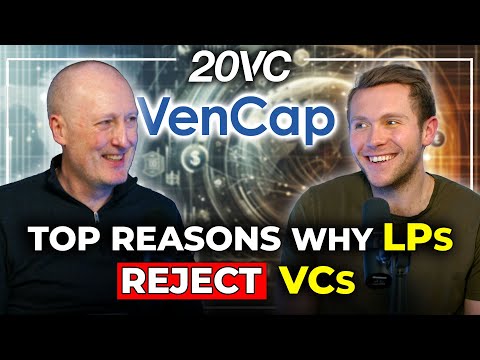
David Clark: Lessons from 32 Years of Fund Investing - Why Exits Will Be Larger | E1131
David Clark (guest), Harry Stebbings (host), Narrator
In this episode of The Twenty Minute VC, featuring David Clark and Harry Stebbings, David Clark: Lessons from 32 Years of Fund Investing - Why Exits Will Be Larger | E1131 explores veteran LP Debunks Myths On Fund Size, Power Laws, And Liquidity LP David Clark of VanCampen (VanCap) reflects on 32 years backing venture funds, emphasizing that venture is a power-law business where a tiny fraction of companies drive industry-wide returns. He challenges the narrative that billion‑dollar funds can’t generate fund‑returning exits, showing data of numerous $1B+ distributions and even a $15B single‑fund outcome. Clark explains VanCap’s highly concentrated, outbound-only, top‑tier manager strategy, their skepticism toward emerging managers, and why they often wait until Fund III to commit. He also discusses liquidity timing, succession in VC firms, fund size, fees, and why venture remains attractive despite mediocre average returns, provided you can access the very best managers.
Veteran LP Debunks Myths On Fund Size, Power Laws, And Liquidity
LP David Clark of VanCampen (VanCap) reflects on 32 years backing venture funds, emphasizing that venture is a power-law business where a tiny fraction of companies drive industry-wide returns. He challenges the narrative that billion‑dollar funds can’t generate fund‑returning exits, showing data of numerous $1B+ distributions and even a $15B single‑fund outcome. Clark explains VanCap’s highly concentrated, outbound-only, top‑tier manager strategy, their skepticism toward emerging managers, and why they often wait until Fund III to commit. He also discusses liquidity timing, succession in VC firms, fund size, fees, and why venture remains attractive despite mediocre average returns, provided you can access the very best managers.
Key Takeaways
Venture only works if you access the true top-tier managers.
Clark’s analysis of 1,200 funds (2000–2015 vintages) shows over 50% haven’t returned even 1x capital, only ~6. ...
Get the full analysis with uListen AI
Billion-dollar funds can still produce fund-returning investments.
Contrary to industry chatter, VanCap’s internal data show 45 investments that each returned over $1B to a single fund—and were full fund-returners—many from the last 7–8 years, including one $15B outcome, meaning large funds are not inherently incapable of strong multiples.
Get the full analysis with uListen AI
Compare today’s fund sizes to exit sizes 10–15 years ahead, not today.
Clark argues the right mental model is to match current fund size with likely exit scales when those companies actually mature; as technology’s share of the economy and market sizes grow, he expects future exits to be larger, supporting big funds if they’re in the very best companies.
Get the full analysis with uListen AI
Rigorous focus and outbound sourcing beat trying to see every manager.
VanCap does almost no inbound; they build a list of top ~1% companies and then work backwards to identify and pursue the early-stage investors behind them, preferring to deepen exposure to proven franchises rather than chase hundreds of emerging managers.
Get the full analysis with uListen AI
Fund III is often the optimal entry point for an LP.
Clark says they most often commit at Fund III, when there is enough evidence that a manager has found at least one true outlier and begun to build a repeatable franchise, but before the firm becomes totally access-constrained.
Get the full analysis with uListen AI
Liquidity timing can make or break venture outcomes.
Because distributions cluster in short windows after long dry spells, Clark values managers who have lived through cycles and understand when to sell or distribute; most of VanCap’s 2019–2021 liquidity came from 2010–2011 investments, and he prefers managers largely to distribute public stock while his firm typically sells upon receipt.
Get the full analysis with uListen AI
Succession and partnership health are decisive for long-term VC franchises.
VanCap has seen strong franchises fail when founders stayed too long, hoarded economics, or mishandled generational transition; they favor firms with explicit age/retirement policies, clear paths for rising partners, and examples like Accel, Sequoia, or Foundry Group’s ‘one‑generation then done’ model.
Get the full analysis with uListen AI
Notable Quotes
“Venture is a power law industry, and it’s 1% of the exits that ultimately generate the bulk of the returns created by the entire industry globally.”
— David Clark
“The idea that you can’t get a fund returner from a billion-dollar fund is just untrue.”
— David Clark
“You don’t have to do every great manager out there… you just have to make sure all the managers you do are great.”
— David Clark
“How do you know the process works unless you judge it by the output?”
— David Clark
“If everyone agreed on everything, life would be so dull. And that’s what makes a market.”
— David Clark
Questions Answered in This Episode
If only a tiny fraction of funds achieve 3–5x DPI, how should non‑elite LPs realistically think about their role and edge in venture capital?
LP David Clark of VanCampen (VanCap) reflects on 32 years backing venture funds, emphasizing that venture is a power-law business where a tiny fraction of companies drive industry-wide returns. ...
Get the full analysis with uListen AI
At what point does a VC fund become too large for even massive future exits to compensate, and how can LPs model that limit in advance?
Get the full analysis with uListen AI
Given the long feedback loops and noisy interim marks, what additional tools or metrics could LPs use to assess manager quality beyond headline TVPI/IRR?
Get the full analysis with uListen AI
How might stricter antitrust enforcement and a weaker M&A environment structurally alter the power-law distribution of venture outcomes over the next decade?
Get the full analysis with uListen AI
What governance and economic structures best support healthy succession and talent elevation inside venture firms without destroying culture or performance?
Get the full analysis with uListen AI
Transcript Preview
One of the prevailing narratives is that you can't get a fund returner for a billion-dollar fund. So, we had a look at our data. And we found 45 investments that have returned a billion dollars to the single fund that invested and were also fund returners. What you need to do is to compare fund sizes today with the exit sizes in 10 to 15 years, because that's when those companies are ultimately going to become liquid.
Dave, I am so excited for this. I've heard, uh, many of your conversations before. Uh, you have some strong opinions-
(laughs)
... which I'm excited to dive into. So, thank you for joining me.
Yeah, no, it's a pleasure, Harry. I've been listening to your podcast for a long time. And, and, you know, really impressed by what you've built here, and the guests, and so honored to be part of it.
Do you know it's been 10 years?
Wow.
Like, I'm getting freaking old.
(laughs)
But, uh, I-
You must have started when you were 12, did you?
I was actually 14.
(laughs)
But I'm glad that it was an early start. You've been an LP for 32 years. And 32 years with VanCap.
Yeah.
How (laughs) ... Sorry, I didn't mean to like age you there. But how did you first become an LP? And when was that, "I wanna do this as a career"?
Yeah. Funnily enough, I didn't grow up thinking, actually, my life's ambition is to become a, an LP in VC funds.
(laughs)
Um, I, so I, I, I, I grew up in a small village in Northumberland. Um, I, I'm pretty sure that nobody in that village had ever heard of venture capital.
(laughs)
And, and, and I hadn't heard of venture capital. Um, but I, I'd sort of finished university. Um, I'd actually was keen to kind of go on and, and, and do a PhD. Um, but, but kind of life intervened at that time. And, and I had to end up getting some real work. And I was just looking for pretty much anything. Um, I saw an advert. So, my, my girlfriend at the time, my wife now, was, was living in Oxford. I was still living with my parents up in Northumberland. And so I, when I came down to see her, um, we were looking for ... I was looking for a job. I saw an advert in the Oxford Times, "Numerous graduates required for global finance firm." And I thought, "Well, that doesn't sound very interesting. But if I don't apply for it, she's gonna see it and she'll kill me." (laughs)
(laughs)
So (laughs) , that was, that was 1992. Um, and I was fortunate enough that, that, um, you know, my, my first boss was willing to take a punt on a, you know, a spotty, fresh graduate with no experience, who'd never heard of VC before.
Install uListen to search the full transcript and get AI-powered insights
Get Full TranscriptGet more from every podcast
AI summaries, searchable transcripts, and fact-checking. Free forever.
Add to Chrome