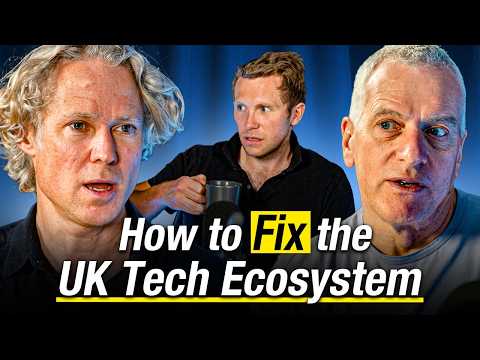
Tom Hulme & Stan Boland: Lessons from Jensen Huang & How to Fix the UK Tech Ecosystem
Stan Boland (guest), Tom Hulme (guest), Harry Stebbings (host), Harry Stebbings (host)
In this episode of The Twenty Minute VC, featuring Stan Boland and Tom Hulme, Tom Hulme & Stan Boland: Lessons from Jensen Huang & How to Fix the UK Tech Ecosystem explores fixing UK Tech: Capital, Talent, and Lessons From Jensen Huang Stan Boland and Tom Hulme dissect why the UK massively underperforms the US in tech value creation and what structural changes are required to fix it. They argue the UK’s core problems are constrained venture capital, insufficient top-tier founders/operators, policy distortion (R&D credits, tax), and weak talent retention versus the US. The pair propose radically scaling fund-of-funds capital via the British Business Bank, refocusing subsidies from zombie R&D into active VC, expanding visas and CS education, and setting an explicit national wealth-creation goal. They also discuss AI’s stack (chips to apps), China’s rise, non-dom taxation, London’s future, and leadership lessons from NVIDIA’s Jensen Huang.
Fixing UK Tech: Capital, Talent, and Lessons From Jensen Huang
Stan Boland and Tom Hulme dissect why the UK massively underperforms the US in tech value creation and what structural changes are required to fix it. They argue the UK’s core problems are constrained venture capital, insufficient top-tier founders/operators, policy distortion (R&D credits, tax), and weak talent retention versus the US. The pair propose radically scaling fund-of-funds capital via the British Business Bank, refocusing subsidies from zombie R&D into active VC, expanding visas and CS education, and setting an explicit national wealth-creation goal. They also discuss AI’s stack (chips to apps), China’s rise, non-dom taxation, London’s future, and leadership lessons from NVIDIA’s Jensen Huang.
Key Takeaways
The UK must explicitly flood its ecosystem with smart venture capital, not more subsidies.
Boland argues the UK is ~£12bn short annually in VC versus a US benchmark; instead of helicopter money via R&D tax credits and weak EIS/VCT managers, that spend should be redirected into high-quality fund-of-funds that back proven and emerging VCs at scale.
Get the full analysis with uListen AI
Talent supply and retention are the true rate-limiters, especially world-class operators.
For every great founder, you need 5–10 exceptional operators; with Oxford/Cambridge/Imperial graduating only ~500 relevant engineers/roboticists a year, the UK must 5x those numbers and staple Tier 2 visas and family rights to STEM degrees to keep and attract global talent.
Get the full analysis with uListen AI
Government should set a clear national tech wealth-creation target and track it visibly.
Boland proposes a 20‑year goal to create ~$4T of tech value (closing the gap with a US-adjusted benchmark), with an interim ~$0. ...
Get the full analysis with uListen AI
The British Business Bank should scale into a true catalytic fund-of-funds with creative structures.
They suggest 10x’ing BBB commitments to ~£4bn/year, allowing 50/50 matching with private LPs, flexing fees/carry between public and private capital, and using UK PLC money to unlock participation from pensions, family offices and even top global funds.
Get the full analysis with uListen AI
Europe must specialize at the top and bottom of the AI stack: semis, hardware, and applications.
They see more winnable ground in fabless semiconductors, AI-focused hardware, and defensible application-layer companies tied to European moats (e. ...
Get the full analysis with uListen AI
Policy distortions are sustaining ‘zombie’ companies and dampening ambition.
Boland is blunt that SME R&D tax credits and many EIS/VCT funds largely keep subscale, low-upside businesses alive and encourage managers to aim for capital preservation, not power-law outcomes; he’d curtail these and let active VCs reallocate talent and capital.
Get the full analysis with uListen AI
Brand, distribution and hardware will shape AI value capture more than foundation models alone.
Hulme now sees OpenAI as a strong consumer brand and application company, not just a model lab, with moats emerging through memory, UX and brand; both expect significant value at the device and semiconductor layer as models commoditize and inference grows.
Get the full analysis with uListen AI
Notable Quotes
“We need to flood the UK with venture capital.”
— Stan Boland
“For every one good founder, you need five or 10 world-class operators. And I think that's the biggest gap for us.”
— Tom Hulme
“The lack of capital crimps the ambition of companies, and therefore, the best founders go to the States.”
— Stan Boland
“If you graduate in engineering or computer science here, you should have stapled to your graduation certificate a tier two visa.”
— Stan Boland
“Building a startup in Europe is doing it on ultra-hard mode… but if you do it in London, it's slightly easier mode.”
— Tom Hulme
Questions Answered in This Episode
If the UK redirected most SME R&D tax credits into a scaled BBB fund-of-funds, how could it minimize adverse selection and ensure only top-tier VCs deploy that capital?
Stan Boland and Tom Hulme dissect why the UK massively underperforms the US in tech value creation and what structural changes are required to fix it. ...
Get the full analysis with uListen AI
What practical policies would most quickly increase the number and quality of UK operators who can scale global, AI-native companies?
Get the full analysis with uListen AI
How can the UK credibly pick and support a few deep-specialization areas (e.g., fabless semiconductors, defense tech, fintech) without falling into industrial-policy capture or cronyism?
Get the full analysis with uListen AI
Given that many of the best UK startups are already US-funded and may list on NASDAQ, what mechanisms could ensure UK savers and pensions still own a meaningful share of that upside?
Get the full analysis with uListen AI
Where should European founders draw the line on partnering with or selling to Chinese companies, balancing market opportunity, IP risk and geopolitical considerations?
Get the full analysis with uListen AI
Transcript Preview
$20 trillion of value created in the last 50 years in building decacorns in the US. The UK has created two, about $170 billion of value in the UK. So, the lack of capital crimps the ambition of companies, and therefore, the best founders go to the States. We need to flood the UK with venture capital.
The biggest challenge is for every one good founder, you need five or 10 world-class operators. And I think that's the biggest gap for us. If you look at Oxford, Cambridge, Imperial, they're only graduating between them about 500 computer scientists or roboticists per year. We should five X that number.
If you graduate in engineering or computer science or something here, you should have stapled to your graduation certificate a tier two visa.
Ready to go? (upbeat music) Guys, I am so excited to make this happen. Uh, two of the smartest people, I think, in European and UK venture and startups. So, I want to start with a little bit of context. Stan, if we start with you and then move to Tom, uh, I- I love listening to you speak about the UK and where we are. What's the background as to how you got here and just a quick one-mid intro on you?
Yeah. So, I joined a company called Acorn, which is a computer company based in Cambridge, um, back in 1997. Uh, it owned this thing called Arm, 40% of this company called Arm. So, I helped get Arm public, um, and then figured out what to do with Acorn. Set up a chip company outside, uh, out of Acorn, which got venture funding for, uh, raised $30 million of capital and sold that company to Broadcom for about $640 million, um, about a year and a half later, this amazing deal. Um, did a second deal, uh, in the chip space, which I built a company and sold that to NVIDIA, um, and did, uh, a third deal, which was in the AI space. So, I've- I've serially founded and ran and then sold companies. Raised about $330 million in venture capital and sold them for about $1.3 billion. So, so that's kind of what I've been doing for the last like 25 years is doing that.
Well, good, good luck to follow on.
I'm mainly here just to learn from Stan. That's the reason I'm here.
I'm sure this will prove.
Tom, what about you?
Uh, so look, yeah, I- I won't give a- a long bio, just a really quick one. So, I helped set up GV in Europe the year you started 20VC, in 2014. And so we've now done over 50 companies, we've invested in, uh, 12 countries, uh, we just broke through half a billion dollars in the UK alone with our investment in Isomorphic last week, and passionate about making the y- sort of European ecosystem as vibrant as possible. So, keen to discuss that.
Install uListen to search the full transcript and get AI-powered insights
Get Full TranscriptGet more from every podcast
AI summaries, searchable transcripts, and fact-checking. Free forever.
Add to Chrome