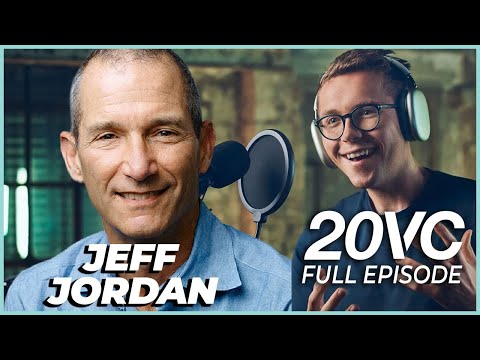
a16z GP Jeff Jordan: The Ultimate Guide to Two-Sided Marketplaces | 20VC #966
Harry Stebbings (host), Jeff Jordan (guest), Narrator
In this episode of The Twenty Minute VC, featuring Harry Stebbings and Jeff Jordan, a16z GP Jeff Jordan: The Ultimate Guide to Two-Sided Marketplaces | 20VC #966 explores jeff Jordan Reveals How Winning Marketplaces Scale, Monetize, And Survive Jeff Jordan, GP at Andreessen Horowitz and former eBay/OpenTable operator, breaks down what makes two-sided marketplaces succeed or fail, drawing on experiences with Airbnb, Instacart, Incredible Health and more.
Jeff Jordan Reveals How Winning Marketplaces Scale, Monetize, And Survive
Jeff Jordan, GP at Andreessen Horowitz and former eBay/OpenTable operator, breaks down what makes two-sided marketplaces succeed or fail, drawing on experiences with Airbnb, Instacart, Incredible Health and more.
He emphasizes the importance of fragmented supply, strong lead generation, non-reliance on paid marketing, and careful management of demand–supply equilibrium as core marketplace design principles.
Jordan also discusses investor–founder dynamics: how ex-operators must avoid being prescriptive, why tough feedback is a fiduciary duty, and how board members can add value without grabbing the wheel.
Throughout, he covers market timing vs. market size, unit economics (LTV/CAC, pay-in-advance models), channel volatility (Google/Facebook/TikTok), and the need for intellectual humility and “mental plasticity” in venture.
Key Takeaways
Fragmented supply is a powerful structural advantage for marketplaces.
Markets like OpenTable, with tens of thousands of small, independent suppliers, are hard to aggregate but even harder to dislodge once built, because no single supplier has the power to walk away and hurt the platform.
Get the full analysis with uListen AI
Lead generation must be real, incremental value—not just tooling.
Suppliers will not share transaction economics if you’re only digitizing their existing customers; they will pay meaningfully when you introduce new, high-intent customers they wouldn’t have acquired otherwise.
Get the full analysis with uListen AI
Avoid over-reliance on paid acquisition; LTV/CAC must have real buffer.
Jordan assumes CACs rise over time; if LTV/CAC is only 2–4x, the model is fragile. ...
Get the full analysis with uListen AI
Get paid in advance is a rare but supercharged marketplace trait.
Businesses like Airbnb and Incredible Health that collect cash upfront (with service delivered later) can become highly capital efficient, sometimes remaining cash-flow positive while still in high growth mode.
Get the full analysis with uListen AI
Market timing risk is unavoidable; focus on learning, not outcomes.
Jordan notes that many “bad” ideas were just early; he stresses post-mortems on decisions rather than outcomes alone, and maintaining mental plasticity so past failures (e. ...
Get the full analysis with uListen AI
Healthy demand is the primary lever to keep a marketplace balanced.
Suppliers follow demand; if hosts, drivers, or contractors see steady earnings and utilization, they stay. ...
Get the full analysis with uListen AI
Founders should choose board members as carefully as long-term bosses.
Because VCs hold portfolios while founders have a single company, incentives can diverge; Jordan urges founders to vet investors deeply for values, vision, and behavior, and he advises board members to be selective, non-prescriptive, and concise.
Get the full analysis with uListen AI
Notable Quotes
“Everything I would like to talk about as an operator and an investor typically involves a network effect.”
— Jeff Jordan
“OpenTable was a long slog before it became an overnight success.”
— Jeff Jordan
“There are no bad ideas, only bad timing.”
— Jeff Jordan (quoting Marc Andreessen’s phrase)
“The demand side is the more strategic side, because suppliers typically will go wherever the demand is.”
— Jeff Jordan
“Please don’t dominate the rap, Jack, if you got nothin’ new to say.”
— Jeff Jordan (quoting the Grateful Dead on board behavior)
Questions Answered in This Episode
How can an early-stage marketplace rigorously test whether its supplier value proposition is strong enough before investing heavily in supply acquisition?
Jeff Jordan, GP at Andreessen Horowitz and former eBay/OpenTable operator, breaks down what makes two-sided marketplaces succeed or fail, drawing on experiences with Airbnb, Instacart, Incredible Health and more.
Get the full analysis with uListen AI
In a world where TikTok and other social platforms are becoming search and discovery engines, how should marketplace founders rethink their channel strategy and brand-building approach?
He emphasizes the importance of fragmented supply, strong lead generation, non-reliance on paid marketing, and careful management of demand–supply equilibrium as core marketplace design principles.
Get the full analysis with uListen AI
What practical steps can a founder take to detect the early signs of negative network effects (e.g., overwhelmed supply, quality decay) before they visibly hit retention and NPS?
Jordan also discusses investor–founder dynamics: how ex-operators must avoid being prescriptive, why tough feedback is a fiduciary duty, and how board members can add value without grabbing the wheel.
Get the full analysis with uListen AI
Given that CACs tend to rise over time, how should teams set LTV/CAC targets and guardrails that remain robust under future competitive and channel shifts?
Throughout, he covers market timing vs. ...
Get the full analysis with uListen AI
How can non-operator VCs deliver hard, contrarian feedback to founders in a way that is candid but still trusted, especially when they haven’t “been in the seat” themselves?
Get the full analysis with uListen AI
Transcript Preview
Jeff, I am so excited for this. I've loved much of your writing before, so thank you so much for joining me today.
Oh, my pleasure. Thanks for having me.
Not at all. But I wanna dive straight in, and a little bit on you. So, how did you make your way into the world of startups? And then, how did you make your way most recently to be a GP at Andreessen?
The world of startups was, you know, quasi-accidental. I was working at Disney and, um, you know, it was a great, uh, time to be at Disney. I ... Frank, uh, Wells and Michael Eisner were there. The company was doing great. But, um, then the internet came along and was t- you know, just it's like y- y- you had to get into it. So, I, I jumped outta Disney, uh, in, I was CFO at the Disney stores, became CFO of a, uh, publicly traded retail company called Hollywood Entertainment that had just bought Real.com, the super store for DVDs and, uh, VHS tapes to, uh, with the, uh, idea of doing video on demand. It was a great idea. It was about two decades too soon. And Net- Netflix ended up d- doing it after. But, um, that, that got me into tech, and then, uh, I just f- found I loved it and I stayed.
I wanna ask, you know, you have the most incredible operating career, as we touched on there. How do you think your operating career positively impacted how you think as an investor today?
Well, y- you know, when, um, the, the big d- uh, big job upgrade for me was, uh, when I g- I went to eBay and got to manage eBay.com. Um, Meg Whitman was my hiring manager at Disney way back in the day, and, and was looking for talent. And all the talent during the ... as the bubble grew w- you know, w- w- all the talent in Silicon Valley was grabbed up, so she went and found me and brought me into Silicon Valley. And so I think, um, doing eBay early, uh, meant there was no playbook. We had to write the playbook. And you get, you g- get to know a, uh, business at such an anatomical, uh, y- you know, uh, way. You're just building it from the ground up and, you know, you're, you're making a ton of mistakes, you're, you're trying to correct them. And getting that level of in- involvement in the network effect business I think gave me a pretty good sense for, okay, this business has the potential to replicate that network effect, this business doesn't. And, and largely as an investor, I'm a kind of a one-trick pony. Everything I would like to talk about as an operator and an investor, uh, i- it typically involves a network effect.
Can I ask, on the flip side, are there struggles or challenges with having had such operational experience and success and now, y- you know, uh, someone said it well to me the other day which is like, "Eyes on, hands off." (laughs)
Install uListen to search the full transcript and get AI-powered insights
Get Full TranscriptGet more from every podcast
AI summaries, searchable transcripts, and fact-checking. Free forever.
Add to Chrome