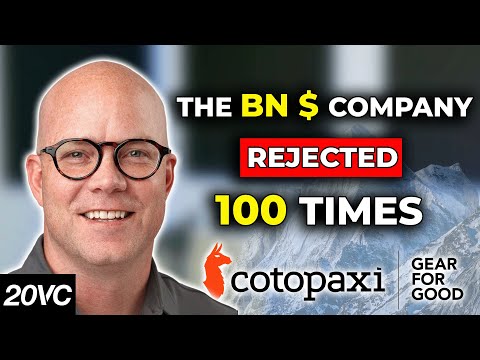
Davis Smith: From Selling $6M of Pool Tables to Scaling Cotopaxi to $150M in Revenues | E1095
Harry Stebbings (host), Davis Smith (guest), Harry Stebbings (host), Narrator
In this episode of The Twenty Minute VC, featuring Harry Stebbings and Davis Smith, Davis Smith: From Selling $6M of Pool Tables to Scaling Cotopaxi to $150M in Revenues | E1095 explores purpose-Driven Founder Builds Cotopaxi While Rejecting Wealth-First Entrepreneurship Davis Smith traces his journey from bootstrapped eBay ventures and a $6M pool-table business to co-founding and scaling Cotopaxi past $150M in revenue as a purpose-led outdoor brand. He emphasizes that chasing wealth is the wrong goal for entrepreneurs, arguing that mission, impact, and caring for people ultimately create stronger businesses and better returns. The conversation dives into co-founder breakup, fundraising realities, venture–mission misalignment, and how Cotopaxi embeds poverty alleviation into its business model. Smith also shares personal philosophies on faith, family, leadership, and why he stepped down as CEO to lead a church mission in Brazil.
Purpose-Driven Founder Builds Cotopaxi While Rejecting Wealth-First Entrepreneurship
Davis Smith traces his journey from bootstrapped eBay ventures and a $6M pool-table business to co-founding and scaling Cotopaxi past $150M in revenue as a purpose-led outdoor brand. He emphasizes that chasing wealth is the wrong goal for entrepreneurs, arguing that mission, impact, and caring for people ultimately create stronger businesses and better returns. The conversation dives into co-founder breakup, fundraising realities, venture–mission misalignment, and how Cotopaxi embeds poverty alleviation into its business model. Smith also shares personal philosophies on faith, family, leadership, and why he stepped down as CEO to lead a church mission in Brazil.
Key Takeaways
Don’t chase wealth; chase purpose and impact instead.
Smith argues that entrepreneurs who orient around money and fundraising make worse decisions; focusing on improving lives, treating employees well, and solving meaningful problems tends to produce both better companies and sufficient financial outcomes.
Get the full analysis with uListen AI
Choose co-founders for complementary skills, not convenience or family ties.
His Brazil baby-products startup, co-led with a cousin, ended in a destroyed relationship and a failed business; he now advises founders to first define the problem and then find the best possible partner to solve it, which likely isn’t a relative or best friend.
Get the full analysis with uListen AI
Mission cannot replace product quality; it must enhance it.
Cotopaxi’s success came from pairing a distinctive, high-quality product line with a clear social mission; customer research shows mission deeply matters, but only after the product meets or beats alternatives in a crowded outdoor market.
Get the full analysis with uListen AI
Fundraising is harder and more repetitive than most founders expect.
Smith pitched around 100 investors both for Cotopaxi’s seed and for a later attempted permanent-capital raise; he stresses that founders underestimate the ambition VCs require (billion-dollar potential) and the volume of rejection they’ll face.
Get the full analysis with uListen AI
Align investor expectations with your mission from day one.
Because Cotopaxi bakes social impact into its core (including giving before profits and benefit-corp structures), many investors passed; the ones who led major rounds were often women who resonated with long-term purpose, which reduced later conflict.
Get the full analysis with uListen AI
Culture and values should be designed and measured—at work and at home.
Smith tracks company culture daily with tools like Officevibe and builds explicit rituals to reinforce values; realizing he wasn’t as intentional with his family, he and his wife codified “SMITH” family values and created weekly practices around them.
Get the full analysis with uListen AI
You can build a big company without sacrificing balance or service.
Contrary to the belief that greatness requires total imbalance, Smith cites Cotopaxi’s top-1% growth trajectory while he still prioritized family, church, and service—and even later stepped away as CEO to lead a mission in Brazil.
Get the full analysis with uListen AI
Notable Quotes
“What do you think entrepreneurs chase today that they shouldn't be chasing? Wealth. It's the wrong focus.”
— Davis Smith
“We're not a backpack company, we're not a jacket company, we're not an outdoor brand. We're a movement of showing that business can be a force for good in the world.”
— Davis Smith
“Alone, a single brand can't change the world, but if we can create a brand that can inspire thousands of other businesses and millions of consumers to think differently about the purpose of business, I think we really could change the world.”
— Davis Smith
“The greatest entrepreneurs are incredible salespeople. You're selling every single day as an entrepreneur.”
— Davis Smith
“One realization I had was that I was being more deliberate and intentional about my company culture than I was about my family culture.”
— Davis Smith
Questions Answered in This Episode
How can founders practically balance a deeply purpose-driven mission with the hard expectations of venture investors seeking liquidity and outsized returns?
Davis Smith traces his journey from bootstrapped eBay ventures and a $6M pool-table business to co-founding and scaling Cotopaxi past $150M in revenue as a purpose-led outdoor brand. ...
Get the full analysis with uListen AI
In hindsight, what governance or structures could have protected both the relationship and the business in Davis’s family co-founder experience in Brazil?
Get the full analysis with uListen AI
How should an early-stage consumer brand quantify and communicate the real impact of its mission so that it resonates with both customers and investors?
Get the full analysis with uListen AI
What would a new long-term or permanent capital model tailored to mission-first founders like Davis actually look like in practice?
Get the full analysis with uListen AI
To what extent is it truly possible to build a multibillion-dollar company while maintaining the level of family time, service, and balance Davis describes—and what trade-offs inevitably arise?
Get the full analysis with uListen AI
Transcript Preview
What do you think entrepreneurs chase today that they shouldn't be chasing?
Wealth. It's the wrong focus. If you focus on (censored) , everything else will work out. I think a lot of entrepreneurs don't understand how big and ambitious the idea needs to be to go raise venture capital.
What do founders not know about fundraising?
I don't think most people understand how hard it is. You will get rejected a lot. I pitched 100 investors to get our first investor. We ended up with a lot of people that kind of jumped on board.
What was the price on that first round?
We raised (censored) .
Whoa. Davis, I am so excited for this. I told you beforehand, I have the best job ever because I basically find brands that I love, like Codopazzi, and then I get to interview the founders. So thank you so much for joining me today.
Harry, it's such a pleasure. I've just, I've loved, uh, your podcast, I've loved listening to it, and so it's an honor to be here with you.
Uh, the British accent gives me about 10 extra IQ points, I think, but I'm thrilled that you liked it. I always think that a lot of, like, who we are is shaped in actually who we were as children. Davis, when you go back to your childhood, what did you want to be when you were growing up?
My mind changed a lot, but I, I, I definitely had like a common thread, which was, I, I had a real deep desire to help other people. Uh, I had moved to Latin America as a four year old, so my, my, with my dad's job. Grew up in a number of different countries. Uh, the Dominican Republic, uh, is where we first moved when I was four, and then we ended up, uh, I spent a bunch of my childhood and teenage years in Ecuador, and a few other countries. And so, you know, I'd always known that I wanted to find a way to help people.
Do you know, it's so funny-
Yeah.
... I'm interrupting you, but one of the biggest commonalities in the most successful founders that I interview is that they move a lot in their childhood. I, I think it, uh, it forces you to embrace different cultures, different types of people. Uh, how do you think moving a lot changed and shaped you?
Yeah. You know, it's a great question. I look at my childhood pictures, like in school, and I'm like, "I just stand out." Like, I look nothing like everyone else around me in my, in my s- class pictures. And I look back now and I think, you know, there were, um, just such beautiful moments that I had as a child, um, a lot of times where I didn't connect with everyone, where I didn't, I didn't fit in like everyone else. And I had, I thought differently, I, l- you know, of course looked different. And I, I think that ended up being a real strength for me as I got into adulthood, where number one, I had a lot more compassion and empathy for others that maybe didn't fit in. I was, I found myself looking out for those, those people. And then the other thing is, I, I was okay to think diff- It was okay to think differently. And so it certainly, as an entrepreneur, it certainly helped, uh, shape that path.
Install uListen to search the full transcript and get AI-powered insights
Get Full TranscriptGet more from every podcast
AI summaries, searchable transcripts, and fact-checking. Free forever.
Add to Chrome