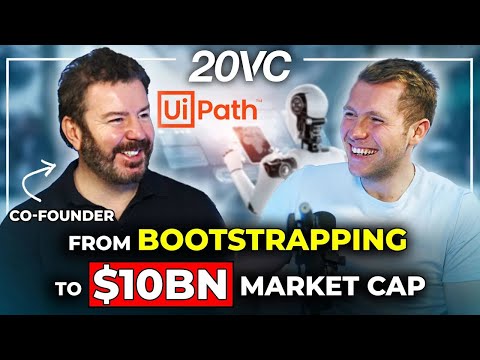
Daniel Dines: From a Dollar a Day to Romania's Richest Man| Happiness, Wealth, Risk and more | E1143
Daniel Dines (guest), Harry Stebbings (host), Narrator
In this episode of The Twenty Minute VC, featuring Daniel Dines and Harry Stebbings, Daniel Dines: From a Dollar a Day to Romania's Richest Man| Happiness, Wealth, Risk and more | E1143 explores from Romanian Poverty To UiPath: Daniel Dines Redefines Work, Risk, Life Daniel Dines recounts his journey from surviving on one dollar a day in post‑communist Romania to building UiPath into a multibillion‑dollar public company.
From Romanian Poverty To UiPath: Daniel Dines Redefines Work, Risk, Life
Daniel Dines recounts his journey from surviving on one dollar a day in post‑communist Romania to building UiPath into a multibillion‑dollar public company.
He describes learning to code and English through sheer obsession, bootstrapping UiPath for a decade without clear product‑market fit, and then seizing a lucky but pivotal RPA opportunity that transformed the company.
Dines reflects on fear, scarcity trauma, and imposter syndrome, explaining how early deprivation shaped both his risk appetite and anxieties around money and leadership.
He also explores the emotional burden of being CEO, the decision to hand over the role, his skepticism about “work‑life balance,” and how he now thinks about happiness, learning, and the future of AI and automation.
Key Takeaways
Scarcity scars can fuel both drive and chronic anxiety.
Dines’ experience of literally not having money for food created a lifelong fear of running out, which pushed him to seek ‘fuck‑you money’ and take big swings, but also made him more paranoid and occasionally constrained his ambition.
Get the full analysis with uListen AI
Deep, self‑directed learning under constraint builds unusual leverage.
He learned English by reading bridge books with a dictionary and learned C++ from a photocopied textbook without a computer; this theoretical, conceptual approach let him reason about complex systems and become more of an architect than a pure coder.
Get the full analysis with uListen AI
You can build the right product for years and still miss the market.
UiPath spent almost a decade as a small toolkit business before an Indian BPO manager, found via a cold email, revealed RPA as the true, massive use case—showing that engineering quality alone isn’t enough without the right customer and problem.
Get the full analysis with uListen AI
Raising capital can psychologically unlock a founder’s willingness to go big.
After bootstrapping for 10 years, Dines says the first seed round removed his internal brakes; having investors’ trust and a financial buffer allowed him to become far more fearless and willing to risk everything on hyper‑growth.
Get the full analysis with uListen AI
Imposter syndrome often leads to overvaluing experience and undervaluing chemistry.
Dines repeatedly hired highly experienced executives he didn’t truly ‘click’ with, trading off cultural fit for resumes; he now believes this pattern caused his biggest leadership mistakes and that chemistry is non‑negotiable for senior hires.
Get the full analysis with uListen AI
Layoffs and cost discipline, done early, can save and strengthen a company.
In 2019 an unexpected forecast showed UiPath would burn twice what he’d planned; Dines chose a painful reduction in force despite a booming macro environment, and in hindsight sees it as necessary surgery that made the company leaner ahead of COVID.
Get the full analysis with uListen AI
Founding a company is incompatible with strict work‑life separation.
He rejects the idea of work‑life balance for founders, arguing that building a company consumes your mind 24/7; if you must strictly protect hours and structures, he suggests you likely shouldn’t start a company at all.
Get the full analysis with uListen AI
Notable Quotes
“I was living on thirty dollars a month. At times I didn’t have money to eat properly. That leaves a mark.”
— Daniel Dines
“When I raised the first money, something switched in my head. I stopped having any fear.”
— Daniel Dines
“If you go big before having product‑market fit, that’s the recipe for disaster.”
— Daniel Dines
“I don’t believe in work‑life balance. Building a company is going to suck you into building the company.”
— Daniel Dines
“I’m not searching happiness in life. I’m searching peace of mind and an environment where my mind can do its best work.”
— Daniel Dines
Questions Answered in This Episode
How can founders from non‑Silicon Valley, low‑resource backgrounds systematically discover product‑market fit faster than Dines did at UiPath?
Daniel Dines recounts his journey from surviving on one dollar a day in post‑communist Romania to building UiPath into a multibillion‑dollar public company.
Get the full analysis with uListen AI
What practical methods can leaders use to balance a healthy paranoia about money with the courage to make aggressive bets?
He describes learning to code and English through sheer obsession, bootstrapping UiPath for a decade without clear product‑market fit, and then seizing a lucky but pivotal RPA opportunity that transformed the company.
Get the full analysis with uListen AI
How should early‑stage founders distinguish between ‘experience’ and ‘chemistry’ when hiring their first senior executives?
Dines reflects on fear, scarcity trauma, and imposter syndrome, explaining how early deprivation shaped both his risk appetite and anxieties around money and leadership.
Get the full analysis with uListen AI
Given Dines’ view that work‑life balance doesn’t really exist for founders, what boundaries—if any—are still worth enforcing?
He also explores the emotional burden of being CEO, the decision to hand over the role, his skepticism about “work‑life balance,” and how he now thinks about happiness, learning, and the future of AI and automation.
Get the full analysis with uListen AI
In a world where hyperscalers and OpenAI dominate the AI stack, where does Dines truly see viable white space for new, defensible application‑layer startups?
Get the full analysis with uListen AI
Transcript Preview
I was, uh, living on, like, $30 (cash register dings) a month. That's $1 a day, right? (cash register dings) At times, I, I didn't have money to eat properly. I knew I (cash register dings) had to make this decision to find my financial freedom, to get this (beep) money. It was almost like a prison. I behaved like a prisoner, just waiting to get out of the prison. Raising the first, uh, money was giving me such a freedom of mind. It was freedom to go big.
Ready to go? (upbeat music plays) Daniel, I am so excited for this. I've wanted to do this for a long time. Uh, I had a great chat to Brandon yesterday, who gave me so many tips. So thank you so much for joining me today.
Well, Harry, thank you so much for having me. It's always fun to see you. (laughs)
Yeah.
Especially this is a little bit unusual because-
(laughs)
... as you know, we met a lot more often in the gym of our-
(laughs)
... building.
There's, i- it's absolutely true, uh, and you put me to shame in the gym. So I'm quite pleased to be out of that, uh, but I would love to start with a little bit on you. I think great entrepreneurs are like shaped in childhood. What were you like as a child, Daniel? And when you think about like what your parents and teachers would have said about you, how would they have described you?
Maybe they will say that I was, uh, a little bit of a curious child that, uh, was argumentative, maybe at-
(laughs)
... times too argumentative for, especially for the likes of my parents. So I always like to engage, like, in debates and have my opinion and talk maybe a little bit too much. But, uh, I think I lost it (laughs) -
(laughs)
... with, with time. So now I prefer a lot more to, to listen to people. But curiosity was something that, uh, always, uh, kind of stuck with me.
Were you good in school?
Um, in, uh, primary school, I was good.
(laughs)
But after that, I discovered, uh, I don't know, other activities like-
(laughs)
... girls and going to pool and hanging out with boys. So I was pretty average except math, where I had like a natural inclination.
(laughs) Uh, th- honestly, I love to hear that 'cause I think you can sometimes hear some stories where it's like, you know, uh, super weird since from like day one and it just feels quite unrelatable. I, I did hear that I had to ask you how you learnt to code. I chatted with Luciana before and she was like, "You have to ask him how he learnt to code." So what was that story?
Well, I think it's pretty wild after today's standard. So I am not the typical hacker that started, you know, creating his first game when he was eight or something (laughs) like this. So I, uh, I went to university to math because it was quite easy for me to, to get in really. I, I haven't studied at all really to pass the exam to the university. But I went to computer science. I went to math and computer science, so I have a dual degree. And, uh, look, I went to computer science just because it was a little bit fancy at that time, but I was very disappointed in, uh, in the university. You need to picture like early 1990 Romania, just fall of communism, but all the professor, the atmosphere was still very communist, ugly people with kind of a fixed mindset, uh, so honestly, I, after the first week in, uh, at university, I decided I, I don't wanna go there. So literally, I went only to, like, exams.
Install uListen to search the full transcript and get AI-powered insights
Get Full TranscriptGet more from every podcast
AI summaries, searchable transcripts, and fact-checking. Free forever.
Add to Chrome