General Catalyst CEO, Hemant Taneja: Lessons Scaling GC to $40BN in AUM
Hemant Taneja (guest), Harry Stebbings (host)
In this episode of The Twenty Minute VC, featuring Hemant Taneja and Harry Stebbings, General Catalyst CEO, Hemant Taneja: Lessons Scaling GC to $40BN in AUM explores hemant Taneja on scaling GC, AI’s impact, and venture’s future Hemant Taneja, CEO of General Catalyst, explains how he’s built GC into a $40B+ AUM firm while insisting that early-stage venture performance cannot scale linearly with capital. He outlines GC’s strategy of keeping core venture funds relatively small, concentrating capital into a few enduring outliers (e.g. Stripe, Livongo), and layering new products like creation, roll-ups, and customer value funds around that core.
Hemant Taneja on scaling GC, AI’s impact, and venture’s future
Hemant Taneja, CEO of General Catalyst, explains how he’s built GC into a $40B+ AUM firm while insisting that early-stage venture performance cannot scale linearly with capital. He outlines GC’s strategy of keeping core venture funds relatively small, concentrating capital into a few enduring outliers (e.g. Stripe, Livongo), and layering new products like creation, roll-ups, and customer value funds around that core.
A major focus is AI: Taneja argues we’re at “peak ambiguity” but inevitable large-scale labor substitution, with AI roll-ups already shrinking offshore workforces and creating a looming global reskilling and sovereignty challenge. He stresses that governments and investors are underprepared for the jobs, energy, and geopolitical implications, and that policy must ensure AI’s gains don’t concentrate solely in a few firms or countries.
On market dynamics, he contends that venture generally can’t grow fund size and maintain top-quartile performance unless it resists AUM bloat and uses extra capital to double down on true compounders instead of enlarging early-stage funds. He also sees retail capital, sovereign wealth, and new structures as inevitable parts of venture’s future, provided they’re applied carefully to the best companies rather than the riskiest segments.
Key Takeaways
You can’t scale traditional venture funds and maintain elite performance without architectural changes.
Taneja argues that simply raising larger early-stage funds dilutes returns because the supply of generational founders is limited; GC keeps venture fund sizes at levels where 4–5x net is possible and uses separate vehicles (creation, customer value, roll-ups) to deploy additional capital without degrading core venture performance.
Get the full analysis with uListen AI
Extra capital should concentrate into proven compounders, not fund bloat or marginal deals.
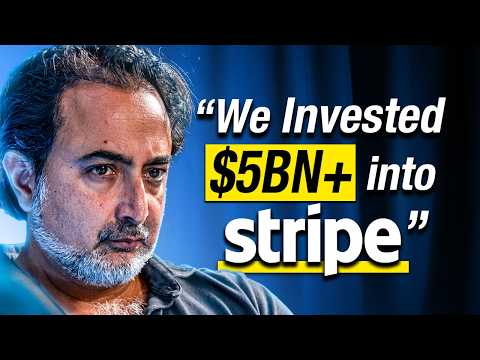
GC’s playbook is to seed or join iconic companies early and then reinvest repeatedly—Taneja notes he’s invested in Stripe 14 times—using growth capital to support long-duration winners rather than to expand the number or size of early-stage bets.
Get the full analysis with uListen AI
AI will trigger a multi-year labor reshaping, especially where work was offshored for cost.
He predicts a roughly five-year timeline for meaningful AI-driven job impact, particularly in BPO/call centers and other offshore labor hubs, and stresses that countries must plan large-scale reskilling and design policies so AI productivity is captured onshore rather than hollowing out local middle classes.
Get the full analysis with uListen AI
Macro AI infrastructure—energy, compute, and sovereign capability—is now strategic, not optional.
Taneja frames AI as a geopolitical and sovereign resilience issue akin to defense, arguing that regions will each want their own AI “defense primes” and energy strategies; investors and firms like GC must think in terms of defense, health, industry, and financial resilience, not just software categories.
Get the full analysis with uListen AI
Price discipline is overrated if you truly believe a company can be iconic.
He criticizes investors who “pass on price” as lacking conviction in potential; if a business can compound into a massive market, a seemingly expensive entry often looks cheap in hindsight, and the real mistake is under-allocating to winners, not overpaying marginally.
Get the full analysis with uListen AI
Traditional SaaS growth heuristics are obsolete in the AI era.
Metrics like “triple-triple-double-double” no longer define exceptional performance when multiple AI companies go from $1m to $100m+ in ARR in a couple of years; the new bar is far higher, and investors must separate raw speed from true durability in assessing these businesses.
Get the full analysis with uListen AI
Venture firms must define a clear true north to navigate peak ambiguity.
Given uncertainty around which AI categories endure, Taneja suggests firms anchor decisions in long-term missions (e. ...
Get the full analysis with uListen AI
Notable Quotes
“I actually have a strong belief that venture capital can’t scale and performance at the same time.”
— Hemant Taneja
“If we don’t do early-stage investing well, we will lose the right to exist, and we’re paranoid about that.”
— Hemant Taneja
“Everywhere you offshored for labor benefit, you’re going to onshore for AI productivity.”
— Hemant Taneja
“Triple, triple, double, double is definitely dead. I tell our investors, ‘Don’t bring that to me.’”
— Hemant Taneja
“If I’m not losing, I’m not winning. The very best founders meet five to seven great firms and pick one.”
— Hemant Taneja
Questions Answered in This Episode
How can venture firms practically balance the desire to scale AUM with the need to protect early-stage performance and founder intimacy?
Hemant Taneja, CEO of General Catalyst, explains how he’s built GC into a $40B+ AUM firm while insisting that early-stage venture performance cannot scale linearly with capital. ...
Get the full analysis with uListen AI
What concrete policies should governments adopt now to ensure AI-driven productivity gains don’t hollow out their middle classes or leak entirely offshore?
A major focus is AI: Taneja argues we’re at “peak ambiguity” but inevitable large-scale labor substitution, with AI roll-ups already shrinking offshore workforces and creating a looming global reskilling and sovereignty challenge. ...
Get the full analysis with uListen AI
In evaluating today’s AI startups, what signals most reliably indicate true durability versus a temporary advantage from being early to a hot use case?
On market dynamics, he contends that venture generally can’t grow fund size and maintain top-quartile performance unless it resists AUM bloat and uses extra capital to double down on true compounders instead of enlarging early-stage funds. ...
Get the full analysis with uListen AI
Where is the line between healthy capital concentration into winners and overexposure that endangers a fund when a thesis turns out wrong?
Get the full analysis with uListen AI
How should retail investors be given access to venture-backed technology companies without exposing them disproportionately to the riskiest segments of the market?
Get the full analysis with uListen AI
Transcript Preview
Our aspirations in venture capital is to be the best seed firm in the world. I actually have a strong belief that venture capital can't scale and performance at the same time. I deeply believe that. Just because we have more money doesn't mean there are more, um, Patrick Collisons or Sam Altmans that are gonna go build iconic companies. I lost a series A of Stripe, of Samsara, of Snap, and the first one I won was a series A of Gusto. Triple, triple, double, double is definitely dead. (laughs) I tell our investors, "Don't bring that to me." Going from one to three to nine to 27 is not interesting. You gotta go, like, one to 15 to 20 to 100.
Are you more bullish on the future of the States with a Trump administration or not?
(inhales deeply)
Ready to go? D'you know what, Hemant? It is so good to have you here. Last time it was seven years ago. It wasn't in person. I've been so looking forward to this, dude.
It's, uh, it has been seven years. Last time I was a little, little younger and you were a little skinnier.
(laughs)
You've gotten fit, and you have no glasses, and I have my glasses right here.
Dude, I was much skinnier.
Yeah.
I think this was before I fell into a protein bucket. (laughs)
Yeah, you've done well. That's good. (laughs)
Uh, my question to you is, you have built now in the last 10 years one of the most defining firms that we have in venture. Do you consider yourself a venture capitalist or do you consider yourself a CEO?
Harry, that's a great question. I, um, I carry the title of CEO and managing director for a very intentional reason, which is General Catalyst is a business, uh, but it wouldn't be a business if it wasn't venture capital at its core. So I am a managing director and a partner just like everybody else, uh, in our partnership, but I'm also the CEO. And that's the duality that it's gonna take to build an iconic, uh, institution in our industry.
Do you think GC is still a VC firm?
GC is very much at the core a VC firm. Not only that, I mean, our aspiration is that we wanna be one of the best seed firms, uh, like you. I mean, that's, that truly is our aspiration because the earliest relationship with founders, uh, and that trust, uh, is the key to actually doing the best work and building the companies that matter.
When you look at total AUM, can you realistically put the hours in and justify that commitment to seed when it's a $200 million vehicle in a $25 billion pool?
Culturally, um, um, this gets hard for, for VC firms as they scale. At GC, the thing we talk about is focus on the ownership and the relationship with the company versus the size of the check that you put in. And when you reorient yourself to think that way, we get that only at seed. And if you think about the last two years, you know, bringing on, uh, Jeannette and La Familia, Yuri and Wayfinder and Neeraj and, uh, Venture Highway, we've tried to really make sure at our core we remain very committed to doing the seed work with the same intensity and rigor that you do, uh, at 20 VC.
Install uListen to search the full transcript and get AI-powered insights
Get Full TranscriptGet more from every podcast
AI summaries, searchable transcripts, and fact-checking. Free forever.
Add to Chrome