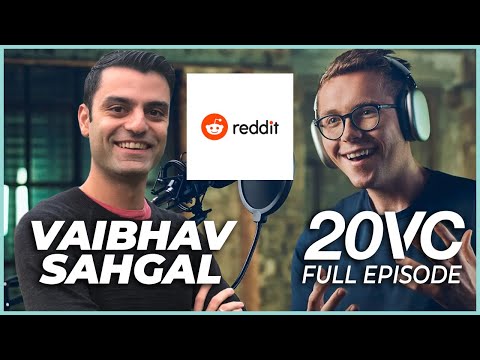
Vaibhav Sahgal: How We Scaled Reddit to 55M Users; Lessons from Zynga | 20VC #942
Harry Stebbings (host), Vaibhav Sahgal (guest), Narrator, Narrator
In this episode of The Twenty Minute VC, featuring Harry Stebbings and Vaibhav Sahgal, Vaibhav Sahgal: How We Scaled Reddit to 55M Users; Lessons from Zynga | 20VC #942 explores from Zynga To Reddit: Building High-Impact Growth Teams Without Burnout Vaibhav Sahgal traces his path from engineer at Hi5 to leading growth at Zynga and Reddit, emphasizing experimentation, deep user understanding, and disciplined channel use. He reframes “growth” as “value connection” – systematically connecting existing product value to the right users – and distinguishes it from core product’s “value creation.”
From Zynga To Reddit: Building High-Impact Growth Teams Without Burnout
Vaibhav Sahgal traces his path from engineer at Hi5 to leading growth at Zynga and Reddit, emphasizing experimentation, deep user understanding, and disciplined channel use. He reframes “growth” as “value connection” – systematically connecting existing product value to the right users – and distinguishes it from core product’s “value creation.”
He offers a detailed playbook for founders on when to hire a head of growth, what profile to seek, how to interview and backchannel, how to structure compensation, and how to resource and onboard that hire. Sahgal also shares hard-won lessons on team-building, including hiring and firing speed, cross-functional harmony, and the importance of culture and ownership during downturns.
The conversation covers idea validation, product reviews, channel guardrails, and how to avoid “growth hacking” traps that burn users and platforms alike. He closes with perspectives on the future of social (interests and communities over friend graphs), standout growth models like Slack’s bottoms-up SaaS, and world-class value connection exemplified by TikTok.
Key Takeaways
Treat growth as 'value connection,' not hacks or mere acquisition.
Growth teams should focus on connecting existing product value to the right users through onboarding, notifications, and lifecycle touchpoints, while core product teams focus on creating new value. ...
Get the full analysis with uListen AI
Know your user so deeply that you can “be” them in decisions.
Go beyond personas on paper: repeatedly talk to real users, build relationships, and internalize their motivations and language. ...
Get the full analysis with uListen AI
Use strict channel guardrails to avoid burning out growth levers.
Set minimum performance thresholds (e. ...
Get the full analysis with uListen AI
Hire a senior, product-strong head of growth post–product/market fit.
Before PMF, optimize for value creation, not sophisticated growth machinery. ...
Get the full analysis with uListen AI
Bias toward fast execution and experimentation, supported by robust validation tools.
Avoid large, unvalidated bets by using lightweight tests—in-app dialogs, push notifications, quick user research, or MVPs—to measure demand before committing heavy engineering resources. ...
Get the full analysis with uListen AI
Invest heavily in hiring, and move decisively when it’s not working.
Early growth leaders should spend 30–40% of their time hiring, and leaders must be willing to remove or reassign people who can’t operate at required speed or fit the culture. ...
Get the full analysis with uListen AI
Design product reviews as accountability and learning rituals, not slide theatre.
Regular product reviews (weekly in fast-twitch gaming, monthly at Reddit) should be short, document-light sessions where cross-functional leads review what was shipped, what happened, what was surprising, and what’s next. ...
Get the full analysis with uListen AI
Notable Quotes
“Growth really should be renamed to something like value connection.”
— Vaibhav Sahgal
“This is about converting engineering time into value for your users and your company.”
— Vaibhav Sahgal
“You should know within three to six months where the wind is blowing.”
— Vaibhav Sahgal
“The right candidate just wants to get going… launching something their second week there.”
— Vaibhav Sahgal
“Ultimately talent is everything or almost everything… I’m investing more in them and less in the product.”
— Vaibhav Sahgal
Questions Answered in This Episode
How can early-stage founders practically balance time between value creation (product) and value connection (growth) before hiring a dedicated growth lead?
Vaibhav Sahgal traces his path from engineer at Hi5 to leading growth at Zynga and Reddit, emphasizing experimentation, deep user understanding, and disciplined channel use. ...
Get the full analysis with uListen AI
What specific signals should a startup watch to know it has enough product/market fit to justify a senior head of growth?
He offers a detailed playbook for founders on when to hire a head of growth, what profile to seek, how to interview and backchannel, how to structure compensation, and how to resource and onboard that hire. ...
Get the full analysis with uListen AI
How can small teams without strong data infrastructure implement effective guardrails and validation experiments without slowing down?
The conversation covers idea validation, product reviews, channel guardrails, and how to avoid “growth hacking” traps that burn users and platforms alike. ...
Get the full analysis with uListen AI
In practice, how do you prevent tensions between product and growth when growth wants to move fast and product worries about user experience or tech debt?
Get the full analysis with uListen AI
Given the shift towards interest-based communities, how should new social products position themselves against incumbents like Reddit, Discord, and TikTok?
Get the full analysis with uListen AI
Transcript Preview
V, this is such a joy to do. I had so many great things from the wonderful Casey Winters before. But thank you so much for joining me today.
Yeah. Thank you for having me and, um, Casey's the, the true wonderful person here, let's, let's be honest. Learned a lot from that guy. So, uh, thank you, Casey, for the introduction.
He is wonderful. But I wanna start here with a little bit on you because you have this incredible, uh, duration at some of the most fantastic companies, both in growth and product roles. So, how did you make your way into some of the most powerful growth orgs with Zynga and Reddit today? What was that entry for you?
Yeah. I mean, mostly by accident to be, to be honest. Um, and I'll, I'll start when, in the beginning, I was a software engineer who just moved to the Valley, had worked for a company called Hi5. Um, I don't know if you know Hi5. Older social-
The video conferencing platform?
No. It, it was, uh, um... That was different. That was also, I think, Hi5. But this is a social network, older social network than Facebook, nearly as successful, as you can tell. Um, so yeah. So, so I started as a software engineer for this little startup no one's ever heard of. Uh, took a big chance, came to the Valley, um, and I was working for this product manager, his name was Mike Starbird, best, best name ever, even better guy, um, and, and he was my PM, I was the engineer, and, and we used to just work together. Um, and we were sending a lot of these emails. Some would say kinda spammy emails, but we were, we were basically sending these emails that, to users, like, telling them who they might know. And so this email was just full of a lot of different pictures and people's names and, like, "Hey, Harry, you might know these 20 people," or whatever. And, and the way the email was designed, and I was the one coding it up, it was, uh, the, the pictures were huge, and so we could only fit so many people in there and so many pictures in the, in the email. And I had an idea one night, I was like, "Hey, what if we just, like, reduced the size of the pictures and we put more, more people in there?" So I ran what, uh, is obviously now known as an A/B test for back then, I, I didn't really know what it was called, and I, I did that, uh, one night, and then the next morning, I came back, I looked at the data, and the click-through rate had gone up 20%. And I was so excited. I was like, "This is, this is amazing." Um, and then from that point on, I just kinda became a junkie for that process. I'm not saying that's all that growth is but, you know, I, the idea that you can, you can have some idea, whether it might be a lousy idea or whatever, test it against real people, um, have them tell you if it's good or not, give them a- a- and, and read i- in the data if it's good or not, to me, it's just romantic. And it's just, it's just really amazing. Um, and from that day on, I was just a junkie for it, uh, and, and I just kept, kept going deeper and deeper into it. So Hi5 doesn't exist anymore, moved over to Zynga, switched to product management, uh, which was essentially, you know, Z- Zynga at that time was basically this school for product management. And, of course, some bad habits as well, which took a while to shake off. Uh, but went through that university, essentially, um, which was amazing to get to do that. Uh, and then just, yeah, kept going deeper and deeper.
Install uListen to search the full transcript and get AI-powered insights
Get Full TranscriptGet more from every podcast
AI summaries, searchable transcripts, and fact-checking. Free forever.
Add to Chrome