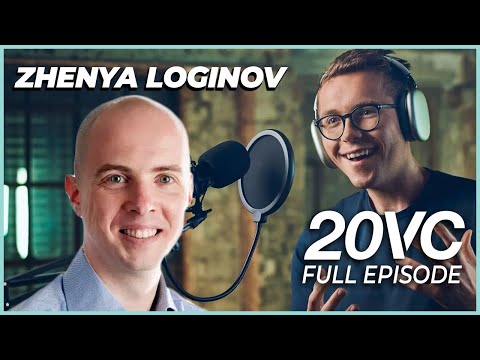
Mire CRO Zhenya Loginov: Hiring Tips for Sales; Why Dropbox Lost Enterprise | 20VC #900
Harry Stebbings (host), Zhenya Loginov (guest)
In this episode of The Twenty Minute VC, featuring Harry Stebbings and Zhenya Loginov, Mire CRO Zhenya Loginov: Hiring Tips for Sales; Why Dropbox Lost Enterprise | 20VC #900 explores miro CRO on PLG, enterprise timing, and hiring transformative sales leaders Miro CRO Zhenya Loginov reflects on lessons from Dropbox, Segment and Miro, focusing on how to balance PLG with enterprise sales and why Dropbox missed its enterprise moment. He argues that winning enterprise requires full‑company commitment, but sequencing matters: nail PLG first if you can, then layer on enterprise early enough to not miss the market. A large portion of the conversation dives into how to hire and onboard senior sales leaders, including why founders should bring in a head of sales early, how to structure rigorous hiring processes, and what red flags to watch in the first 90 days. He also covers deal reviews, international expansion, remote sales culture, and the ideal relationship between CROs, heads of sales, and product‑led growth teams.
Miro CRO on PLG, enterprise timing, and hiring transformative sales leaders
Miro CRO Zhenya Loginov reflects on lessons from Dropbox, Segment and Miro, focusing on how to balance PLG with enterprise sales and why Dropbox missed its enterprise moment. He argues that winning enterprise requires full‑company commitment, but sequencing matters: nail PLG first if you can, then layer on enterprise early enough to not miss the market. A large portion of the conversation dives into how to hire and onboard senior sales leaders, including why founders should bring in a head of sales early, how to structure rigorous hiring processes, and what red flags to watch in the first 90 days. He also covers deal reviews, international expansion, remote sales culture, and the ideal relationship between CROs, heads of sales, and product‑led growth teams.
Key Takeaways
Winning enterprise requires full‑company commitment, not just a sales team push.
Loginov explains Dropbox failed to dominate enterprise because the CEO, product, engineering, and culture never fully embraced enterprise and sales as core to the strategy, leading to missed timing and fragmented leadership.
Get the full analysis with uListen AI
Sequence PLG and enterprise carefully: nail PLG first if possible, but start enterprise early enough.
He believes the best model is PLG + enterprise, but warns that enterprise capabilities take years to build; start too early and you become a pure sales‑led company, start too late and you miss the market window, as he thinks happened at Asana and Dropbox.
Get the full analysis with uListen AI
Hire a head of sales early—once you have initial product‑market fit—not junior reps.
After the founder closes the first deals (up to roughly $1M ARR), Loginov recommends hiring a head of sales who can build the playbook and organization, arguing junior reps mainly consume founder bandwidth while strong leaders create it.
Get the full analysis with uListen AI
Design a rigorous, structured hiring process with clear must‑have criteria.
He sets 3–5 resume‑screen must‑haves (e. ...
Get the full analysis with uListen AI
Onboard leaders by freeing their first month and forcing broad relationship‑building.
For new heads of sales, he intentionally removes immediate delivery pressure so they can learn the product and meet future cross‑functional partners (e. ...
Get the full analysis with uListen AI
Treat deal reviews as a learning clinic for the whole team, not a performance trial.
Weekly, in‑depth deal reviews (often on in‑flight deals) should focus on what worked and what didn’t so everyone learns; if reps feel judged, they become defensive and curate information, destroying the review’s value.
Get the full analysis with uListen AI
Prevent PLG vs. enterprise conflict through org design and shared incentives.
At Miro, self‑serve/PLG sits in product while Loginov owns all revenue, so he has no incentive to favor high‑touch over self‑serve; he warns that splitting ownership (self‑serve vs. ...
Get the full analysis with uListen AI
Notable Quotes
“At Dropbox we had an opportunity to be Dropbox for the enterprise, and we sort of lost this opportunity to other companies.”
— Zhenya Loginov
“In the long run, the best business model you can have is PLG plus enterprise.”
— Zhenya Loginov
“I usually look for somebody who knows 70% of the job but is really passionate about getting the other 30%.”
— Zhenya Loginov
“If you don’t see any results delivered in the first three months, that’s a big red flag for me.”
— Zhenya Loginov
“Your job as a leader is to figure out how to either have the buy‑in or change the process so that the buy‑in is there.”
— Zhenya Loginov
Questions Answered in This Episode
How should a founder objectively decide the right moment to layer enterprise sales on top of a PLG motion?
Miro CRO Zhenya Loginov reflects on lessons from Dropbox, Segment and Miro, focusing on how to balance PLG with enterprise sales and why Dropbox missed its enterprise moment. ...
Get the full analysis with uListen AI
What are concrete examples of early enterprise customers that are worth saying no to, even if they offer significant revenue?
Get the full analysis with uListen AI
How can non‑sales founders best educate themselves on sales so they can effectively hire and manage a head of sales?
Get the full analysis with uListen AI
What specific metrics and behaviors would you track in the first 90 days to determine if a new head of sales is working out?
Get the full analysis with uListen AI
How can startups apply Miro’s PLG–enterprise org design (product‑owned PLG, CRO owning all revenue) at much smaller scales?
Get the full analysis with uListen AI
Transcript Preview
Three, two, one, zero. You have now arrived at your destination. Zhenya, this is such a pleasure to do. I've wanted to do this one for a while. I heard so many great things from Peter and from Olga. So thank you so much for joining me today.
Harry, it's a pleasure to be here. Thank you for inviting me.
Not at all, but I wanna unpack a little bit of the background, 'cause there's some incredible history here. So talk to me, how did you make your way into the world of tech, and then how did you come to lead some of the most powerful revenue and sales orgs, most recently with, you know, where we are today?
Yeah. I think my kind of upbringing and education, uh, probably, uh, kind of prepared me for the world of tech. So in high school and college, I did a bunch of, like, computer programming competitions, all Russian competitions, and so on. Um, but then eventually went, instead of, kind of becoming an engineer, which was the, the path that I think I was prepared for, I went into the business side, um, and spent, you know, five years doing consulting and finance. And then eventually made it to tech, uh, by starting a company. So I saw friends of mine, uh, start their own companies. I thought that it's exciting. Wanted to see, you know, what it's like and started a company in e-commerce space. Um, and then found that I loved it. Uh, and so eventually, you know, when I closed that company, made it to larger companies like eBay and then Dropbox and then Segment and Miro.
Uh, I mean, I, I love the way you just kind of glossed over some of those companies 'cause I wanna unpack a couple of learnings. If we look at, say, um, Segment and Dropbox. If we were to isolate one to two learnings from your time there, what would you say are the one or two biggest takeaways from each? Can you unpack them for me?
Sure. I think the biggest one for me from Dropbox was that you have to win the enterprise market. If your market kind of includes the enterprise, you, you have to figure out as a company how to be in the enterprise market. Um, I think at Dropbox when I left, uh, my biggest learning was that, y- you know, we had an opportunity to be Dropbox for the enterprise and we sort of lost this opportunity to other companies, and I never wanted to be in this position again at, uh, others. So when I was joining Segment after Dropbox, uh, one of my biggest things that I wanted to accomplish was take the company into the enterprise and make it a major enterprise player in that space.
Now, I, I just wa- I just wanna pause there.
(laughs)
I'm too interested 'cause I most often see founders and they say, "We need to move into enterprise." And I always say to them, "Listen, SMB is deeper than you think it is, and you can build a bigger business than you think you can staying there. Don't move there too soon." How do you think about that, given the need to also win enterprise?
Install uListen to search the full transcript and get AI-powered insights
Get Full TranscriptGet more from every podcast
AI summaries, searchable transcripts, and fact-checking. Free forever.
Add to Chrome