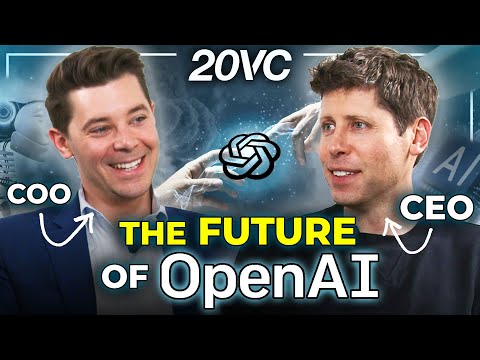
Sam Altman & Brad Lightcap: Which Companies Will Be Steamrolled by OpenAI? | E1140
Sam Altman (guest), Harry Stebbings (host), Brad Lightcap (guest)
In this episode of The Twenty Minute VC, featuring Sam Altman and Harry Stebbings, Sam Altman & Brad Lightcap: Which Companies Will Be Steamrolled by OpenAI? | E1140 explores sam Altman warns: OpenAI will steamroll shallow AI startups worldwide Sam Altman and Brad Lightcap discuss OpenAI’s origins, the conviction behind betting on deep learning and scale, and how their complementary partnership enables rapid innovation and commercialization. They frame AI company-building around two strategies: either assume models stay static, or assume they improve rapidly—and argue most founders mistakenly bet on stasis, making themselves easy to “steamroll.”
Sam Altman warns: OpenAI will steamroll shallow AI startups worldwide
Sam Altman and Brad Lightcap discuss OpenAI’s origins, the conviction behind betting on deep learning and scale, and how their complementary partnership enables rapid innovation and commercialization. They frame AI company-building around two strategies: either assume models stay static, or assume they improve rapidly—and argue most founders mistakenly bet on stasis, making themselves easy to “steamroll.”
They emphasize building a culture of repeatable, frontier research, tight integration between research, product, and go‑to‑market, and securing massive compute as critical moats over the next decade. The conversation also covers enterprise adoption, what kinds of AI startups will endure, how iterative deployment shapes society’s adaptation to AI, and the personal trade‑offs and leadership lessons involved in scaling OpenAI.
Looking forward, they expect intelligence to become extremely cheap, AI to dramatically accelerate scientific progress, and enterprises to adopt AI much faster than historic tech waves, even as geopolitics and social stability feel increasingly fragile.
Key Takeaways
Build assuming AI models will improve dramatically, not stay static.
Altman argues there are two startup strategies: treat today’s models as fixed and build thin layers on top, or assume a 10–100x improvement curve. ...
Get the full analysis with uListen AI
Ask whether a 100x better model helps you or kills you.
As an investor or founder, the key test is: does model improvement deepen your moat and expand use cases, or remove your reason to exist? ...
Get the full analysis with uListen AI
Enduring differentiation will come from personalization and integration, not raw models.
Altman expects base models to become more commoditized and provided by a small number of large players. ...
Get the full analysis with uListen AI
Sustained innovation requires a protected research culture and massive compute.
They see two existential risks to OpenAI’s velocity: losing its top research talent/culture and failing to secure enough compute to train frontier models and serve global demand. ...
Get the full analysis with uListen AI
Iterative deployment of powerful models is essential but must be better managed.
OpenAI believes releasing models in stages is safer than a single AGI “big bang,” because it lets society adapt and give feedback. ...
Get the full analysis with uListen AI
Enterprises underappreciate diffuse productivity gains and overfocus on narrow ROI projects.
Lightcap notes big companies want crisp P&L wins (e. ...
Get the full analysis with uListen AI
For leadership, obsess over the 1–3 things that matter right now.
Brad credits Sam’s ability to identify and relentlessly focus the company on a few true priorities, while delegating everything else. ...
Get the full analysis with uListen AI
Notable Quotes
“If you're building something on GPT‑4 that a reasonable observer would say, 'If GPT‑5 is as much better as GPT‑4 over GPT‑3 was… we're going to steamroll you.'”
— Sam Altman
“There were two things that seemed really important: deep learning seemed to actually be working, and it got better with scale.”
— Sam Altman
“I think we can drive the cost of a very high quality of intelligence to very near zero.”
— Sam Altman
“People criminally underrate how important it is to just give people access to the technology.”
— Brad Lightcap
“I’m really happy. I wouldn’t say I’m having fun, but I am really, like, deeply happy.”
— Sam Altman
Questions Answered in This Episode
How should a startup practically redesign its product roadmap if it fully assumes 10–100x model improvements over the next few years?
Sam Altman and Brad Lightcap discuss OpenAI’s origins, the conviction behind betting on deep learning and scale, and how their complementary partnership enables rapid innovation and commercialization. ...
Get the full analysis with uListen AI
What concrete mechanisms could ensure OpenAI’s research culture stays frontier‑leading as the company adds more enterprise and sales focus?
They emphasize building a culture of repeatable, frontier research, tight integration between research, product, and go‑to‑market, and securing massive compute as critical moats over the next decade. ...
Get the full analysis with uListen AI
How will privacy, data control, and security work in a world where the most valuable AI systems are deeply personalized with an individual’s entire life context?
Looking forward, they expect intelligence to become extremely cheap, AI to dramatically accelerate scientific progress, and enterprises to adopt AI much faster than historic tech waves, even as geopolitics and social stability feel increasingly fragile.
Get the full analysis with uListen AI
What governance or industry structures are needed to keep compute access from becoming a bottleneck that entrenches only a few AI providers?
Get the full analysis with uListen AI
If iterative deployment is the strategy, what specific thresholds or “red lines” would cause OpenAI to delay or withhold future models from broad release?
Get the full analysis with uListen AI
Transcript Preview
There are two strategies to build on AI right now. There's one strategy which is assume the model is not going to get better, and then you kind of, like build all these little things on top of it. There's another strategy which is build assuming that OpenAI is going to stay on the same rate of trajectory, and the models are going to keep getting better at the same pace. It would seem to me that 95% of the world should be betting on the latter category. But a lot of the startups have been built in the former category. When we just do our fundamental job because we like have a mission, we're going to steamroll you.
Ready to go? Guys, I'm so excited for this. I've wanted to do this for a long time. Also, this is the first time that you've done an interview together.
I think it is, yeah.
I think that's right.
This is going to be the most unique interview then that you've done together. So this is very exciting. I want to start, I spoke to many mutual friends before and they said, "We've got to start with context." Sam, what gave you the conviction to- to do this seven years ago?
I think there were two things that seemed... Well, I've been interested in AI since I was a little kid. Um, but, and I studied it at college and nothing was working. But when we started, there were two things that seemed really important. One, deep learning seemed to actually legitimately be working. And two, it got better with scale. We didn't know how predictably it got better with scale at the time, but it was clear that like bigger was better. And that seemed like a remarkable set of things. And the confusing thing to us at the time was like, "Why does everybody else not see this and why is e- everybody else not jumping on it?" But they weren't. And so we wanted to do it.
Can I ask, when there were those moments of doubt from everyone else, which there were across those years, what gave you the conviction to stick at it when bluntly very few others had that same confidence?
It just seemed to us like it was going to work and we kept making progress. Like it- we- it was not- it was- I wouldn't call- I would not call it blind faith, although there is some amount of you just, you know, you got to believe you can do a hard thing. But it- it felt really important to us t- to do this, that if we could do it, it would be, you know, hugely meaningful, um, to the world in some way and that it might work. Like we had an attack vector we believed in, we had, ah, and then we had continued data that the approach was working. Of course the specifics took a long time to figure out. Uh, you know, we did not start off doing language models obviously. We kind of knew that if we could keep doing things that we previously thought were impossible, that was somehow a good sign for progress. And we had this like fundamental conviction on the approach and the attack vector at a very high level for a very long time. And the details took a long time to work out and many brilliant discoveries by our colleagues. There was never any doubt that AI would be a big deal if we could do it. So that's helpful. Like it's going to be really valuable. Um, the approach we got successively more confident in, although it- it did take some wandering in the jungle for a while, or the desert, whatever that phrase is.
Install uListen to search the full transcript and get AI-powered insights
Get Full TranscriptGet more from every podcast
AI summaries, searchable transcripts, and fact-checking. Free forever.
Add to Chrome