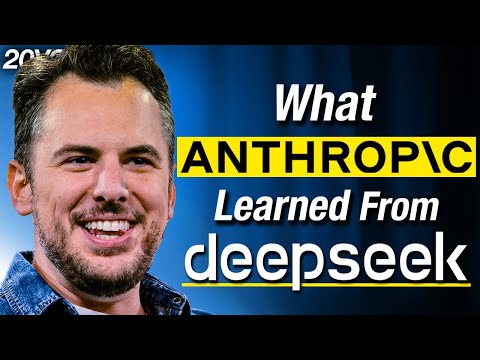
Mike Krieger, Instagram CoFounder & Anthropic CPO: Where Will Value Be Created in an AI World?|E1265
Mike Krieger (guest), Harry Stebbings (host)
In this episode of The Twenty Minute VC, featuring Mike Krieger and Harry Stebbings, Mike Krieger, Instagram CoFounder & Anthropic CPO: Where Will Value Be Created in an AI World?|E1265 explores mike Krieger on where AI value emerges: products, partners, not models Mike Krieger, Instagram cofounder and now Anthropic’s CPO, argues that durable AI value will accrue to companies with differentiated go‑to‑market, deep domain knowledge, and proprietary data, not just to frontier model labs.
Mike Krieger on where AI value emerges: products, partners, not models
Mike Krieger, Instagram cofounder and now Anthropic’s CPO, argues that durable AI value will accrue to companies with differentiated go‑to‑market, deep domain knowledge, and proprietary data, not just to frontier model labs.
He explains how model providers must evolve from “token vending machines” into long‑term AI partners, while also deciding when to build first‑party applications versus enabling an ecosystem via APIs.
Krieger dives into product and UX challenges unique to AI—non‑determinism, leaky abstractions, eval gaps, trust, and ‘vibes’—and how these shape everything from coding tools to enterprise workflows.
He also reflects on global competition (including China and DeepSeek), the changing role of software engineers, and how AI may accelerate breakthroughs in domains like healthcare and drug discovery.
Key Takeaways
Sustainable AI startups need real-world moats: distribution, domain expertise, and proprietary data.
Krieger stresses that the most defensible companies will pair foundation models with deep understanding of specific industries (e. ...
Get the full analysis with uListen AI
Don’t wait for perfect models; build now so you’re ready when capabilities leap.
Teams that experiment early, suffer current model limits, and build context in a domain are best positioned to capitalize when a new model crosses a quality threshold that finally makes their product viable.
Get the full analysis with uListen AI
Model providers must offer AI partnerships, not just APIs that trade tokens for tokens.
Anthropic’s strategy is to differentiate via talent, distinctive model “character,” and deep co-design relationships with customers, moving beyond commoditized API access toward long-term, high-trust collaboration.
Get the full analysis with uListen AI
AI product design now fuses model quality, prompting, evals, and UX into one discipline.
Because models are non-deterministic, designers and PMs are effectively building scaffolds around stochastic systems; choices like follow-up questions, reasoning depth, and memory become core UX decisions, not implementation details.
Get the full analysis with uListen AI
Agentic coding will shift engineers from code authors to orchestrators and reviewers.
Krieger sees developers increasingly delegating tasks to AI agents, focusing on what to build, system design, and code review (including security and correctness), while tools run experiments, test UI flows, and propose implementations.
Get the full analysis with uListen AI
First-party products are critical for learning fast and shaping the model roadmap.
Internal tools like Claude Code quickly surface real-world failure modes that feed directly back into training and capabilities; relying only on third-party usage slows this feedback loop and weakens the product moat.
Get the full analysis with uListen AI
Current AI usage is still far from being indispensable to most people’s work.
Despite hype and daily model launches, Krieger believes we are in “day one” of AI as a core workflow tool; staying power will come from products that unlock hours of real work and deeper professional leverage, not just novelty chats.
Get the full analysis with uListen AI
Notable Quotes
“The thing that's gonna give you legs and be durable over the long run is being able to sell into those places, understand them uniquely, and get better for being deployed there over time.”
— Mike Krieger
“Don't wait around for the models to be perfect. Be exploring in this space, be frustrated by the current generation of the models, and then be very aggressively trying the next one.”
— Mike Krieger
“Models over time get more different rather than more similar.”
— Mike Krieger
“We are in day one around: is AI an indispensable part of most people's work? And I think the answer is no.”
— Mike Krieger
“You can't separate model quality from product and UX anymore… you're designing a scaffold around a fundamentally non-deterministic system.”
— Mike Krieger
Questions Answered in This Episode
How should a startup in a heavily regulated vertical (like healthcare or finance) practically balance early experimentation with today’s imperfect models against regulatory and accuracy constraints?
Mike Krieger, Instagram cofounder and now Anthropic’s CPO, argues that durable AI value will accrue to companies with differentiated go‑to‑market, deep domain knowledge, and proprietary data, not just to frontier model labs.
Get the full analysis with uListen AI
What concrete frameworks can product teams use to measure and tune the ‘vibes’ and personality of a model, beyond standard quantitative evals?
He explains how model providers must evolve from “token vending machines” into long‑term AI partners, while also deciding when to build first‑party applications versus enabling an ecosystem via APIs.
Get the full analysis with uListen AI
Where is the line for labs between being a neutral model platform and competing with their own ecosystem by building end-user applications?
Krieger dives into product and UX challenges unique to AI—non‑determinism, leaky abstractions, eval gaps, trust, and ‘vibes’—and how these shape everything from coding tools to enterprise workflows.
Get the full analysis with uListen AI
How can engineering organizations safely transition developers into more ‘manager-of-agents’ roles without losing deep technical judgment and code quality over time?
He also reflects on global competition (including China and DeepSeek), the changing role of software engineers, and how AI may accelerate breakthroughs in domains like healthcare and drug discovery.
Get the full analysis with uListen AI
Given the rise of players like DeepSeek and China’s capabilities, how should Western labs and startups rethink their assumptions about long‑term defensibility and geopolitical risk in AI?
Get the full analysis with uListen AI
Transcript Preview
I think models over time get more different, rather than more similar. I still think we are in like day one around, is AI an indispensable part of most people's work? And I think the answer is no. I think the DeepSeek piece, people seem surprised that there were cutting edge research teams there. And if you were paying attention, that part should not have been the surprising piece. I think we've, if anything, underinvested a bit in two things. One is just having a faster iteration speed on first product ... products. And then on second part, on the API side...
Ready to go? (instrumental music) Mike, dude, I am so excited for this. I've literally just been out for a walk and I've been listening to like every show that you've done in the last year. And so, I told you before, I don't wanna start with the, "Oh, how did you get into tech?" And all the normal rubbish. I wanna start with a very challenging first question, which is, I, as a venture investor today, have to determine where value is in the future. And I look at the world today, and I don't know. And so my question to you is, when we look forward, where will value be generated in an AI-driven decade that we have ahead of us?
I think it's an awesome question. I get a version of this question often from entrepreneurs who, you know, "I went from, you know, uh, purely building startups myself, to now running a company that is, uh, partly enabling these startups to get created or helping boost their, their fortunes." And the question I get often is like, "Well, what can I build that is not gonna be in the lane of an Anthropic or, you know, another one of these labs?" And, um, I don't have a perfect answer, 'cause it's hard. I have the crystal ball, but like my, my sense of where it ends up being most valuable to exist, is places where you have some differentiated go-to-market, some differentiated knowledge of some particular industry or some special data that only you have access to. Ideally, two or, or even three of those as well. So, companies that are, you know, within a financial sector, within a legal sector, within healthcare. I mean, healthcare I've like gotten exposed to, and it is, you know, a tremendously complex, uh, sort of ball of yarn. And like the work upfront, it's not the sexy work, it's actually not the work that you're gonna be able to really do in a, you know, accelerator or, you know, a short amount of time. But it is the worth and the legwork that you've put in, I think those are durable places to generate value. And then, you know, you can sit in a place where you can pull on what's great from the foundation models. You can do your own fine-tuning if you need it. You can do your own AI sort of specialization, if needed. But the thing that's gonna give you legs and like be durable over the long run is being able to sell into those places, have something that you understand about those places uniquely, and then get better for being deployed there over time.
Install uListen to search the full transcript and get AI-powered insights
Get Full TranscriptGet more from every podcast
AI summaries, searchable transcripts, and fact-checking. Free forever.
Add to Chrome