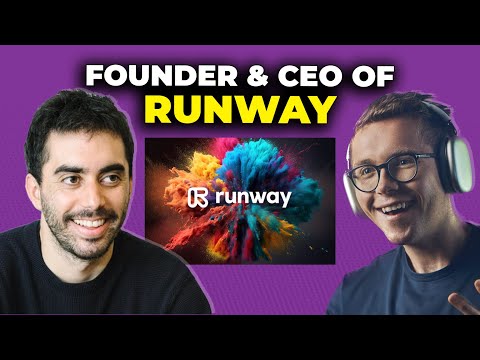
Cris Valenzuela: AI Creators vs Hollywood Writers; How We Grew Runway into a $1.5B Company | E1054
Harry Stebbings (host), Cris Valenzuela (guest), Narrator, Narrator
In this episode of The Twenty Minute VC, featuring Harry Stebbings and Cris Valenzuela, Cris Valenzuela: AI Creators vs Hollywood Writers; How We Grew Runway into a $1.5B Company | E1054 explores runway’s Founder on Creative AI, Outsider Grit, and Relentless Learning Cris Valenzuela, co-founder and CEO of Runway, discusses building a $1.5B generative video company from art school experiments, emphasizing deep founder–product fit and an outsider perspective that fuses art and science.
Runway’s Founder on Creative AI, Outsider Grit, and Relentless Learning
Cris Valenzuela, co-founder and CEO of Runway, discusses building a $1.5B generative video company from art school experiments, emphasizing deep founder–product fit and an outsider perspective that fuses art and science.
He explains Runway’s philosophy on high-performance teams, rapid model iteration, shipping early, and learning directly from creators rather than over-optimizing for frameworks, UIs, or valuations.
Valenzuela argues AI is a creative enabler rather than a pure replacement, calling for more nuanced narratives about AI’s role in film, media, and society and differentiating between language-model fears and creative-model realities.
The conversation also covers hiring for bias toward action, fundraising as an immigrant outsider, the limits of investors’ impact, and his belief that we still underestimate how transformative AI will be over the next decade.
Key Takeaways
Treat learning as hands-on experimentation, not abstract study.
Valenzuela builds understanding by reconstructing systems from scratch (e. ...
Get the full analysis with uListen AI
Hire for people who “just figure it out” and stay humble.
Runway optimizes for bias toward action, proactivity, and humility over pedigrees, using practical exercises to test whether candidates can execute and adapt rather than simply talk well in interviews.
Get the full analysis with uListen AI
Ship early, learn fast, and let users co-discover new mediums.
Because generative video is a genuinely new medium, Runway deliberately releases imperfect models (e. ...
Get the full analysis with uListen AI
Optimize for vision and people, not valuations or singular models.
He views models as transient and not true moats; what matters is the team’s ability to learn and iterate quickly, and maintaining alignment around a long-term vision rather than trying to “grow into” a specific valuation.
Get the full analysis with uListen AI
Use free access and unlimited generation to unlock experimentation.
Because experimentation is central to creative workflows, Runway offers free tiers and unlimited plans to remove cost anxiety and encourage users to explore many variations, which in turn accelerates product learning.
Get the full analysis with uListen AI
Be skeptical of generic startup “recipes” and heavy frameworks.
Runway discarded standard tools like OKRs when they didn’t fit, instead inventing its own team structures; Valenzuela argues founders should experience and design their own systems rather than copy-pasting advice.
Get the full analysis with uListen AI
Reframe AI narratives from horror stories to human-centered tools.
He contends media and Hollywood often reduce AI to language-chat threats and sci-fi doom, overlooking how creative models can augment artists; he calls for more nuanced, user-driven stories about what AI actually enables.
Get the full analysis with uListen AI
Notable Quotes
“We didn’t found the company; I think the company founded us.”
— Cris Valenzuela
“If you learn how to learn, you can figure out anything.”
— Cris Valenzuela
“Models are not a moat; models eventually don’t matter. What matters most is the people building those models and how fast you can change and learn.”
— Cris Valenzuela
“There’s no rules. There’s no algorithm. You just have to do it.”
— Cris Valenzuela
“It doesn’t get easier. You get more used to the pain.”
— Cris Valenzuela
Questions Answered in This Episode
How should creative professionals practically integrate tools like Runway into their existing workflows without feeling like they’re undermining their own craft?
Cris Valenzuela, co-founder and CEO of Runway, discusses building a $1. ...
Get the full analysis with uListen AI
What specific examples has Runway seen where AI-enabled video led to a type of storytelling that would have been impossible or unaffordable before?
He explains Runway’s philosophy on high-performance teams, rapid model iteration, shipping early, and learning directly from creators rather than over-optimizing for frameworks, UIs, or valuations.
Get the full analysis with uListen AI
How can smaller startups realistically compete on compute and model iteration speed against tech giants in the generative AI space?
Valenzuela argues AI is a creative enabler rather than a pure replacement, calling for more nuanced narratives about AI’s role in film, media, and society and differentiating between language-model fears and creative-model realities.
Get the full analysis with uListen AI
In what ways might unions and creative guilds collaborate with AI companies to shape fair, pro-creator standards instead of defaulting to opposition?
The conversation also covers hiring for bias toward action, fundraising as an immigrant outsider, the limits of investors’ impact, and his belief that we still underestimate how transformative AI will be over the next decade.
Get the full analysis with uListen AI
What organizational practices allow Runway to maintain high speed and a 55-person team as it scales, and where does he expect that model to break or need adjustment?
Get the full analysis with uListen AI
Transcript Preview
Does it get easier over time?
It doesn't get easier. You get more used to the pain.
Chris, I am so excited for this. I heard so many great things from so many different people on your cap table, so thank you so much for putting up with my terrible British tones today.
Thank you so much for inviting me. I'm a huge fan of the podcast. Happy to be here.
That is very, very kind of you. Now listen, I spoke to Sunil at Amplify before we started, and he said to me that you and Runway is the perfect embodiment of founder/product fit. So just take me to the founding moment of the company and that a-ha moment for you. Why does he say that?
Yeah. Uh, Sunil is too kind. Runway's, uh, journey dates back to 2015, 2016, where I met my co-founders, Alejandro and Anastasios, in actually art school. Um, we went to- to a school, um, that's a very unique school that combines art and technology. It's been running for 40 years here in New York, um, ITP from- from NYU. And, um, the best way to think about it is art school for engineers and engineering school for artists. And while we were there, we were all coming from all sorts of different backgrounds and experiences from, uh, programming, engineering, business, and we started just tinkering and playing around with state-of-the-art AI at that time. I know- I know a lot of things that happen now, but try to imagine where, uh, models were and where research was, uh, 10 years ago or eight years ago. Um, and we just built a lot of different things. We built... I remember, um, Anastasios built this- this beautiful, uh, video semantic search tool that you could just type a word and it will, like, create a trailer for you, um, combining all sorts of different, uh, input videos, uh, analyzing, uh, sequences and scenes. Um, and so we started tinkering with this idea of taking AI models or research at the time and building creative tools. We built those three transformers. Uh, we- we built, using, um, LSTMs, this co-pilot for writing, and so you could... uh, that runs entirely on the browser using WebGPU, using, at the time, TensorFlow.js, which is- which is a framework that was built at the time. Um, and you could write and then, uh, and then a model was co-writing with you, uh, different sentences, trained on different authors that you liked. And so we were just building experiments and experiments over experiments, and realizing that there was something here, something special. And then we started delving into image and video generation. And again, PyTorch was, like, a year old. TensorFlow was, like, two years old. So things were very different from where we are today. Um, and I think we realized at some point that after building so many things, there was something special around both, um, where things are heading and how much passion we had to- for building these things, and for building an- an- an understanding how to take these models, uh, and apply them in a creative, artistic context. Um, and so I- I think the- the... we didn't found the company, I think the company founded us.
Install uListen to search the full transcript and get AI-powered insights
Get Full TranscriptGet more from every podcast
AI summaries, searchable transcripts, and fact-checking. Free forever.
Add to Chrome